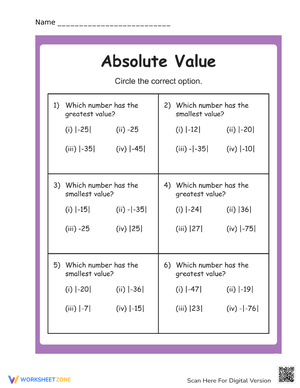
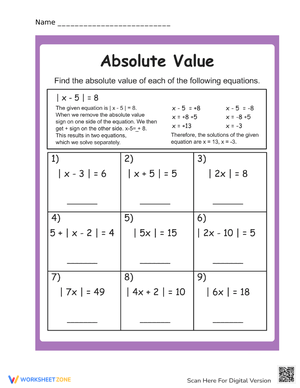
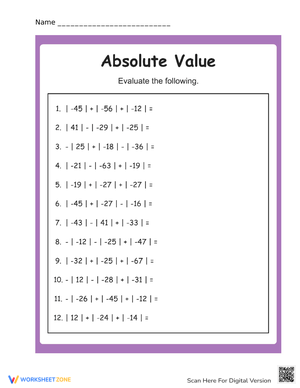
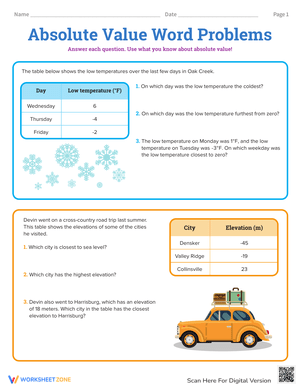
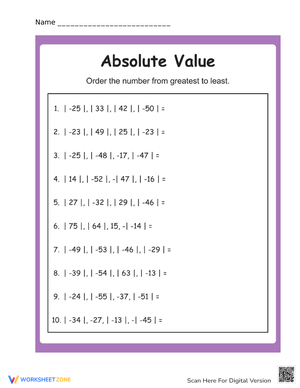
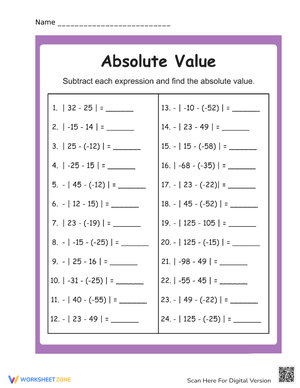
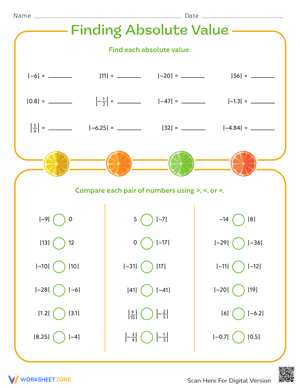
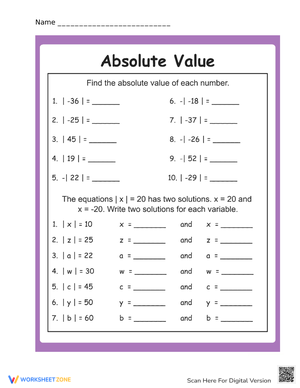
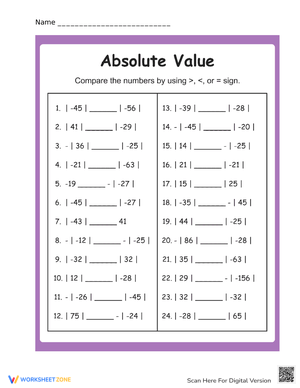
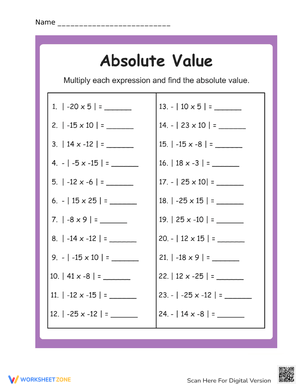
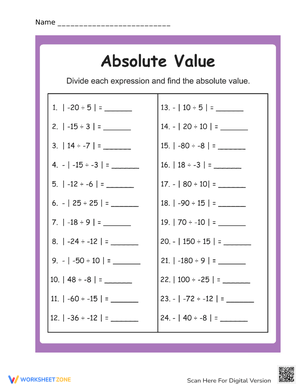
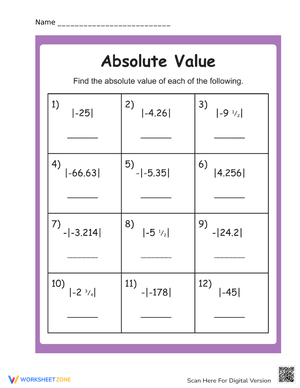
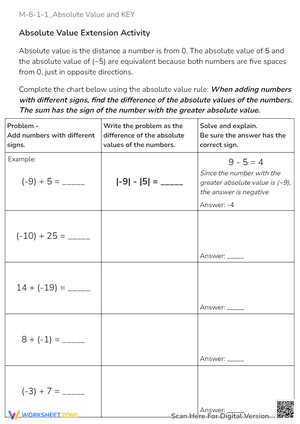
These absolute value worksheets for 6th grade give teachers a focused set of resources for building integer understanding before students encounter rational number operations, inequality comparisons, and coordinate graphing. The definition that anchors everything at this level is distance from zero on a number line — not a rule about dropping the negative sign. That distinction shapes every worksheet in the set.
What the Set Covers
Each worksheet targets one or two related skills rather than cramming the full concept into a single task. The progression moves from visual understanding toward independent symbolic work — the sequence 6th graders need to actually retain the concept rather than memorize a surface pattern.
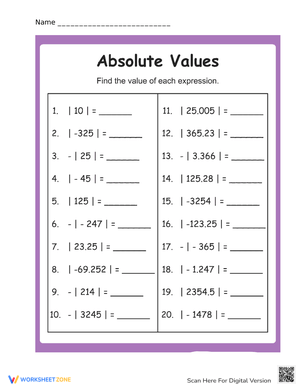
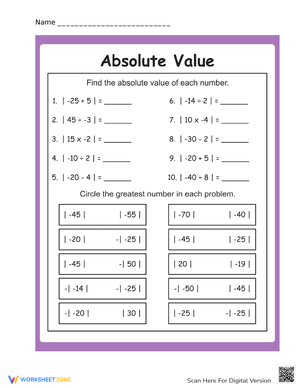
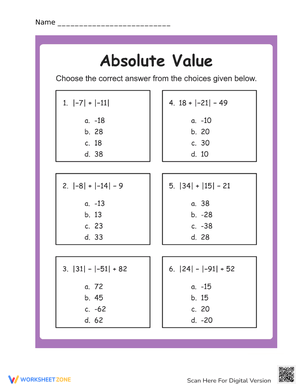
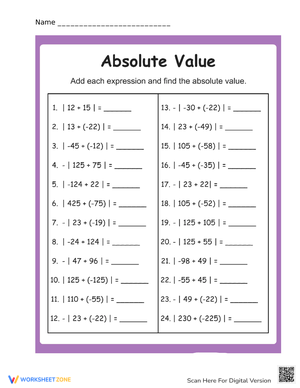
- Notation recognition: Students read and write expressions such as |6|, |-6|, and |0| — including zero, which students skip more often than teachers expect.
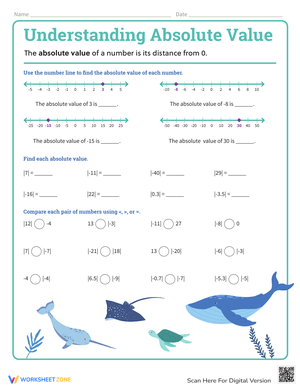
- Number line connection: Students plot integers, draw arrows to zero, and identify the counted distance as the absolute value.
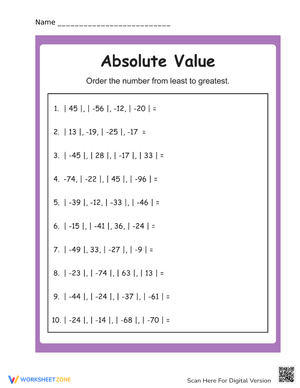
- Comparing integers: Students determine which of two integers has the greater absolute value and explain why a number farther from zero carries a larger value regardless of sign.
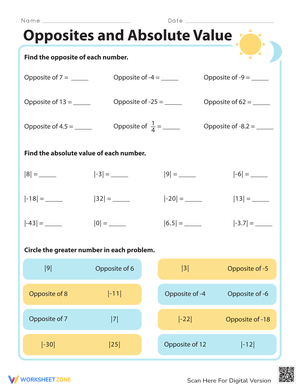
- Opposite vs. absolute value: Students label both the opposite and the absolute value of a given integer on the same worksheet, building a clear distinction between two ideas that students frequently collapse into one.
- Context problems: Students apply the concept to short scenarios involving temperature changes, elevation, and money owed — enough variety to push transfer without overloading working memory.
Frequent Mistakes Students Make — and What They Tell You
The most persistent error is the "makes it positive" shortcut. Students who say |-7| equals 7 "because you drop the negative" are reciting a pattern, not showing understanding. When those same students hit a comparison question — which integer has the greater absolute value, -9 or -2 — they often answer incorrectly because the shortcut gives them nothing to reason from. The worksheets return to number lines repeatedly to keep interrupting that surface-level rule before it calcifies.
A second pattern: students conflate opposites with absolute value. Because the opposite of -4 is 4 and the absolute value of -4 is also 4, students often treat the two operations as synonyms. Each worksheet that introduces opposites asks students to label both values separately on the same number line, which forces the distinction into view rather than leaving it buried at the bottom of the directions block.
Zero causes more hesitation than teachers anticipate. Many students write |0| = 1 or leave it blank entirely. Including zero in every notation set — not just the opening warm-up — keeps the definition honest. Zero is already at zero, so the distance is zero units, and that fact belongs in regular rotation rather than treated as a special case.
How to Build These Worksheets Into Your Lesson Sequence
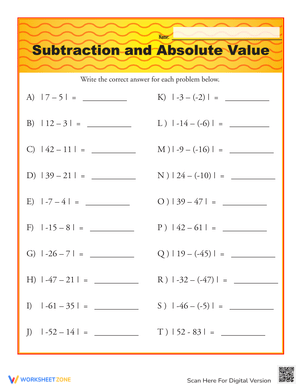
Absolute value is a compact concept, and absolute value worksheets for 6th grade fit multiple spots in a math block without much reworking. The number line worksheet works as a warm-up before instruction — it surfaces prior knowledge and reveals which students need more time with visual models before notation enters the picture. The evaluation and comparison worksheets are strong for independent practice after direct teaching. The word-problem worksheet makes a natural exit ticket or homework assignment once students have the core concept in hand.
One approach that sharpens reteaching: instead of sorting returned worksheets by score, sort by the type of problem students missed. A student who misses notation items has a vocabulary gap. One who misses number line items has a representation gap. One who misses only the word problems is likely solid on the concept but struggling to apply it outside a math context. That three-way sort takes about two minutes and gives you specific reteaching groups rather than a generic "needs more practice" pile.
- Partner work: Have students solve each problem and then read the answer aloud using the phrase "distance from zero" — not "positive."
- Centers: Pair the number line worksheet with physical integer cards or a projected interactive model for tactile reinforcement.
- Intervention: Pull a small group and work through the number line worksheet together before reintroducing notation problems.
- Sub plans: Because the concept is self-contained and the directions are direct, the set holds up well on days when a substitute is covering the class.
Standard Alignment
These worksheets address CCSS 6.NS.C.7, which covers the ordering and absolute value of rational numbers. Standard 6.NS.C.7c specifically asks students to understand absolute value as a number's distance from 0 on the number line and to interpret it in real-world contexts. Standard 6.NS.C.7d asks students to distinguish comparisons of absolute value from statements about order — the comparison worksheet in this set targets that distinction directly. In most 6th grade scope-and-sequence maps, this cluster appears in the first or second unit on integers, right before students move into coordinate plane work where absolute value reappears as the distance between a point and an axis.
Adjusting the Practice for a Range of Learners
The set supports tiered use without requiring teachers to build separate lessons. For students who need more time with the concept, the number line worksheet stays productive longer than you might expect — drawing arrows from each integer to zero and labeling the unit count keeps the idea concrete rather than symbolic. Sentence frames help too: "The absolute value of ___ is ___ because it is ___ units from zero" gives students language for reasoning before they can generate it independently. That kind of structured support is especially useful in the first few days of the unit when vocabulary and concept are being built at the same time.
On-level students move through notation, comparison, and a couple of context problems in one session. For students ready for more challenge, the set includes missing-value tasks — "Name two integers with an absolute value of 8" — and reasoning prompts that ask students to explain why two numbers with different signs can share the same absolute value. Those items require articulation, not just computation. At this grade level, the ability to explain the concept is the stronger indicator of durable understanding.
Frequently Asked Questions
Do these worksheets work as formative assessment, or are they mainly for practice?
Both. Because each worksheet targets a specific skill, error patterns are easier to interpret than on a longer mixed-review worksheet. Teachers use the number line worksheet to check representation, the notation worksheet to check vocabulary, and the word-problem worksheet to check transfer. Any one of them can function as a quick formative check depending on where students are in the unit.
Can these be used in intervention with students who are below grade level on integers?
Yes. Students who are still building comfort with negative numbers benefit most from the number line worksheet, where the distance interpretation is visible rather than abstract. Starting there — before introducing notation — keeps the concept accessible. The absolute value worksheets for 6th grade in this set are sequenced with that order in mind, and most intervention teachers work through the number line worksheet across two or three sessions before moving students to symbolic practice.
What's the best way to introduce absolute value when students haven't seen the notation before?
Start with distance, not symbols. Ask students how far -5 is from zero on a number line before writing |-5| anywhere. Once students can describe and point to that distance, introduce the bars as notation for what they already know. The worksheets follow this order — the number line task appears first, and the notation worksheet comes only after students have a visual model to attach the symbols to.
Are these worksheets better suited for classwork or homework?
The number line and notation worksheets are more effective in class, where a teacher can redirect before a misconception takes hold. The mixed review and word-problem worksheets translate well to homework once students have enough classroom exposure to work independently. Short, focused absolute value worksheets for 6th grade — five to eight problems aimed at one clear skill — are far easier to complete at home without support than longer mixed sets that ask students to juggle multiple concepts at once.













 Interactive Worksheet Maker
 Quiz Maker
 Word Search Maker
 Crossword Puzzle Maker
 Word Scramble Generator
 Sentence Scramble Generator
 Handwriting Worksheet Generator
 Name Tracing Generator
 Fill In The Blank Generator