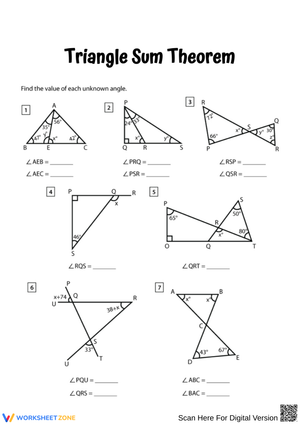
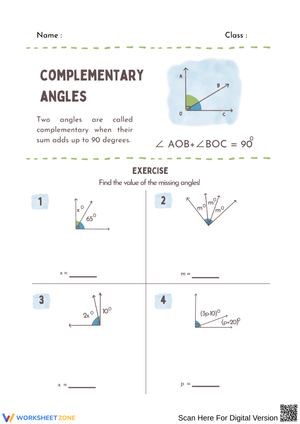
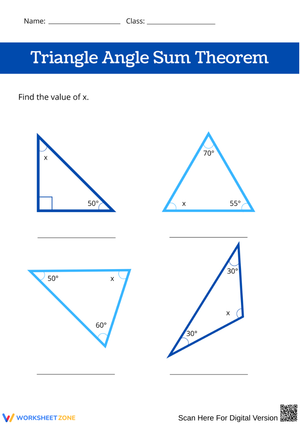
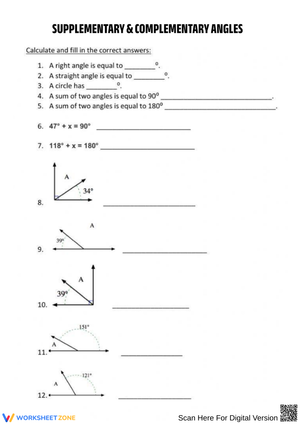
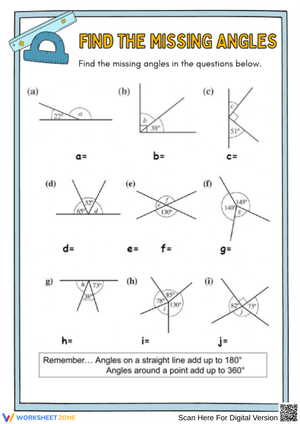
These 6th grade missing angles printable worksheets resources give teachers a ready supply of geometry practice covering diagram reading, angle relationship identification, and equation writing — three skills that consistently appear together on unit assessments and need repeated, structured exposure before they stick. What teachers get from a well-built set is practical: clear diagrams, varied relationship types, space for students to show reasoning, and an answer key that makes checking fast enough to be worth doing.
The Angle Relationships These Worksheets Cover
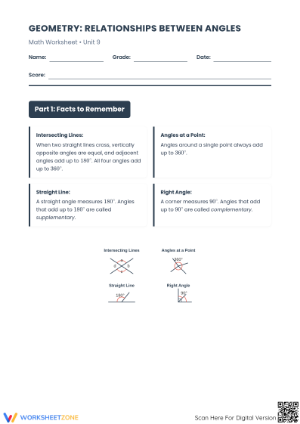
Missing angle work at this level centers on a handful of foundational relationships. Students identify whether two angles are complementary, supplementary, vertical, or adjacent, then use that classification to write and solve an equation. That sequence — classify, then compute — is the heart of the skill, and it is where students most often break down if they have only ever practiced one relationship type in isolation.
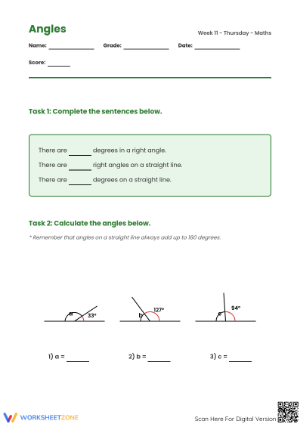
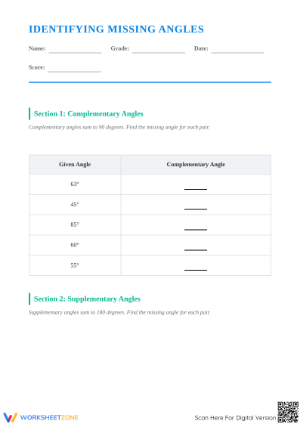
- Complementary pairs: students subtract a given angle from 90 degrees to find the missing measure.
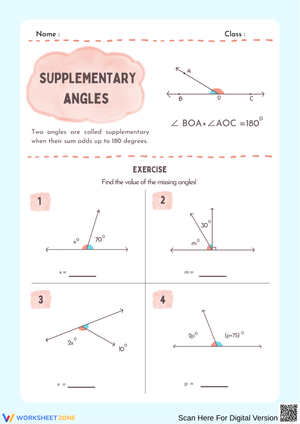
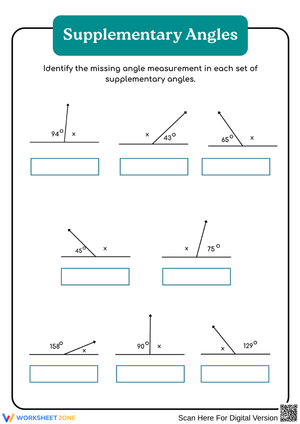
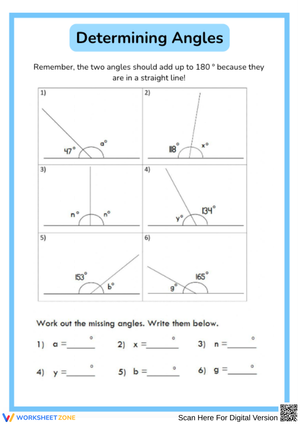
- Supplementary pairs: students apply the 180-degree total along a straight line or in an angle pair.
- Vertical angles: students recognize that opposite angles formed by two intersecting lines are equal — no addition required, just identification.
- Adjacent angles: students combine neighboring angles or compare them to a known total.
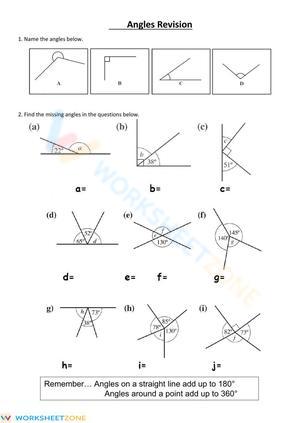
- Angles around a point: students sum all angles to 360 degrees and work backward to find the unknown.
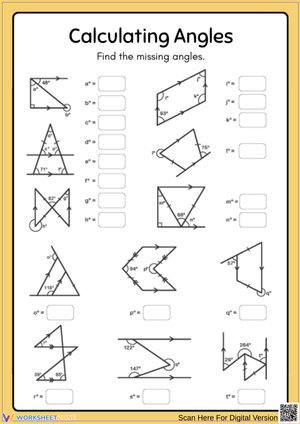
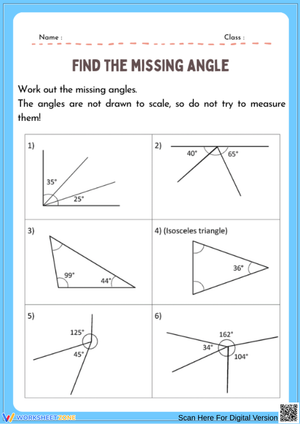
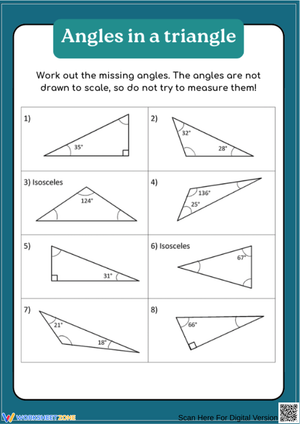
- Multi-step diagrams: students apply more than one relationship inside a single figure — the task type that most closely mirrors what appears on middle school unit tests.
A sequence that begins with single-relationship diagrams and adds complexity over time lets students build fluency before they attempt multi-step reasoning. Without that progression, students often memorize the "90 or 180" rule without understanding when each applies.
Diagram Annotation as a Thinking Tool
One concrete classroom move that improves accuracy noticeably: require students to write the relationship name before they write any numbers. When a student labels a pair as supplementary before setting up an equation, it commits them to a specific claim. If the equation they write does not match that label, the error becomes visible immediately — to the student, not just to the teacher during grading. In a lot of 6th grade classrooms, we see students calculating 90 minus a given angle when the diagram actually shows a straight line. Writing "supplementary" first stops that pattern cold.
Printable worksheets support this annotation routine better than most digital formats because students can physically mark the diagrams — circling known angle measures, drawing tick marks on equal angles, writing equations beside each figure. Those marks give teachers a window into reasoning that a final numerical answer never provides on its own.
Frequent Student Errors Worth Watching For and Correcting
The most persistent error in missing angle work is applying the wrong total. Students confuse the 90-degree sum for complementary pairs with the 180-degree sum for supplementary ones, especially in diagrams where the two angles look roughly similar in size. A student who correctly answers a word problem that says "two complementary angles" will still write 180 − 47 when the same information appears inside an intersecting-line diagram — because the visual looks like a straight angle to them, not a right angle. That mismatch between verbal and diagrammatic reasoning is worth watching for, and a mixed worksheet catches it in a way that a single-type drill cannot.
Vertical angles produce a different error: students frequently add or subtract rather than recognizing equality. They know something connects the two angles, but they default to arithmetic because that feels like doing the work. A quick check is to ask students to explain why vertical angles are equal without using numbers — students who understand the structure describe intersecting lines; students who have only memorized the rule go silent or repeat it without justification.
Multi-step diagrams surface a third issue. Students who handle one-step problems reliably struggle to identify which relationship to apply first when a diagram contains several angle measures. They often pick the largest or most obvious angle rather than asking which relationship involves the unknown. Building in problems where the missing angle is embedded inside a larger figure — not sitting obviously at the end of a labeled pair — exposes this gap before the unit assessment does.
Building These Worksheets Into Your Weekly Lesson Plans
These 6th grade missing angles printable worksheets sets fit into almost any instructional slot because the individual problems are short and self-contained. Most teachers find them most effective in the ten to fifteen minutes directly after a brief teacher-modeled example — students have seen the thinking process once, and the worksheet gives them immediate repetition while the model is still fresh.
- Bell ringers: assign two or three problems before the lesson begins to prime students on the relevant relationship type for that day.
- Guided practice: work the first problem together, annotating the diagram on the board while students mark their own, then release students to work independently.
- Small-group intervention: pull students who conflate supplementary and complementary and work through a half-worksheet together, talking aloud about the diagram before anyone writes a number.
- Homework: a mixed-relationship worksheet reinforces the day's work; students who struggled in class often clarify their thinking when they slow down at home.
- Spiral review: embed two or three angle problems into a review worksheet alongside ratio or equation items — missing angle tasks are short enough to include without crowding everything else out.
For sub plans, a complete worksheet with an answer key is one of the most low-maintenance geometry assignments available. The diagrams explain themselves, there are no manipulatives to manage, and students can self-check when they finish.
Standard Alignment
The core standard these worksheets address is CCSS 7.G.B.5: "Use facts about supplementary, complementary, vertical, and adjacent angles in a multi-step problem to write and solve simple equations for an unknown angle in a figure." Many 6th grade teachers introduce angle relationship work as a direct preview of this standard, particularly in districts that use an accelerated sequence or whose adopted curriculum front-loads geometry concepts. Using these worksheets in 6th grade gives students the relational vocabulary and equation-writing practice they need before formal 7th grade geometry instruction begins. Teachers using programs such as Illustrative Mathematics or Open Up Resources will find this material sits naturally in the bridge between the 6th and 7th grade geometry progressions.
Adjusting the Worksheets for a Range of Learners
When using 6th grade missing angles printable worksheets resources with a mixed-ability class, the most practical approach is to vary diagram complexity rather than create entirely separate assignments. Every student works on angle relationships; what changes is how many steps the problem requires and whether any angle is expressed as a variable.
- For students who need more support: use diagrams with fully labeled angles, clear arc marks, and relationship names provided. Sentence frames — These angles are ___, so they add to ___ — help students explain reasoning in writing without getting stuck on vocabulary.
- For on-level students: use diagrams where students must identify the relationship type on their own before calculating, with one or two multi-step problems included.
- For advanced learners: assign problems where one angle is expressed as an algebraic expression, such as 3x + 12, requiring students to write and solve an equation before finding the measure. These problems also preview 7th grade equation-solving work.
Color-coding is worth mentioning as a concrete tool: students who physically mark equal angle pairs in one color and supplementary pairs in another before solving make far fewer relationship-confusion errors. It adds roughly ninety seconds to the task and reduces the need for re-teaching after the fact.
Frequently Asked Questions
Which angle relationships should 6th graders know before moving on?
Students leaving a missing angles unit should be able to identify complementary, supplementary, vertical, and adjacent pairs from a diagram — not just from a definition list — and should be able to write and solve a one-step equation from each. Multi-step reasoning is a stretch goal at this level, not a baseline expectation, though students who demonstrate fluency with single-relationship problems generally handle multi-step diagrams with teacher guidance.
Are there versions that work for students who struggle with reading diagrams?
Yes, and they are worth seeking out specifically. Worksheets with larger figures, bolder angle arcs, and fewer labels per diagram reduce the visual processing load for students who lose the mathematics inside a cluttered drawing. Multilingual learners and students with visual processing differences benefit most from this format, and the mathematical demand does not decrease — only the perceptual noise does.
How many problems per worksheet is the right amount for focused practice?
For an independent practice session in a 45- to 50-minute class, eight to twelve problems covers the relationship types without becoming fatiguing. Fewer than six problems often does not include enough variety to surface misconceptions. More than sixteen typically means students are drilling a single type rather than reasoning across relationship types — which is a different skill entirely.
Do these worksheets prepare students for standardized geometry assessments?
Many state assessments and placement tests include angle relationship items in their middle school geometry strands, and 6th grade missing angles printable worksheets practice builds exactly the classification and equation-writing fluency those items require. The format — read a diagram, identify the relationship, write an equation, solve — mirrors the task structure students encounter on benchmark and end-of-year assessments.













 Interactive Worksheet Maker
 Quiz Maker
 Word Search Maker
 Crossword Puzzle Maker
 Word Scramble Generator
 Sentence Scramble Generator
 Handwriting Worksheet Generator
 Name Tracing Generator
 Fill In The Blank Generator