


























Views
Downloads

Reading and Calculating Angles | Grade 4-5 Essential
Paste this activity's link or code into your existing LMS (Google Classroom, Canvas, Teams, Schoology, Moodle, etc.).
Students can open and work on the activity right away, with no student login required.
You'll still be able to track student progress and results from your teacher account.
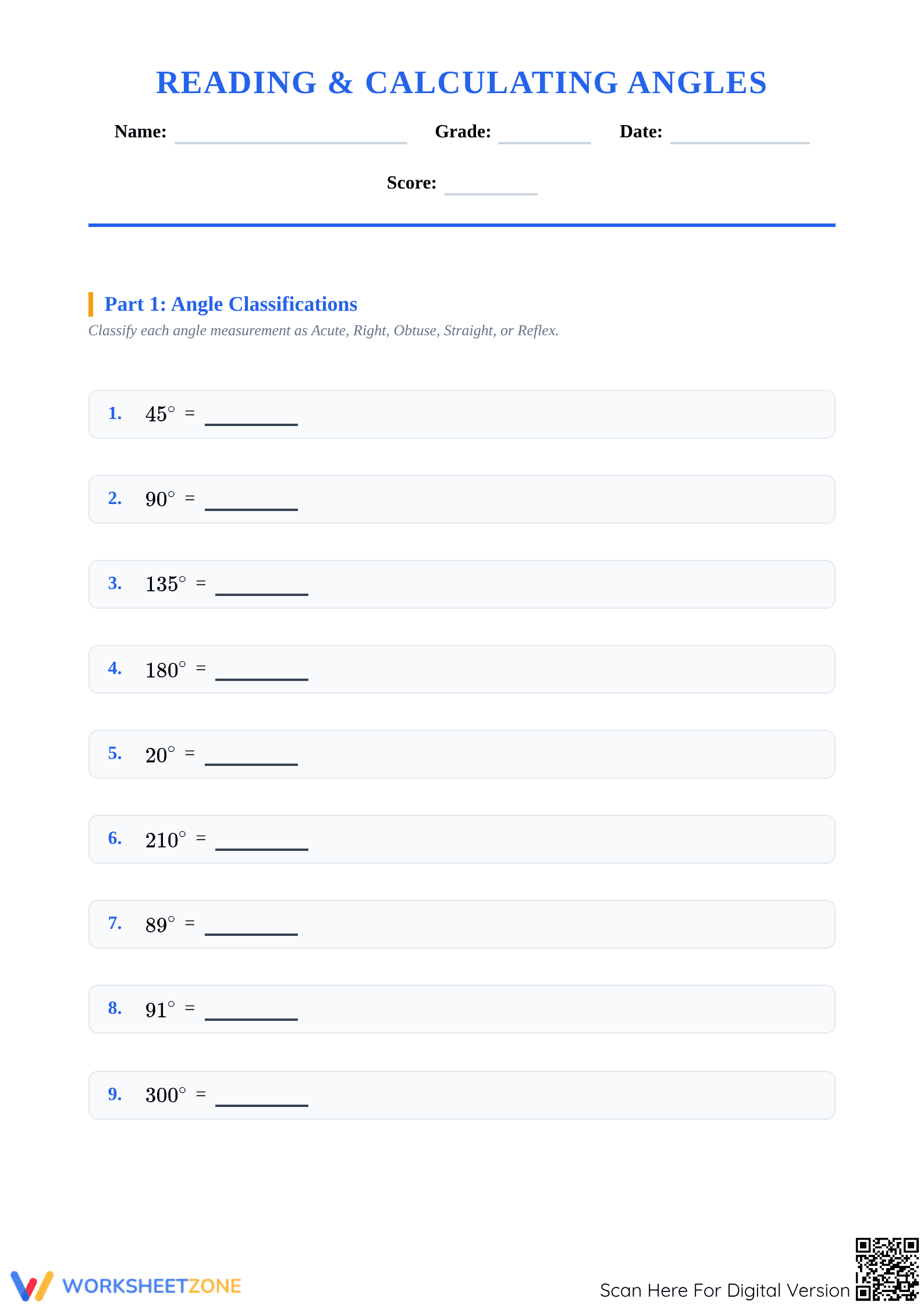
This comprehensive Grade 4 and 5 math worksheet provides a rigorous pathway for students to master the properties of angles. By moving from simple classification to complex calculations involving supplementary and complementary relationships, students develop a deep geometric intuition. This resource ensures learners can accurately read protractors and apply algebraic thinking to find missing values in various diagrams.
At a Glance
- Grade: 4-5 · Subject: Math
- Standard:
CCSS.MATH.CONTENT.4.MD.C.7— Recognize angle measure as additive and solve addition and subtraction problems.- Skill Focus: Angle classification and calculation
- Format: 5 pages · 34 problems · Answer key included · PDF
- Best For: Comprehensive unit review or assessment
- Time: 45–60 minutes
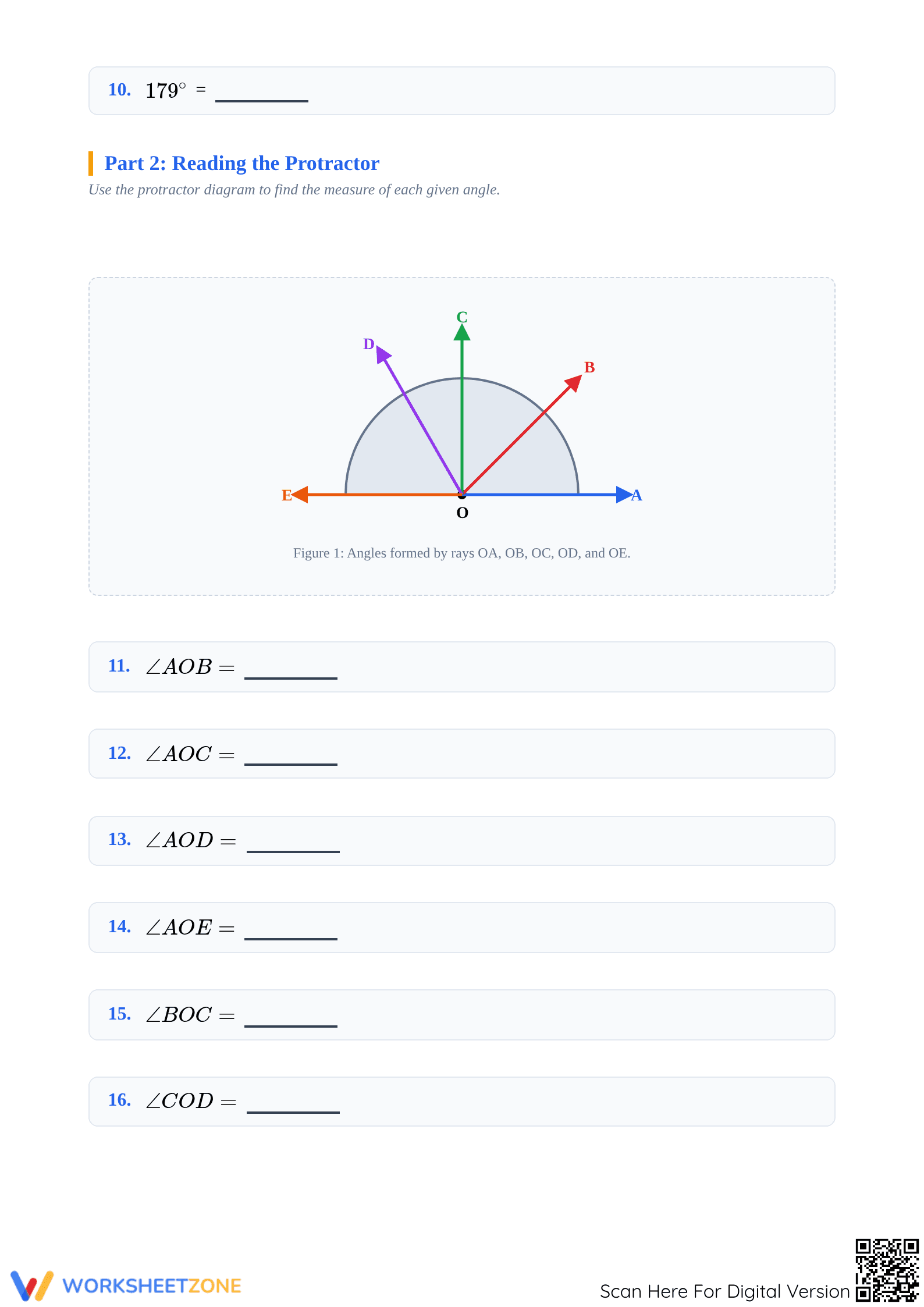
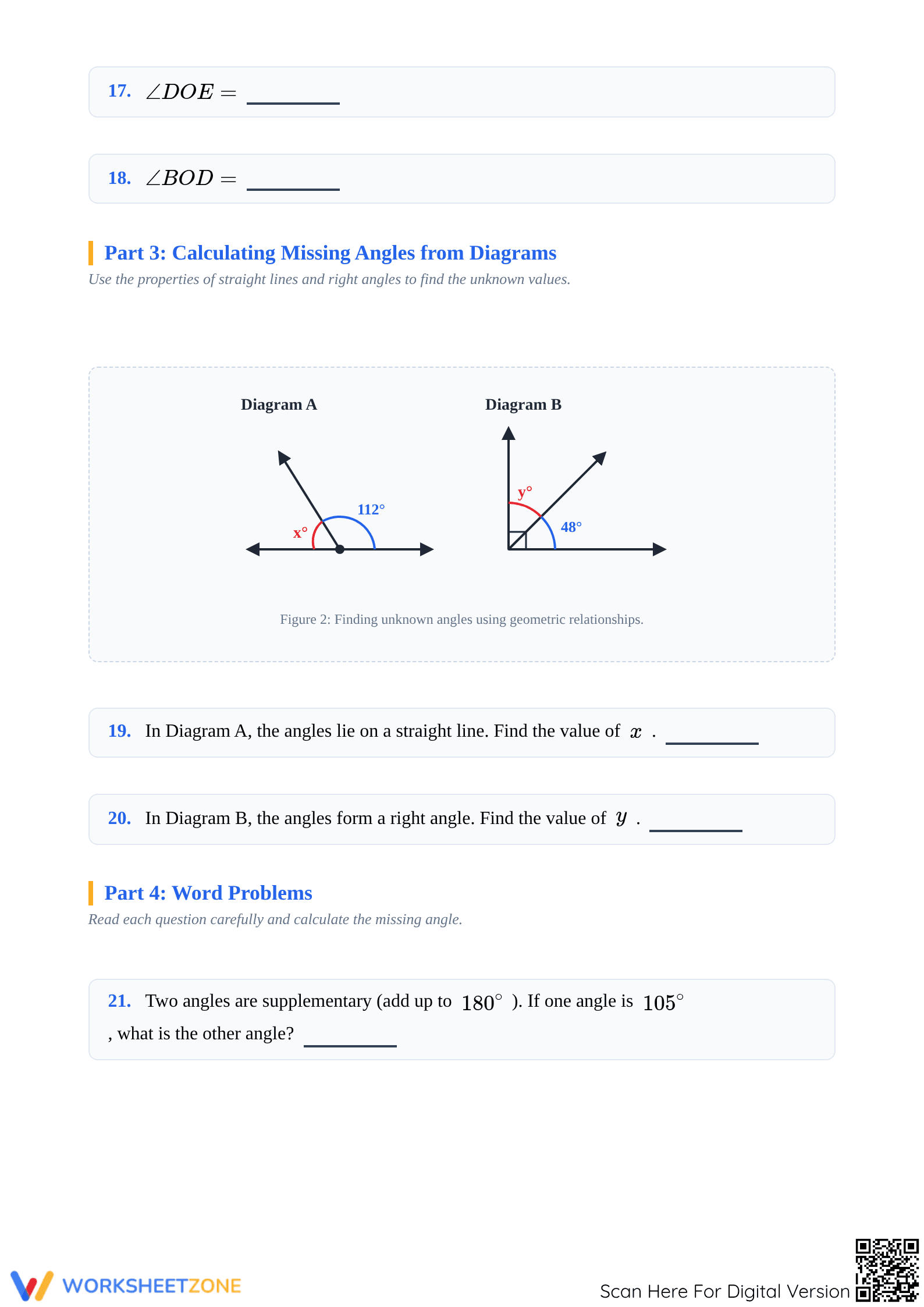
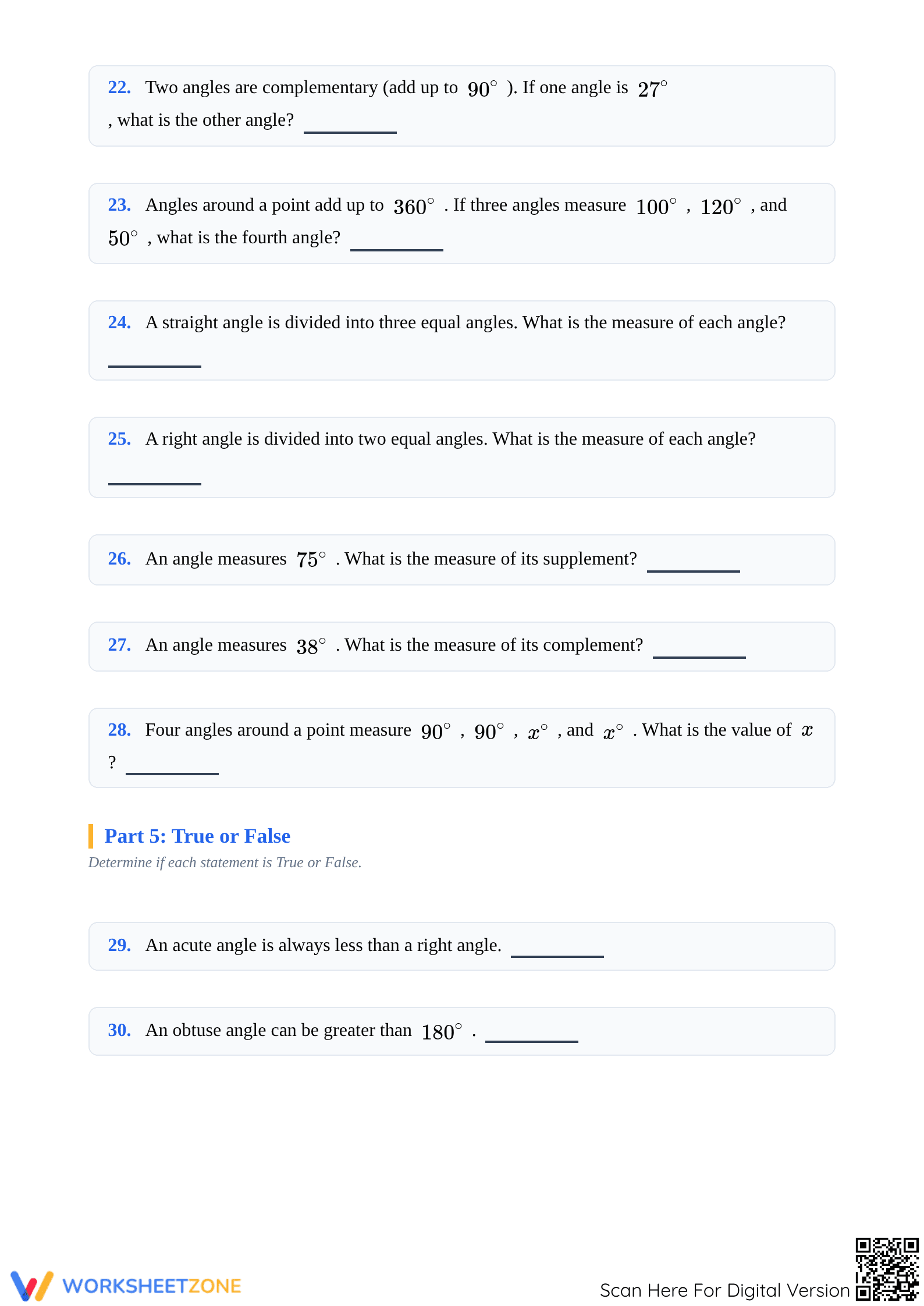
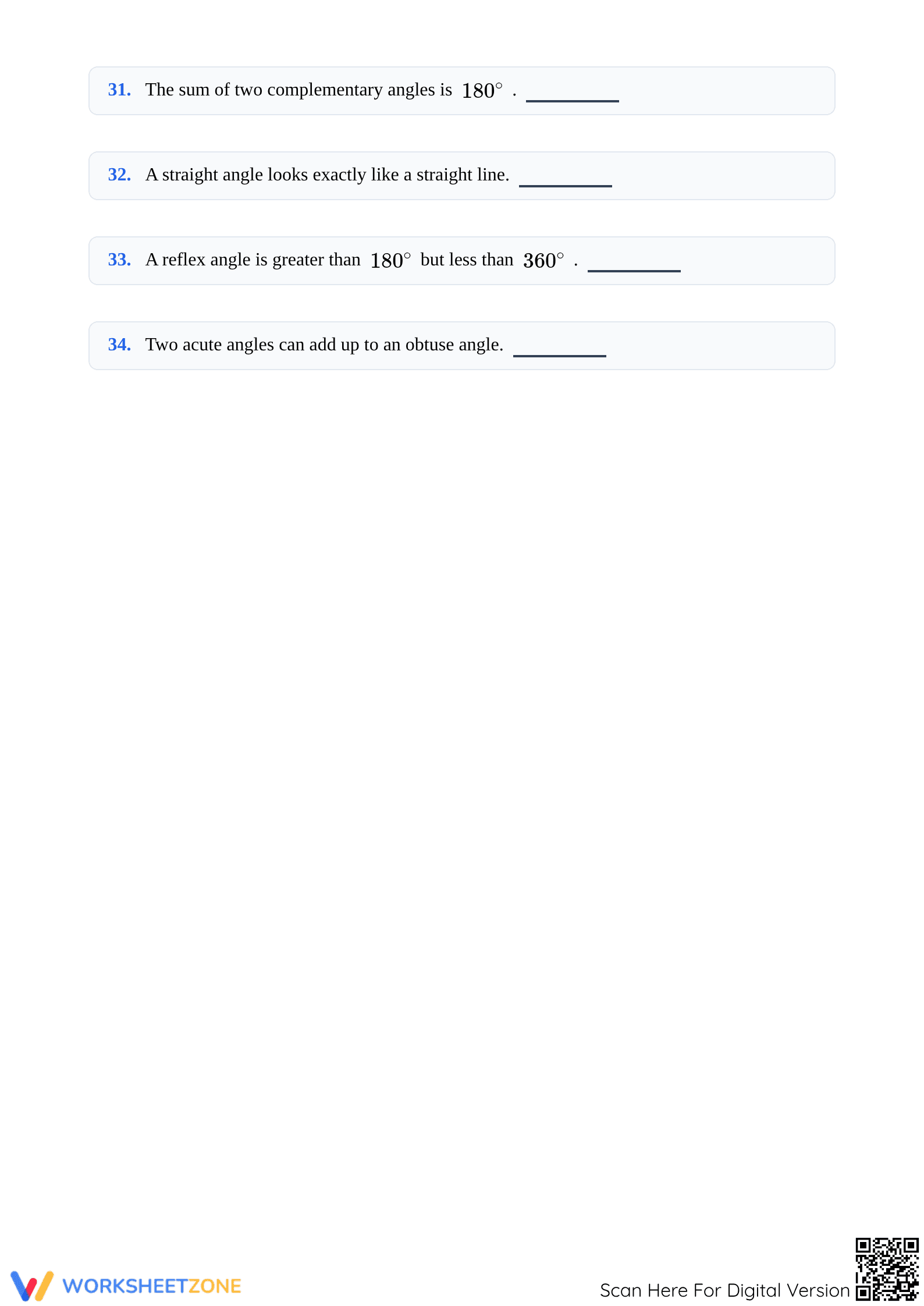
The 5-page packet contains 34 diverse tasks organized into five logical sections. It begins with 10 classification problems, followed by 8 protractor reading exercises using a clear central diagram. The middle sections introduce geometric relationships on straight lines and right angles, while the final pages challenge students with word problems and conceptual true-or-false statements. A full answer key is included for every problem.
The zero-prep design allows for immediate classroom implementation. Step 1: Print the 5-page PDF (30 seconds). Step 2: Distribute to students for independent or guided work (1 minute). Step 3: Use the provided answer key for rapid grading or student self-correction (under 1 minute). This workflow minimizes administrative overhead, making it an ideal choice for substitute plans or end-of-unit evaluations where teacher time is at a premium.
The primary focus is CCSS.MATH.CONTENT.4.MD.C.7, which requires students to recognize angle measure as additive. When an angle is decomposed into non-overlapping parts, the angle measure of the whole is the sum of the angle measures of the parts. This worksheet also supports CCSS.MATH.CONTENT.4.MD.C.6 regarding measuring angles with a protractor. Both standard codes can be copied directly into lesson plans, IEP goals, or district curriculum mapping tools.
Assign this packet as a summative assessment after completing a unit on geometry to gauge student mastery of angle relationships. Alternatively, use individual pages as formative exit tickets during the instructional week. During the protractor reading section, observe if students are correctly identifying the vertex and rays; this is a prime moment to correct common misconceptions about inner versus outer scales. Completion typically takes 45 to 60 minutes.
This resource is designed for general education students in grades 4 and 5, but it serves as excellent remediation for 6th graders or enrichment for advanced 3rd graders. It pairs naturally with a physical protractor demonstration or an anchor chart detailing the differences between acute, obtuse, and reflex angles.
According to research by Fisher & Frey (2014) on the gradual release of responsibility, students require structured opportunities to move from conceptual identification to complex problem-solving. This worksheet facilitates that transition by first requiring students to classify angles before asking them to apply additive properties to find unknown measures. The inclusion of 34 distinct tasks ensures sufficient repetition for procedural fluency, a key component of the CCSS.MATH.CONTENT.4.MD.C.7 standard. By integrating visual protractor reading with algebraic word problems involving supplementary and complementary relationships, the resource addresses multiple cognitive domains. Data from NAEP suggests that proficiency in geometric measurement in upper elementary grades is a strong predictor of success in middle school geometry. This comprehensive packet provides the rigorous practice necessary to bridge the gap between basic shape recognition and advanced geometric reasoning, making it a vital tool for standard-aligned mathematics instruction.


