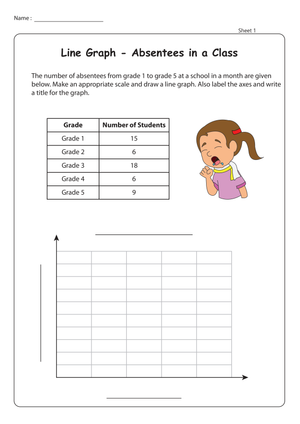
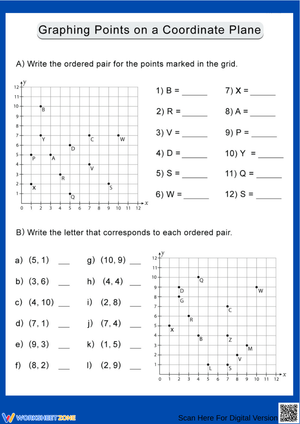
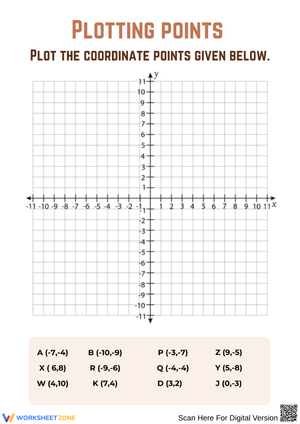
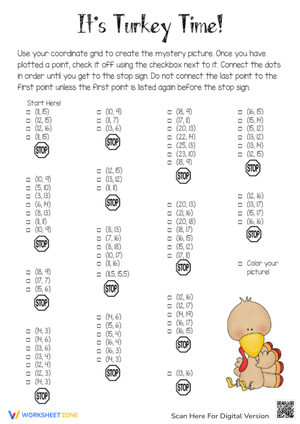
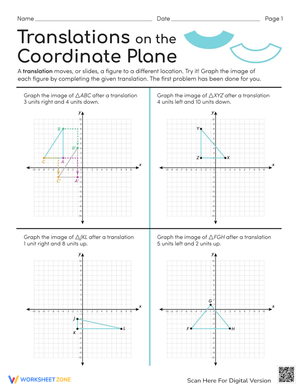
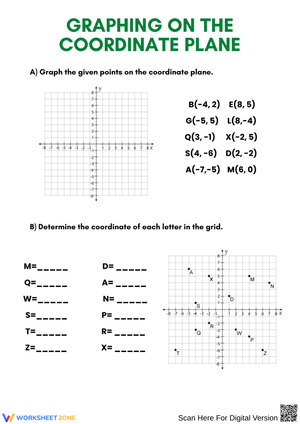
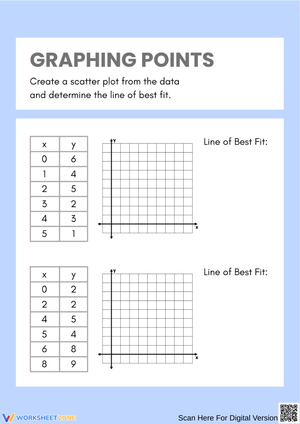
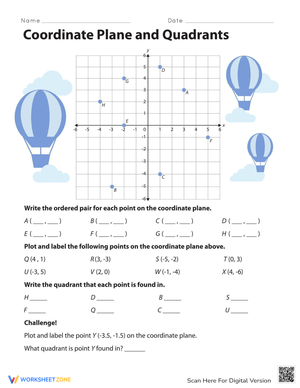
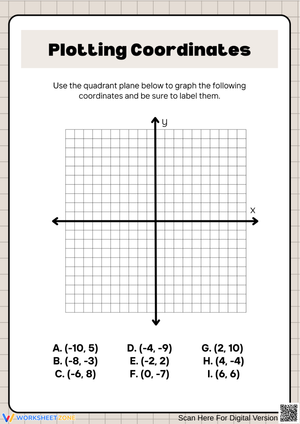
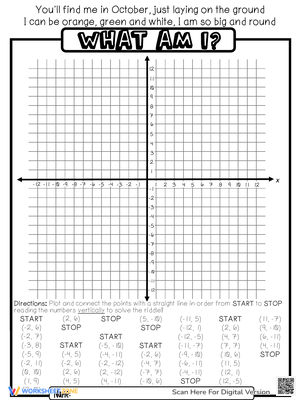
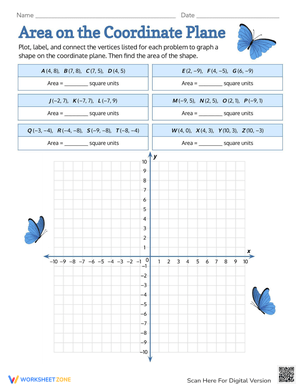
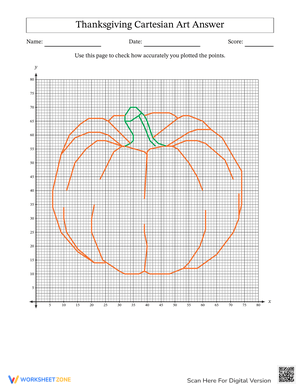
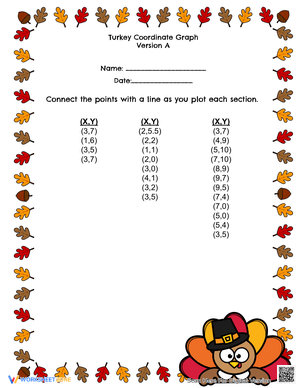
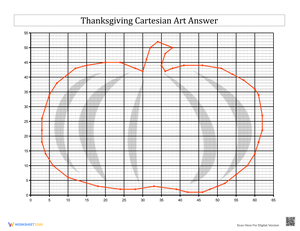
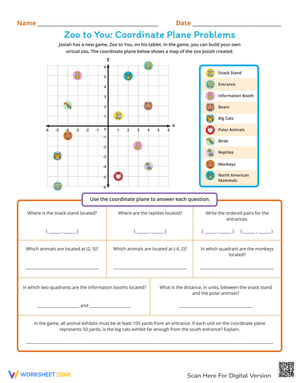
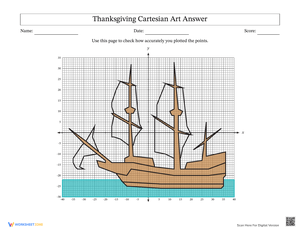
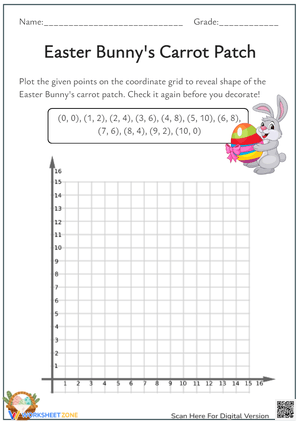
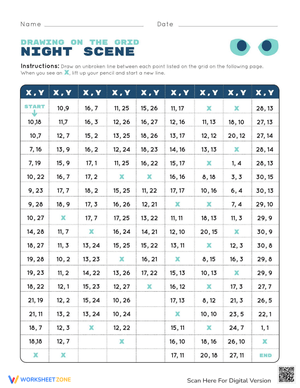
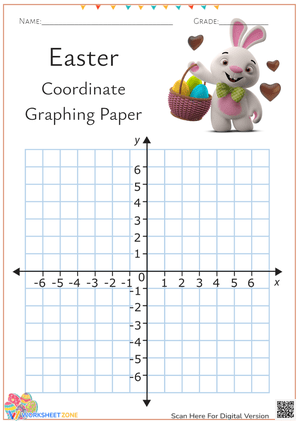
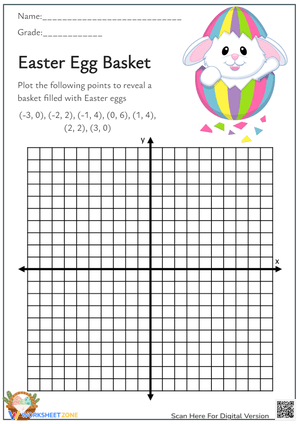
These coordinate planes printable worksheets for 6th grade target the specific graphing skills that appear in CCSS 6.NS.6 and 6.G.3 — reading ordered pairs, plotting points with precision, and connecting coordinates to draw polygons. The set moves from first-quadrant work to four-quadrant practice, giving teachers a sequenced progression through the geometry unit rather than an isolated activity.
The Specific Skills Targeted
Grade 6 is when students first encounter the full coordinate plane, and the skills compound quickly if one breaks down early. Each worksheet keeps the task load tight — students aren't simultaneously navigating the grid, absorbing new vocabulary, and solving problems for the first time on the same task.
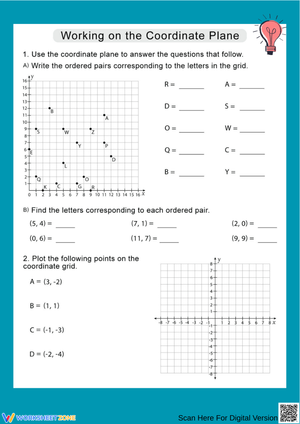
- Reading ordered pairs: Students identify the x-coordinate first, then the y-coordinate — the ordering that trips up the most 6th graders in week one.
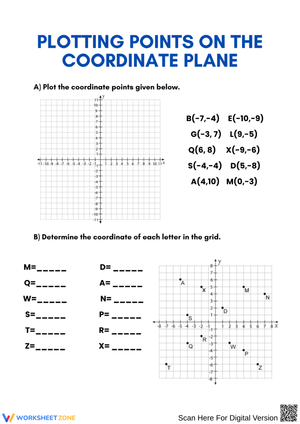
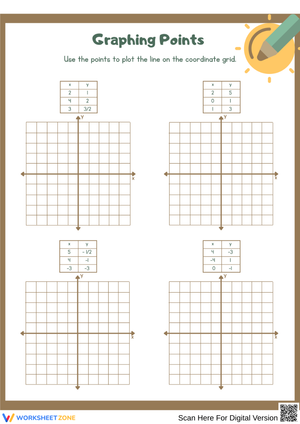
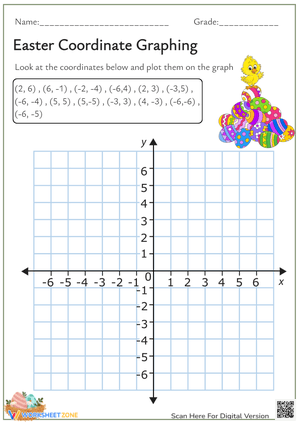
- Plotting points from a list: Learners practice moving horizontally along the x-axis first, then vertically. That physical sequence needs repetition before it becomes automatic.
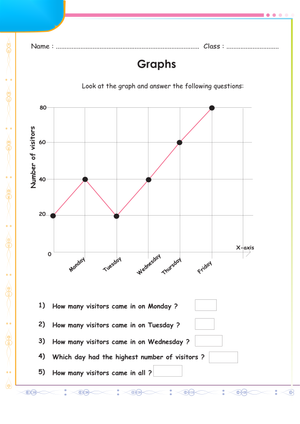
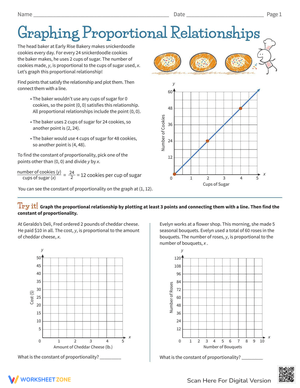
- Naming coordinates from a graph: Students reverse the process — reading a placed point and writing its ordered pair. This reveals gaps that pure plotting practice misses entirely.
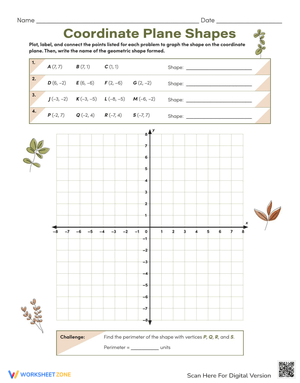
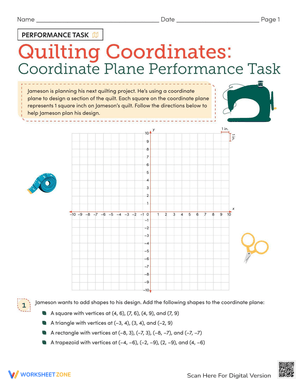
- Graphing polygons by connecting vertices: Students plot a set of ordered pairs, connect them in sequence, and identify the resulting shape. Several worksheets ask them to classify the polygon after graphing it.
- Four-quadrant work with negative integers: Once students are accurate in the first quadrant, they extend to plotting coordinates like (−4, 3) without sign reversal or incorrect reflection across an axis.
Frequent Student Errors Worth Watching For
The most consistent error at this level is axis reversal — students move vertically first, then horizontally, producing points that are wrong in the same predictable direction every time. A student who plots (3, 5) at the location of (5, 3) on every item isn't being careless; they've memorized the wrong movement order. These worksheets address this by pairing plotting tasks with naming tasks on the same worksheet, so students self-check their positions rather than repeat the error across an entire assignment unchallenged.
In four-quadrant work, sign confusion surfaces quickly. Students who handle positive coordinates without error will still plot (−3, 2) at the position of (3, 2), treating the negative sign as decoration rather than direction. Short cues printed directly on each worksheet — something like "negative x: move left from zero" — reduce that error more reliably than reteaching it verbally after students have already finished the task incorrectly.
How to Build These Worksheets Into Your Lesson Plans
The format adapts to almost any instructional slot. The shorter worksheets — three to five points, first quadrant only — work well as bell ringers or to fill the last eight minutes of class after a lesson has already concluded. Polygon graphing worksheets belong mid-lesson as a structured follow-up to direct instruction, not as independent openers when students haven't seen the skill modeled yet.
For centers, pair coordinate planes printable worksheets for 6th grade with colored pencils and a straightedge so students can plot, connect, and visually compare each other's work. The included answer keys keep rotations low-maintenance — students confirm their graphs independently, which frees the teacher for pull-small-group instruction. A pre-task habit worth establishing early: have students lightly trace the x-axis in one color and the y-axis in another before starting any graphing task. It takes under a minute and reduces reversed-coordinate errors during independent work more consistently than verbal reminders from the front of the room do.
Differentiating These Worksheets Across Ability Levels
Students still unsteady with number lines benefit from first-quadrant worksheets with larger grids, pre-labeled intervals, and an example point already plotted. Keeping those students on grade-level content — reading and plotting ordered pairs — while reducing the visual load is more useful than lowering the skill expectation entirely.
For students ready to push further, remove some axis labels, mix plotting and naming on the same worksheet, or add a reasoning prompt. A strong extension task: "Three vertices of a rectangle are at (2, 1), (2, 5), and (6, 5). Plot the fourth vertex and write its coordinates." That requires coordinate reasoning, not just grid navigation. Coordinate planes printable worksheets for 6th grade also serve well as reteach material after a quiz — when a student's work shows axis-reversal errors throughout, one naming worksheet worked through in a five-minute targeted session is more efficient than repeating the full lesson.
Standard Alignment
These worksheets align to CCSS 6.NS.6c, which requires students to find and position integer pairs on a coordinate plane, and to CCSS 6.G.3, which addresses drawing polygons from given vertex coordinates and using coordinates to find side lengths. In most Grade 6 sequences, 6.NS.6c is addressed early in the year during the Number System unit, with 6.G.3 appearing later in the Geometry unit. Ordered pair plotting and reading tasks fit cleanly into 6.NS.6c instruction, while polygon graphing worksheets align most directly to 6.G.3 and work best when students already have consistent first-quadrant accuracy before the geometry unit begins.
Frequently Asked Questions
Should 6th graders start with all four quadrants or just the first?
First-quadrant work first — without exception. Students need clean, repeated practice with positive coordinates before negative values enter. Four-quadrant extension is appropriate in Grade 6, but teachers who introduce it before students are accurate in the first quadrant usually spend more time correcting compounded confusion than teaching new content. Most Grade 6 classrooms spend at least a week on first-quadrant precision before expanding the grid.
How do these worksheets work for students who are still shaky on number lines?
Students who haven't solidified number line understanding will struggle with the coordinate plane — the two skills are directly connected. The coordinate plane is two number lines intersecting, and saying that explicitly to students often helps. Pair first-quadrant worksheets with brief number line review rather than treating them as separate topics. Making that connection visible early prevents a lot of confusion later in the unit.
How do I know when a student is ready to move from plotting to polygon tasks?
Accuracy is the signal, not volume. Once a student plots five or six ordered pairs correctly without reversing axes, they're ready for polygon tasks. The naming-coordinates worksheets serve as a useful readiness check — a student who can accurately read coordinates from a finished graph understands the relationship between ordered pairs and grid position well enough to work with vertices and connected shapes.
Are these suitable for homework?
Yes, with one clear condition: send home worksheets that mirror what students practiced in class that day. A first-quadrant plotting worksheet is appropriate homework after guided instruction on the same skill. Coordinate planes printable worksheets for 6th grade that introduce polygon reasoning or four-quadrant work are better kept in the classroom, where confusion can be addressed before it hardens into a misconception students carry home and practice incorrectly.













 Interactive Worksheet Maker
 Quiz Maker
 Word Search Maker
 Crossword Puzzle Maker
 Word Scramble Generator
 Sentence Scramble Generator
 Handwriting Worksheet Generator
 Name Tracing Generator
 Fill In The Blank Generator