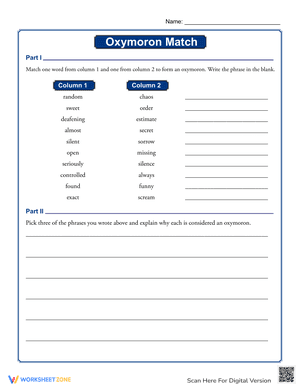
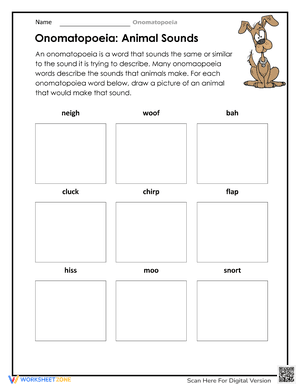
These 6th grade figurative writing printable worksheets resources push students past the identification phase that dominates most elementary figurative language work. By sixth grade, the instructional target shifts: students should be able to explain how a metaphor changes a passage's tone, not just circle it and label it correctly. Each worksheet in this set builds toward that shift — from spotting a technique to using it deliberately in student writing.
What Students Practice Across the Set
The six techniques that appear most often in middle school ELA — simile, metaphor, personification, hyperbole, idiom, and imagery — form the core of these materials. Each worksheet targets one or two of those techniques in focused exercises, while several mixed-review worksheets bring multiple types together. Tasks move through three levels of demand: students underline and label examples in short passages, rewrite flat sentences using a named technique, and compose original examples from open-ended prompts.
Passage-based tasks appear throughout because reading figurative language in context is meaningfully different from reading a definition in isolation. When a student encounters "the silence chewed at him" inside a short narrative, they have to decide whether it's metaphor or personification, explain what it implies about the character's state, and then attempt a parallel move in a sentence of their own. That read-analyze-apply sequence is the engine behind the harder revision tasks. The 6th grade figurative writing printable worksheets in this format do more instructional work than drill sheets because students see the technique operating in real prose before they attempt it themselves.
Where Student Writing Goes Wrong With Figurative Language
The most common issue at this grade level is technically correct but weak writing. A student produces "her voice was like music" and considers the task done. The simile is categorically accurate, but it adds nothing specific to the writing. What moves students forward is asking them to rate the strength of their comparison, not just its category. When they place their phrase next to a stronger example from a mentor text, the difference in precision becomes visible in a way that a score or a red comment rarely achieves on its own.
Idioms generate a separate problem. Students who grew up hearing American English idioms process "she had butterflies in her stomach" without pausing. Students newer to English, or from households where different idioms circulated, may read that phrase literally and miss the emotional context entirely. Worksheets that embed idioms inside short paragraphs with enough contextual detail handle this better than worksheets that present idioms as translation tasks stripped of any surrounding text.
A third pattern appears when students move from identification to original composition. Many can correctly label personification in a passage but freeze when asked to write one from scratch. The gap between recognizing a technique and deploying it independently is real at this age, and it is one reason the worksheets include sentence-level prompts with just enough structure to get students started — naming a natural phenomenon and asking students to give it a human action, for example — before moving to fully open prompts.
Fitting These Worksheets Into Your Planning Week
A five-day sequence works well for introducing each new technique. Day one: bring in a sentence or two from a text the class is already reading and discuss what the technique does to the line. Day two: use one worksheet for guided revision — students work through three or four sentences, then write one original example. Day three: students apply that same move inside a paragraph draft they're already working on. Day four: pull a mixed-review worksheet that includes the new technique alongside previously taught ones. Day five: use the set's shorter exit-task worksheets to see who can produce an original example independently.
Outside that sequence, these worksheets fit naturally into several other classroom moments:
- Bell ringers: three to five quick revision items that review one technique from the prior lesson
- Centers and stations: mixed-review worksheets paired with a short passage and a written response prompt
- Targeted reteaching: single-technique worksheets work well with small groups that need a second look after a quick formative check
- End-of-unit checks: mixed-review worksheets serve as informal assessments before a larger writing evaluation
During a narrative writing unit, students can work through the imagery and personification worksheets alongside their drafts. During a poetry unit, those same worksheets function as analysis tools. The 6th grade figurative writing printable worksheets set moves with you across different units rather than standing apart as a disconnected figurative language block.
Tiering the Work for Mixed-Ability Classes
Students who need more support do better starting with the matching and sorting tasks before moving to open composition. Having a short word bank visible, or seeing a partially completed sentence, reduces the vocabulary burden enough that figurative language skill actually surfaces in student work. Without that kind of adjustment, a student who understands metaphor conceptually can score poorly simply because they're also managing dense directions at the same time — and that conflation tells a teacher nothing useful.
For students who move through identification tasks quickly, the more demanding work is the analysis writing: name the technique, then write a sentence explaining how it changes the emotional weight of the excerpt. A further extension that reliably pushes advanced writers is asking them to revise the same short passage twice — once using imagery, once using personification — then explain which version better fits the narrator's mood. That comparative task asks students to think about technique as a deliberate stylistic choice rather than a label to apply. While those students work through that, students who need more focused practice can work through a structured sentence-revision worksheet from the same set without the class feeling split in two.
Standard Alignment
These worksheets align to CCSS.ELA-LITERACY.RL.6.4, which calls on students to determine the meaning of words and phrases as they are used in a text, including figurative and connotative meanings, and to analyze the impact of word choice on tone. The writing-focused worksheets connect to CCSS.ELA-LITERACY.W.6.3d, which requires students to use precise words, relevant sensory details, and figurative language in narrative writing. That pairing matters for lesson planning: teachers can draw on the reading-oriented worksheets during a literature unit and the writing-oriented ones during narrative or descriptive writing without the two feeling disconnected. The underlying skill being built — using figurative language as a deliberate craft decision — runs through both standards and both units.
Frequently Asked Questions
Do these worksheets include answer keys?
Yes. Each worksheet includes a corresponding key with sample responses for the open-ended writing tasks, not just the identification and labeling items. That makes them practical for centers, independent stations, and small-group instruction where teachers cannot review every response in real time.
How much class time should I plan for each worksheet?
Focused single-technique worksheets typically run 10 to 15 minutes for on-level students. Mixed-review and passage-based worksheets take closer to 20 to 25 minutes. That range covers bell ringers and exit tasks on the shorter end and mini-lesson follow-up work on the longer end — without needing to cut a task short or add filler to fill the period.
Are these accessible to students who struggle with reading?
Passages in the set are written at a 5th to 6th grade readability level. Students reading well below grade level may need read-aloud support or a partner for the passage-based worksheets, but the sentence-level revision and identification tasks are generally accessible to most students in a standard sixth-grade classroom without modification.
Can these materials work with 7th graders doing review?
The 6th grade figurative writing printable worksheets resources work well as start-of-year intervention or diagnostic tools in seventh grade. The mixed-review worksheets are especially useful in that context because they quickly surface which students have solid control of technique differences — metaphor versus personification, idiom versus hyperbole — and which still need focused practice before moving on to more nuanced author's craft work.















 Interactive Worksheet Maker
 Quiz Maker
 Word Search Maker
 Crossword Puzzle Maker
 Word Scramble Generator
 Sentence Scramble Generator
 Handwriting Worksheet Generator
 Name Tracing Generator
 Fill In The Blank Generator