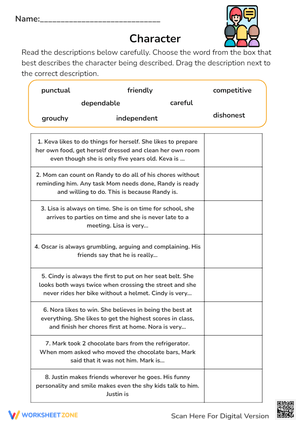
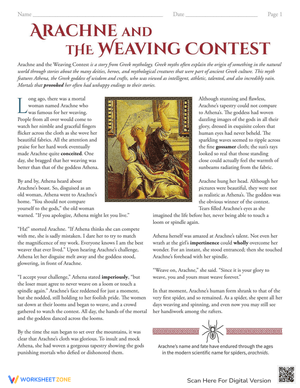
These 6th grade relevant details worksheets resources give teachers a concrete tool for the judgment call that consistently trips up middle schoolers: not just identifying a topic, but deciding which details actually serve a specific claim. The worksheets move from recognition tasks — sorting relevant from irrelevant details and explaining the difference — to paragraph revision and evidence generation, where students practice supplying stronger support on their own. Each worksheet targets a distinct point in that progression.
Student Error Patterns Worth Knowing Before You Hand Out the Set
The most consistent error at this grade level is confusing interesting with relevant. A student writing a paragraph about why renewable energy matters to local communities may include a sentence about how solar panels are manufactured — accurate, factual, and genuinely related to the topic. But if the paragraph's claim is about economic benefits to rural families, that sentence addresses a different question than the one the topic sentence poses. It fits the subject without supporting the point, and most sixth graders don't feel that distinction until someone explicitly names it for them.
A second pattern appears during paragraph revision tasks: students delete the off-topic sentence but don't replace it. They recognize that the detail doesn't belong, but they don't notice the gap in reasoning that remains. Each worksheet's revision tasks require students to supply a stronger replacement after removing the weak sentence — which surfaces this habit early, before it carries into their own drafts.
A third issue shows up with quotation-based items. Students tend to select the longest or most dramatic quotation rather than the one that addresses the specific claim. Asking them to write one sentence explaining what the quotation proves — before choosing it — slows down that impulse and builds a more deliberate selection habit over time.
What's Inside the Set
The worksheets cover five distinct task types, each one moving the skill forward rather than repeating the same exercise at varying difficulty levels.
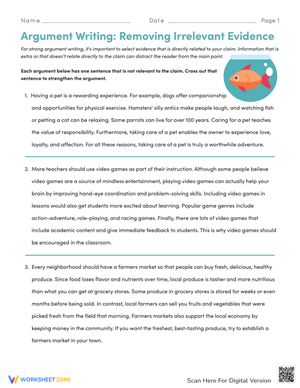
- Topic sentence–to–detail matching: Students read a claim and choose which of several details best supports it, then write a brief justification for their selection.
- Relevant vs. irrelevant sorting: Students categorize a list of sentences and record a one-sentence explanation for each placement.
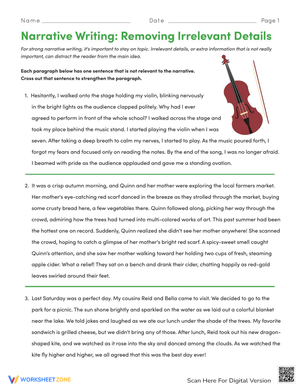
- Paragraph revision: Students identify and remove the off-topic sentence in a short passage, then supply a stronger replacement that actually supports the topic sentence.
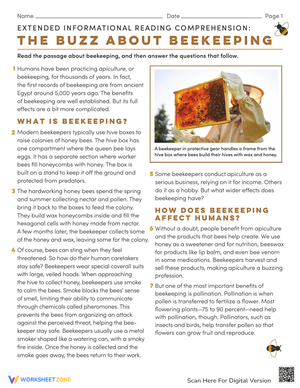
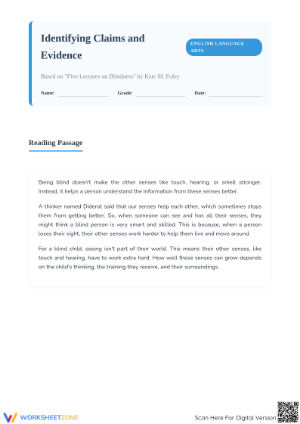
- Passage-based evidence selection: Students read a short informational text and select only the details that support a given claim before writing a constructed response.
- Evidence brainstorming before drafting: Students generate facts, examples, or quotations that fit a prompt before writing begins — a step that transfers directly into prewriting during writing workshop.
The revision and evidence-generation tasks push students past recognition and into production. That distinction matters because students can often pick the correct answer on a multiple-choice item while still selecting weak or off-topic evidence in their own writing.
Building These Worksheets Into Your Lesson Sequence
Each worksheet works best as the third move in a four-step sequence: direct instruction, teacher think-aloud with a real paragraph, guided practice on two or three examples as a class, then the independent worksheet. Skipping to the printable without the first three steps turns a skill-building task into a guessing exercise.
Once students are working independently, a three-pass structure holds up well. Students work alone first and mark their choices. Partners then compare answers using sentence frames — "This detail supports the main idea because..." — and flag any disagreements. The class revisits one or two disputed items together, and that final whole-class discussion is where the deepest misconceptions surface. The ten minutes at the start of the period after morning announcements, or the Friday review block before a weekend, are natural windows for the partner comparison step.
Teachers also connect each worksheet directly to the current writing unit. If students are mid-draft on an informational paragraph, ask them to highlight one sentence in their own writing that might be off-topic or underdeveloped. That transfer move — from controlled worksheet practice to a live personal draft — is where the skill starts to hold. When students include off-topic information, treat the misplaced detail as a revision clue rather than just a mistake: asking "What were you trying to prove with this sentence?" often helps students replace it with stronger support they already have in mind.
A 6th grade relevant details worksheets set also functions as reliable sub-plan material because the directions are self-contained. Students don't need a teacher introduction to access the sorting and revision tasks, and the completed responses give a returning teacher a quick formative read of where the class stands before the next lesson.
Tailoring These Worksheets for Intervention, On-Level, and Advanced Learners
The core task stays constant across groups: students identify details that support a specific claim and explain why other details don't fit. What changes is the amount of structured support built into each student's working context.
- Intervention groups: Shorter passages with pre-highlighted topic sentences, three answer choices instead of four or five, and permission to explain reasoning aloud before writing anything down. Oral justification often reveals whether a student understands the concept even when written output is slow.
- On-level learners: Standard multiple-choice and short-response items that require a written justification for each selection.
- Enrichment: Students write their own distractor details for a given paragraph, build a full evidence set for a new claim, or revise a weak paragraph from scratch using only the details they judge as relevant.
For multilingual learners, sentence frames ("This detail belongs because..." / "This sentence doesn't fit because it shifts to talking about...") and a brief vocabulary anchor for terms like relevant, support, evidence, and off-topic make the expectations more transparent. The goal across all groups is for students to produce at least one sentence of reasoning — not just mark an answer — because that written justification shows real understanding rather than test-taking instinct.
Standard Alignment
These worksheets address CCSS.ELA-LITERACY.W.6.2b, which requires students to develop a topic with relevant facts, definitions, concrete details, quotations, and other information. In most 6th grade ELA sequences, this standard appears first during fall informational writing units when students are learning to build focused paragraphs, then reappears during research and argument writing later in the year. Each worksheet gives students repeated practice with the specific judgment the standard demands: not just locating information, but evaluating whether that information actually serves the point being made.
Frequently Asked Questions
What is the difference between a relevant detail and a related detail?
A related detail fits the general topic. A relevant detail fits the specific claim or topic sentence. A paragraph arguing that urban tree cover lowers summer temperatures might include a detail about city budget allocations for parks — related to the subject, but not relevant to that particular claim. These worksheets train students to ask "Does this detail prove my claim?" rather than "Does this detail fit my topic?" — a distinction that changes how they approach every drafting and revision task.
How many items does each worksheet include?
Item count varies by task type. Sorting and matching worksheets typically include eight to twelve items, while paragraph revision tasks include two or three passages each with follow-up justification prompts. The evidence-brainstorming worksheet is open-ended. That variation prevents students from learning the format rather than the skill.
Can these worksheets be used during reading instruction, not just writing?
The passage-based items connect directly to reading comprehension — specifically to evaluating how well an author's evidence supports a central idea. A strong 6th grade relevant details worksheets set pulls the same analytical thinking into both reading and writing contexts. If your class is working on close reading of informational texts, the passage-based tasks give students a structured way to annotate for evidence quality before moving into a whole-class text discussion.
How do I know when students are ready to apply this skill in their own writing?
Correct worksheet answers are the starting point, not the finish line. A more reliable transfer check is to ask students to highlight one sentence in their current draft that might be off-topic, then explain in writing why they'd keep it or cut it. If a student marks a sentence, produces a clear justification, and proposes a stronger replacement, they're ready to move forward. If they mark randomly without coherent reasoning, another round of guided practice — with the teacher modeling the thought process aloud again — comes before independent drafting. A well-used 6th grade relevant details worksheets resource functions as rehearsal for that drafting decision, not a replacement for it.












 Interactive Worksheet Maker
 Quiz Maker
 Word Search Maker
 Crossword Puzzle Maker
 Word Scramble Generator
 Sentence Scramble Generator
 Handwriting Worksheet Generator
 Name Tracing Generator
 Fill In The Blank Generator