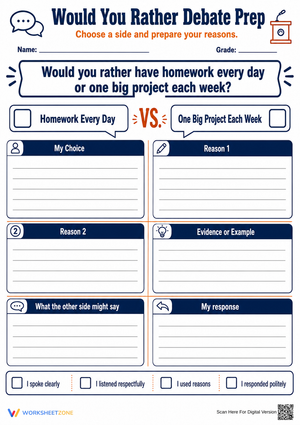
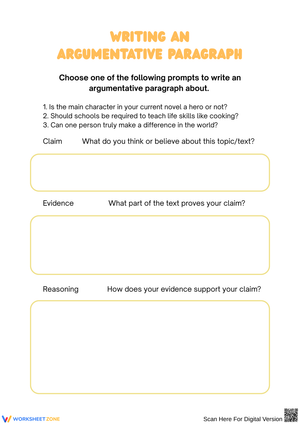
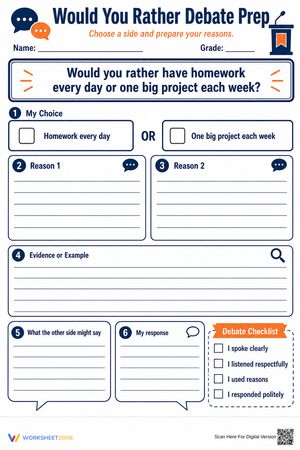
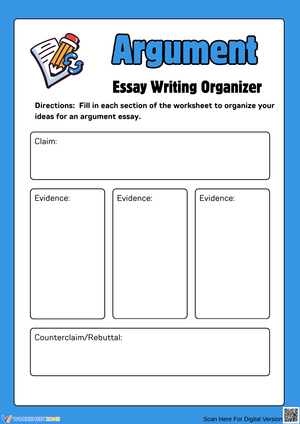
These argument writing printable worksheets for 6th grade give teachers a targeted way to break down one of the hardest transitions in middle school ELA: moving students from personal opinion statements to evidence-backed arguments with a defensible, specific claim. Sixth grade is the year that shift becomes a formal instructional priority, and many students arrive still writing "I think" responses from fifth grade. Each worksheet in this set targets one skill — claim writing, evidence selection, counterclaim practice, or revision — so teachers can see exactly where a student's argument falls apart.
The Specific Skills Each Worksheet Builds
The set covers the full arc of argument writing without trying to address every skill in a single task. Worksheets focus on these distinct moves:
- Claim writing: Students sort sentences into topic, weak opinion, and genuine arguable claim — then draft their own specific position on a prompt.
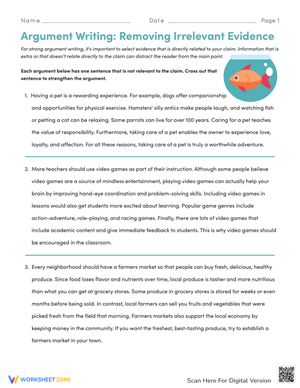
- Reasons and evidence: Students match reasons to a given claim, sort relevant versus irrelevant evidence from a short passage, and practice citing specific details rather than paraphrasing loosely.
- Explanation sentences: Structured frames require students to connect evidence back to the claim using "This shows that..." and "This matters because..." — the step most sixth graders skip entirely.
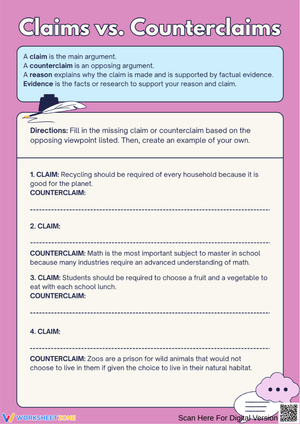
- Counterclaim practice: Students identify an opposing viewpoint, write it fairly without straw-manning, and draft a brief rebuttal grounded in logic rather than dismissal.
- Planning organizers: Graphic organizers walk students through claim, reasons, evidence, explanation, and conclusion in a repeatable structure they can internalize over the year.
- Revision checklists: Focused criteria ask students to underline the claim, circle evidence, and mark any spot where explanation is missing before they revise and resubmit.
That separation matters. A student who struggles to explain how evidence connects to a claim has a fundamentally different gap than a student who selects irrelevant evidence in the first place. Separate worksheets make that distinction visible during a lesson instead of after a full essay is turned in.
Student Errors These Worksheets Help You Catch Early
The most persistent error in sixth grade argument writing is treating a claim like a topic announcement. Students write "This essay is about school uniforms" or "Many people have different opinions on homework" when the task calls for a specific, arguable position. A claim-sorting worksheet that presents three versions of the same sentence — topic, vague opinion, strong claim — and asks students to rank and explain their choice makes that distinction stick faster than a vocabulary definition on the board.
The second pattern is evidence dumping. Students copy a quote or statistic, drop it into the paragraph, and move on as if their work is done. They've found the evidence; they just haven't learned to explain it. The explanation-sentence frames in these worksheets prevent that habit from taking hold — students can't move to the next section without completing the "this shows that..." sentence, which forces the logical connection most sixth graders skip.
A third error is less obvious but worth watching for during revision: the restatement conclusion. Students who write a strong claim and solid body paragraphs often end by copying their opening sentence nearly verbatim. The conclusion worksheets ask students to draft a closing that frames a broader implication or calls for a specific action — a different cognitive task than paraphrasing the intro, and one that requires direct practice before it becomes a habit.
How to Build These Worksheets Into Your ELA Block
Each worksheet completes in a focused stretch of ten to twenty minutes, which makes the resources flexible enough for almost any slot in the period. The most reliable use is as a bell ringer immediately following a mini-lesson — students apply the just-modeled skill while the teacher circulates and catches misunderstanding before it solidifies. A five-minute claim-writing warm-up on Monday morning tells you quickly who retained Friday's lesson and who needs another worked example before moving on.
During a full writing unit, the argument writing printable worksheets for 6th grade work best when sequenced deliberately rather than assigned in any order. Begin with claim identification, move to evidence sorting and explanation practice, then add paragraph drafting, and hold the multi-paragraph essay until students have shown they can execute each piece independently. Teachers who assign the full essay before students can write a clean explanation sentence end up correcting the same error on every single line.
For intervention, pull the evidence-sorting or explanation-sentence worksheet and work through one example together before releasing students to try it independently. That fifteen-minute small-group session produces cleaner feedback than a round of comments on a full draft. The revision checklists make a reliable Friday consolidation task: students bring a paragraph from earlier in the week, apply the checklist criteria, and rewrite at least one sentence before the block ends. That combination — short targeted practice, then self-assessment — reinforces the skill twice in the same class period.
Standard Alignment
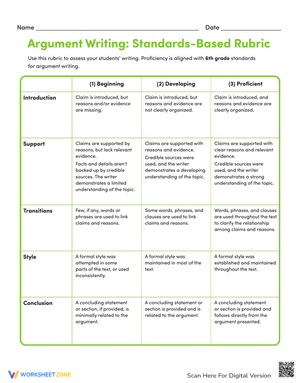
These worksheets address CCSS.ELA-LITERACY.W.6.1, the standard that asks sixth graders to write arguments supporting claims with clear reasons and relevant evidence. The sub-standards W.6.1a through W.6.1e cover introducing a claim and organizing supporting material logically, distinguishing the claim from counterclaims, using credible sources, maintaining a formal style, and writing a conclusion that follows from the argument. Most worksheets in this set map to one or two sub-standards, which makes it straightforward to match a specific worksheet to the exact skill you're checking on a given day.
W.6.1b gets the most instructional time in most classrooms: supporting a claim with clear reasons and relevant and sufficient evidence while acknowledging counterclaims. The word "sufficient" is where sixth graders consistently fall short — they include one piece of evidence per reason when the standard calls for enough support to actually make the reasoning hold. The evidence-evaluation worksheets address this directly by asking students to judge whether their evidence is strong enough, not just whether they included any at all.
Adjusting This Set for Writers at Different Readiness Levels
In a typical sixth grade ELA class, you'll find students who can draft a clean body paragraph with a stated claim sitting next to students who don't yet understand what makes a claim different from a topic. The same worksheet can serve both groups with deliberate, low-prep adjustments. For students who need more guided support, provide a claim frame — "Schools should [position] because [reason 1] and [reason 2]" — and keep the reading passage under 150 words. That reduces the cognitive load enough for students to focus on the argument structure itself. Oral rehearsal before writing also helps: talking through a reason with a partner activates thinking that students with limited writing fluency often can't access through a blank page alone.
On-level writers benefit from complete graphic organizers with enough structure to stay organized but enough open space to generate their own reasons and evidence. Advanced writers can extend any worksheet by adding a second counterclaim, comparing two evidence options and arguing which is stronger, or rewriting a weak sample paragraph and annotating each change they made. These extensions don't require a different worksheet — they're prompts you can add in the margin or write on a sticky note.
Teachers working with multilingual learners will find that word banks, sentence-level models, and brief oral rehearsal before writing make argument writing printable worksheets for 6th grade accessible without reducing academic expectations. The structural consistency across the set helps here: when every worksheet follows the same claim-reason-evidence-explanation sequence, students spend less mental energy decoding the task format and more energy developing their actual argument.
Frequently Asked Questions
What is the difference between opinion writing and argument writing at the sixth grade level?
Opinion writing, the standard in grades K–5, asks students to state what they think and offer a reason or two. Argument writing asks for a specific, debatable claim supported by evidence from a source, acknowledgment of counterclaims, and a logically ordered response. The counterclaim requirement alone marks a significant cognitive leap — students have to hold two positions in mind simultaneously, understand why one is stronger, and explain that reasoning in writing.
How many worksheets does a focused argument writing unit typically need?
A unit covering claim writing through full-draft revision generally works well with eight to twelve worksheets spread across three to four weeks, with each targeting a single skill. Assigning one or two focused worksheets over several days keeps feedback manageable and lets students see their progress skill by skill rather than feeling overwhelmed by a long multi-part assignment all at once.
Can these worksheets serve as formative assessment tools?
Yes, and a narrow task often gives better assessment data than a full essay. A one-worksheet claim-and-evidence task shows clearly whether a student understands how to connect those two elements — clearer than reading through several paragraphs to find the same error buried deeper in the draft. The revision checklists are especially useful: when students evaluate their own paragraph against specific criteria, you learn both what they produced and whether they understand what strong argument writing looks like.
How should these worksheets be ordered within a writing unit?
Start with claim identification before students write any claims of their own. Once students can distinguish a strong claim from a topic or vague opinion, move to reasons and evidence. Add explanation-sentence practice before assigning full paragraphs. Counterclaim and conclusion work come last, after students have the core structure under control. Skipping ahead creates a situation where students practice the form without understanding the reasoning behind each component.
Are these worksheets appropriate for struggling writers or English language learners?
The argument writing printable worksheets for 6th grade include structured frames, graphic organizers, and focused tasks that give students with varying writing backgrounds a clear entry point. For struggling writers, sentence starters and partially completed organizers lower the barrier to getting words on paper without removing the cognitive demand of constructing an argument. For English language learners, pairing each worksheet with a brief oral rehearsal — students talk through their claim and reasons before writing — makes the written task significantly more productive.












 Interactive Worksheet Maker
 Quiz Maker
 Word Search Maker
 Crossword Puzzle Maker
 Word Scramble Generator
 Sentence Scramble Generator
 Handwriting Worksheet Generator
 Name Tracing Generator
 Fill In The Blank Generator