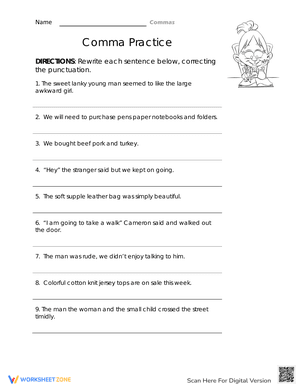
These commas with nonrestrictive elements pdf worksheets for 6th grade give teachers a targeted practice sequence for one of the grammar decisions that looks manageable during direct instruction but breaks down when students write independently: correctly punctuating extra information that doesn't change the sentence's core meaning. The set moves from identification tasks to editing to original sentence writing, covering appositives, nonessential relative clauses, and direct address. Each worksheet produces usable information about which students have internalized the concept and which are still placing commas by feel.
The Specific Skills Each Worksheet Targets
The central task across the set is recognizing a nonrestrictive element — a phrase or clause that adds detail about a noun without being necessary to identify it. Students work with three main categories: appositives (Ms. Chen, our science teacher, leads the robotics club), nonessential relative clauses (The documentary, which aired last spring, won two awards), and direct address interruptions (Jordan, please bring your notebook to the table). Every category demands the same underlying judgment: can this phrase be removed without changing who or what the sentence is about?
- Identification items: students underline the nonrestrictive element in a complete sentence
- Multiple-choice editing: students select the correctly punctuated version from two options
- Sentence editing: students add missing commas or remove misplaced ones
- Sentence rewriting: students embed an appositive or nonessential clause into a base sentence
- Original writing: students generate sentences using a specified nonrestrictive structure from scratch
That last format — creating the extra detail rather than correcting it — is the most revealing task type in the set. A student who succeeds in multiple-choice but falters when asked to construct a sentence hasn't fully internalized the rule; they've learned to recognize correct punctuation, which is a different skill entirely.
The Errors Sixth Graders Consistently Make on This Skill
The most predictable error isn't a missing comma — it's a misread of what the sentence is doing. Students who correctly punctuate My dog, a golden retriever, runs every morning will often leave commas out of The student who scored highest should present first, assuming every relative clause gets set off. What they haven't worked out is that "who scored highest" does essential identification work — it tells readers which student — so no commas belong. The distinction between a clause that narrows meaning and one that only adds a side note is the conceptual center of this whole unit, and a single whole-group explanation almost never resolves it.
A second pattern worth tracking: students who pause to apply the removal test — does the sentence still make sense without this phrase? — usually land on the right answer. Students who skim through editing items tend to select the version with more commas, because heavily punctuated sentences read as more careful and sophisticated to many sixth graders. Including items where the correct answer has fewer commas directly addresses that bias and gives teachers a window into who is actually applying the rule versus who is pattern-matching.
How to Build These Worksheets Into Your Lesson Plans
The sequence that works best starts with eight to ten minutes of direct instruction — not a slide full of rules, but two or three modeled examples where the teacher reads the removal test aloud: If I lift this phrase out, does the sentence still clearly name the right person or thing? If yes, commas go on both sides. Doing this twice — once with an appositive and once with a relative clause — gives students a decision-making model before any independent practice begins. Moving to the worksheet too quickly tends to produce a round of corrected errors rather than actual skill development.
These commas with nonrestrictive elements pdf worksheets for 6th grade fit several roles across the week beyond the initial lesson. A single editing sentence works as a bell ringer. Two identification items serve as an exit ticket after whole-group instruction. During writing workshop, asking students to find one sentence in their current draft where they can add a nonrestrictive appositive creates the bridge from isolated grammar practice to authentic writing — and that transfer is where the rule starts to hold. For small-group reteaching, keeping the language consistent matters more than most teachers expect: pairing the formal term with extra detail, not necessary gives students a concrete procedure to fall back on when the terminology alone doesn't click.
Standard Alignment
The worksheets address CCSS.ELA-LITERACY.L.6.2a, which calls for students to use punctuation to set off nonrestrictive or parenthetical elements. For teachers building a grammar scope and sequence, these commas with nonrestrictive elements pdf worksheets for 6th grade land most naturally in the second or third quarter, after students have worked with clause identification and sentence combining. Worth noting: the standard names the comma rule without making the restrictive-versus-nonrestrictive distinction explicit — that conceptual groundwork is where direct instruction does its real work, not the worksheet. Pairing this punctuation unit with sentence-combining tasks, where students practice embedding appositives into longer sentences, consistently produces better retention than teaching the comma rule in isolation.
Differentiating the Set for a Range of Learners
For students still building clause awareness, the identification items are the right starting point — and adding a physical step before any comma decisions are made strengthens the task considerably. Have students highlight the core sentence in one color and the extra detail in a second color. That visual separation makes the abstract distinction concrete: they can see the marked phrase floating independently, not changing the sentence's subject or verb, and the punctuation logic becomes easier to trust once the structure is visible.
Students who have the basic concept down are ready for the open-ended writing items. A productive constraint: ask them to write three sentences on a topic from their current science or social studies unit, each using a different nonrestrictive structure — one appositive, one which clause, one direct address. The content focus narrows the task enough to stay manageable while requiring original composition rather than corrected examples. Strong writers can push further: write one sentence with an intentionally restrictive clause, then explain in a sentence why no commas belong — a task that requires holding both sides of the distinction in working memory at once.
Frequently Asked Questions
What types of nonrestrictive elements does this set address?
The set covers appositives, nonessential relative clauses, and direct address — the three types students encounter most in sixth-grade reading and are most likely to produce in their own writing. Each worksheet focuses on one or two of these types, so teachers can assign based on what students currently need rather than working through the full set in sequence.
How do students reliably distinguish a restrictive clause from a nonrestrictive one?
The removal test is the most teachable procedure at this level: students remove the phrase or clause, reread the sentence, and ask whether it still clearly identifies the right person, place, or thing. If the sentence is still precise, the element is nonrestrictive and needs commas. If removing it makes the sentence too vague — if a reader wouldn't know which one — the clause is restrictive and no commas belong. Students who apply this test consistently make far fewer comma errors than those who listen for pauses or judge by sentence length.
Where do commas go when the nonrestrictive element appears at the end of a sentence?
When the extra detail falls at the end, one comma before it is correct. When it falls in the middle, commas belong on both sides. Students who learn the middle-placement rule first sometimes forget to drop to a single comma for end-of-sentence placement — a small but consistent error worth watching for in independent writing and in drafts students bring to writing conference.
Can these worksheets be used with fifth or seventh graders?
Teachers who use these commas with nonrestrictive elements pdf worksheets for 6th grade with fifth graders find the identification and multiple-choice items transfer well as a first introduction to the concept. The editing and original writing items work for seventh graders revisiting the rule before informational or argumentative writing units. Because each worksheet stands alone, teachers can pull individual worksheets based on where their students are rather than assigning the full set at once.















 Interactive Worksheet Maker
 Quiz Maker
 Word Search Maker
 Crossword Puzzle Maker
 Word Scramble Generator
 Sentence Scramble Generator
 Handwriting Worksheet Generator
 Name Tracing Generator
 Fill In The Blank Generator