These 6th grade commas worksheets give teachers a targeted set of practice resources covering the comma patterns that surface most reliably in middle school student drafts — and the error types that travel with them. Each worksheet moves students from controlled single-sentence practice into paragraph editing, which is where comma decisions actually carry weight during revision.
The Comma Decisions Grade 6 Students Need to Practice
Grade 6 is where comma instruction shifts from recall into judgment. A student who can add a comma to "However she did not agree" still stumbles when asked whether "my neighbor who has three dogs" needs commas around the relative clause — because the answer depends on whether that clause identifies the neighbor or simply adds information about her. This set targets five patterns where that kind of judgment develops:
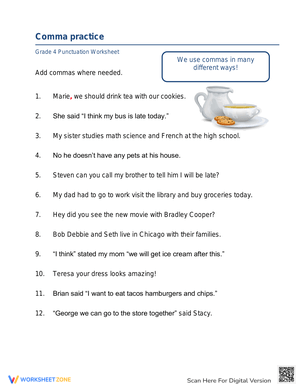
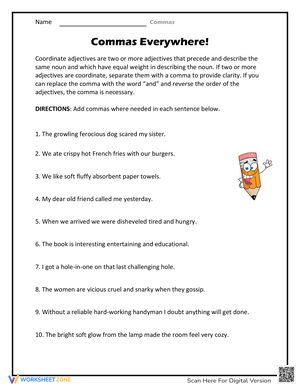
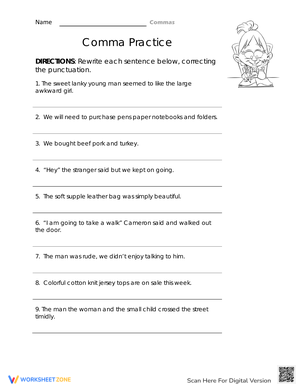
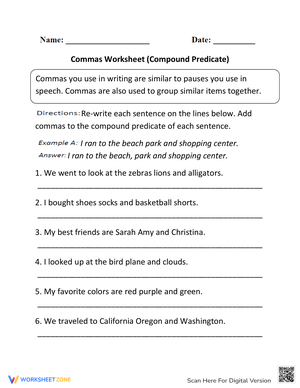
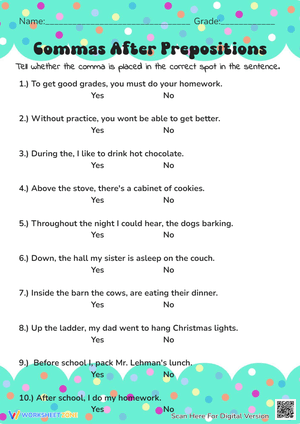
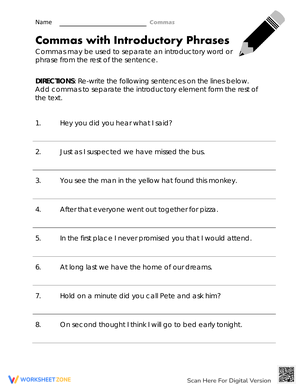
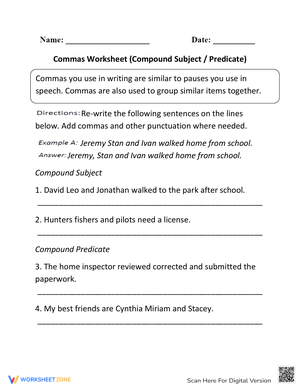
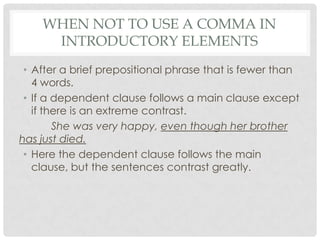
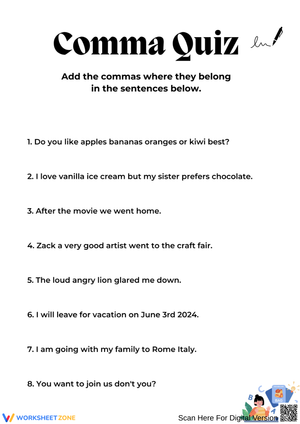
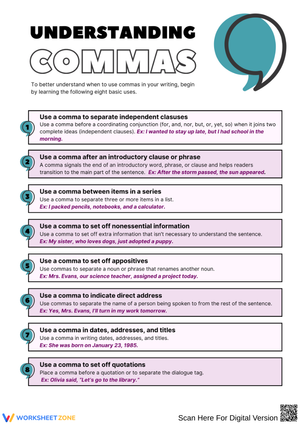
- Introductory elements: Commas after single adverbs, short prepositional phrases, and longer dependent clauses, so students learn that the opener's type drives the rule, not its length.
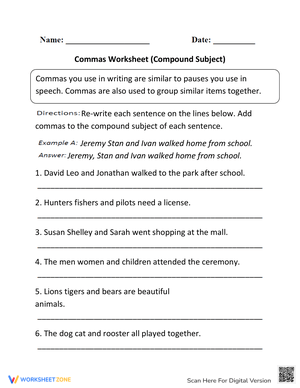
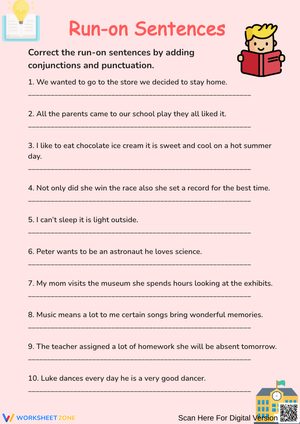
- Compound sentences: Two independent clauses joined by a coordinating conjunction, alongside examples where one "clause" is actually a phrase — a distinction that changes the punctuation entirely.
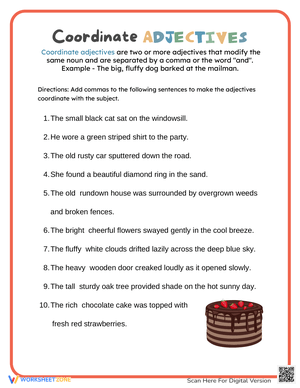
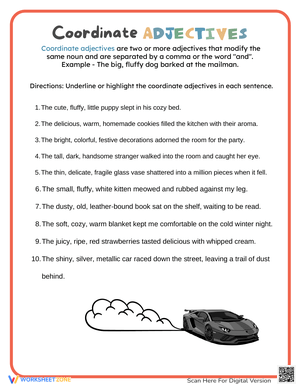
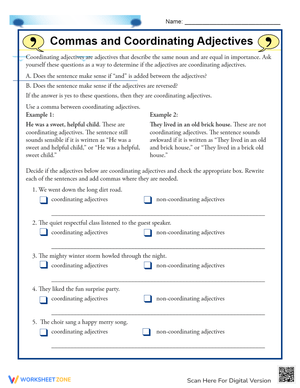
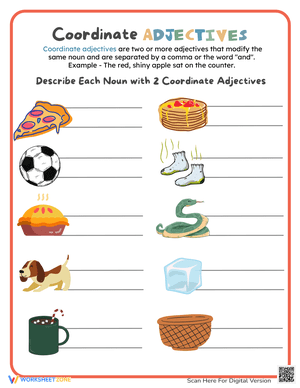
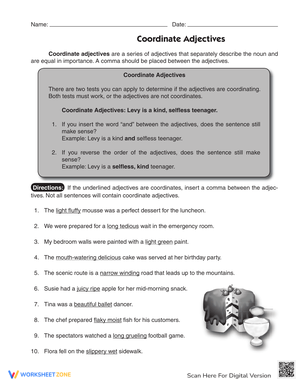
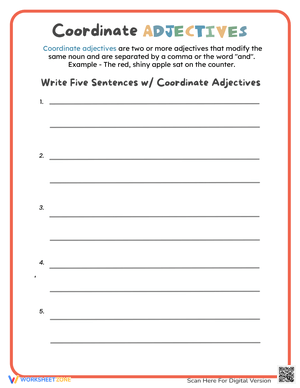
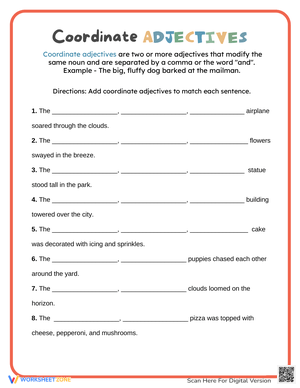
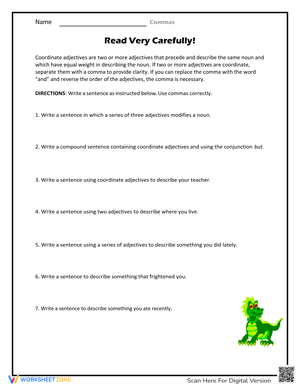
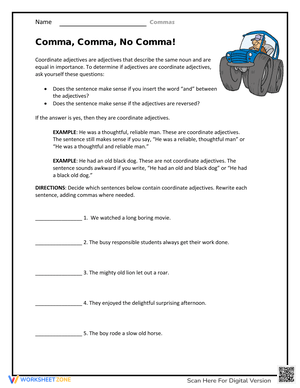
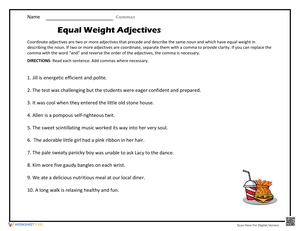
- Coordinate adjectives: Students apply the order-swap test and the and insertion test to decide when a comma between two adjectives is required, optional, or wrong.
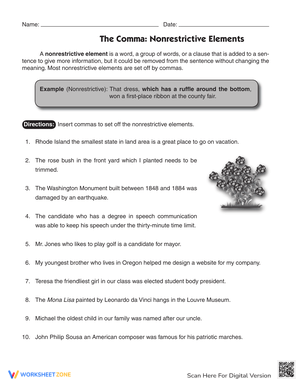
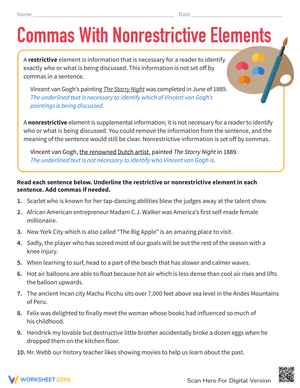
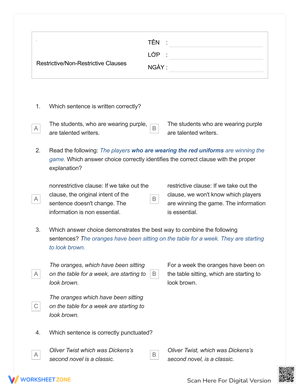
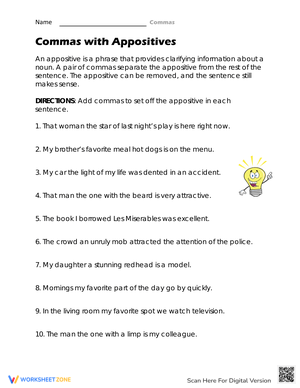
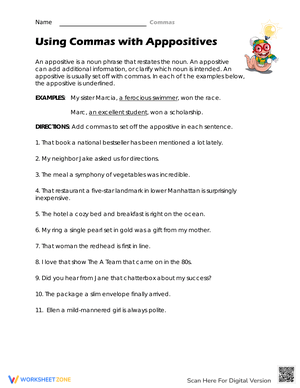
- Nonrestrictive and parenthetical elements: The Language 6.2a grade-level anchor — phrases and appositives that add information without changing the sentence's core meaning, requiring commas on both sides.
- Comma splices beside correct comma use: Side-by-side examples that train students to see the difference between a valid comma rule and a sentence-boundary error that belongs in a different lesson.
When 6th grade commas worksheets address this full range of patterns, teachers collect meaningful information about whether a student is missing commas, overusing them, or confusing a punctuation rule with a structural error that a different lesson needs to target.
What Student Comma Errors Actually Look Like
The error pattern that appears most consistently across sixth-grade writing: students who handle commas in a series correctly still produce comma splices in the same paragraph. They have internalized "commas go between list items" and extended that rule, incorrectly, to "commas can connect any two sentences." A student who writes "She revised the paragraph three times, it still felt incomplete" is not confused about whether commas exist — she has overgeneralized a rule that worked in a simpler context. Worksheets that place comma splices and correct compound sentences side by side force that distinction into view before it embeds itself in a draft.
Nonrestrictive elements produce a different and predictable error. Students often place the opening comma correctly — "My uncle, who coaches soccer" — and then drop the closing comma, producing a sentence that reads as only partially punctuated. During self-editing, students read for meaning rather than structure, so the missing comma stays invisible. Asking students to underline the extra-information phrase and then check for commas bracketing it on both ends makes the error findable before it transfers into independent writing.
Short introductory phrases create a third consistent problem. Students generally remember the comma after a long adverbial clause but omit it after "By Friday" or "In the hallway." No rule based on word count resolves this reliably — students need enough exposure to short openers that the pattern becomes automatic, which is why the introductory-element worksheets include both long and short examples rather than clustering around the obvious cases.
Fitting These Worksheets Into the Grammar Block
The most sustainable use of 6th grade commas worksheets is as bell ringers — three to five sentences targeting a single pattern, ready before students sit down. A Monday warm-up on introductory phrases, a Wednesday check on compound sentences, and a Friday paragraph edit give students spaced contact with each skill across the week without consuming independent writing time. That spaced return to the same pattern outperforms a single longer review session because students are re-accessing a rule they encountered earlier rather than meeting it fresh each time.
For intervention groups, sort students by error type before pulling the group. A student who drops commas after introductory phrases needs different practice than a student who creates comma splices. Each worksheet covers a narrow enough scope that two different groups can work simultaneously — one group with the introductory-element worksheet, the other with the comma-splice worksheet — while the teacher conferences with each group for roughly eight minutes before returning students to their drafts.
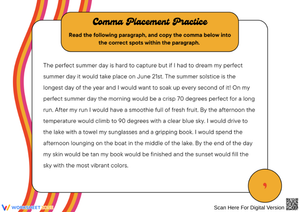
Exit tickets work best when the closing task is a short paragraph edit rather than isolated sentences. One paragraph with three comma decisions embedded in it shows whether students transfer a rule into running text, which is the version of the skill that actually appears in their own writing. The isolated sentence shows recognition; the paragraph edit shows application under realistic conditions.
Standard Alignment
Common Core State Standards for ELA, Language 6.2a is the direct anchor for this set. The standard requires students to use punctuation — including commas — to set off nonrestrictive or parenthetical elements. In classroom terms, that means students need to identify whether a phrase adds essential meaning or extra information, then punctuate accordingly. The nonrestrictive-element worksheets address that standard directly. The introductory-element and compound-sentence worksheets address patterns that many sixth graders have not yet consolidated — patterns that Language 6.2a implicitly depends on, because students cannot reason about nonrestrictive phrases if they are still uncertain about where independent clauses begin and end.
Using the Set With Students at Different Readiness Levels
Students who are still consolidating foundational patterns — commas in a series, basic introductory phrases — benefit from starting with the narrower single-rule worksheets before working with mixed examples. A sorting task — mark this sentence correct or incorrect, then name the rule being applied — builds pattern recognition without requiring students to generate punctuation from scratch. That step-by-step format reduces cognitive demand before students attempt paragraph-level editing, where several rules compete for attention at once.
Students who have foundational patterns under control gain more from the worksheets that combine two or three rules in a single paragraph. Asking these students to annotate each comma — labeling it "introductory," "compound," "nonrestrictive," or "splice error" — turns review into analysis. The annotation vocabulary also transfers directly into writing conferences, where a student can name what she was attempting in her draft rather than pointing at a sentence and saying something felt off. These 6th grade commas worksheets support that analytical work without requiring a separate enrichment handout.
For students who move through the set quickly, the most productive extension is not additional worksheets — it is returning to a recent draft with a single editing lens. Locate every introductory phrase and check the comma. Locate every compound sentence and check the conjunction pattern. That transfer task reveals whether the skill is genuinely internalized or only reliable in controlled practice conditions, which is the distinction that matters before a writing assessment.
Frequently Asked Questions
What comma rules are grade 6 students expected to know?
Grade 6 students need consistent control over commas in a series, after introductory elements, in compound sentences, around coordinate adjectives, and bracketing nonrestrictive or parenthetical elements. They also need to identify comma splices — knowing the difference between a correct comma and a sentence-boundary error is part of the grade-level expectation established by Language 6.2a.
How do these worksheets connect to actual student writing rather than isolated drills?
The most direct connection point is revision. After finishing a grammar worksheet, students scan their current draft for the same pattern — one introductory phrase, one compound sentence, one nonrestrictive element — and check whether their own comma use matches the rule. That two-minute transfer step keeps punctuation practice grounded in real drafting rather than treating grammar as a separate subject. During conferences, the worksheet examples also give teachers and students shared language to work from.
Can these worksheets serve students across a wide ability range in the same classroom?
Yes, with intentional assignment. Students who need foundational support start with the narrowest tasks — single-rule sentences — before moving to paragraph editing. Students who are ahead of grade level work on the combined-rule worksheets with an annotation requirement: label every comma by rule and find a matching example in their own draft. The set supports both uses without requiring the teacher to prepare separate materials for each group.
What is the practical difference between a nonrestrictive element and a comma splice?
A nonrestrictive element adds information that is genuinely extra — remove it, and the sentence still says what it needs to say. Commas set it off on both sides: "The principal, a former English teacher, reads student essays carefully." A comma splice joins two complete thoughts with only a comma and no coordinating conjunction — "The principal read the essay, she made notes in the margins." Both involve commas between substantial chunks of text, which is why students conflate them. The fix for each is entirely different: nonrestrictive elements need a second comma added, while comma splices need a period, semicolon, or a rewritten sentence. Showing both types in the same worksheet makes the contrast concrete rather than abstract.












 Interactive Worksheet Maker
 Quiz Maker
 Word Search Maker
 Crossword Puzzle Maker
 Word Scramble Generator
 Sentence Scramble Generator
 Handwriting Worksheet Generator
 Name Tracing Generator
 Fill In The Blank Generator