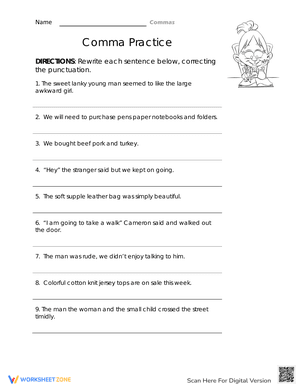
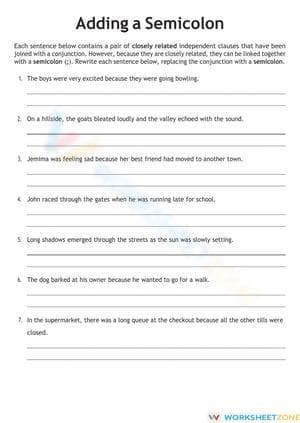
These punctuation printable worksheets for 6th grade give teachers a ready set of targeted editing practice — focused enough for a Monday warm-up, substantial enough for an intervention block. The set covers the punctuation decisions that actually stall sixth graders: commas inside complex sentences, marks that signal extra information, and dialogue punctuation that requires coordinating multiple rules at once. Teachers who have watched a class nail a comma rule during direct instruction and then miss it entirely in their own drafts will recognize exactly what this set is built to address.
What's Inside the Set
At grade 6, punctuation instruction stops being mostly about end marks and starts being about structure. Students need to understand that a comma after "Although she studied hard" isn't optional — it signals where the introductory clause ends and the main clause begins. That shift from rule-following to meaning-making drives the skill selection here.
- Introductory elements: Students add commas after opening adverb clauses and prepositional phrases, then compare how clarity shifts in versions with and without the mark.
- Nonrestrictive and parenthetical elements: Students identify extra information inside a sentence and choose whether commas, parentheses, or dashes best signal its status.
- Dialogue punctuation: Students edit spoken-word passages to place quotation marks, commas, and end punctuation correctly in relation to one another.
- Series and compound sentences: Focused tasks on comma placement where omission actually shifts reading — not just style.
- Mixed editing passages: Short paragraphs requiring multiple punctuation decisions, the format closest to what students face when revising their own writing.
Mixed editing is where the real diagnostic value lives. A student who fixes one error type in isolation but misses three different punctuation problems in a paragraph is giving useful information about how far understanding has transferred to new contexts — and that's worth knowing before students move into peer editing or longer revision tasks. It's also why punctuation printable worksheets for 6th grade belong in the resource folder across the full semester, not just during the grammar unit; the mixed editing tasks double as low-effort spiral review.
Common Student Mistakes Teachers Should Anticipate
The most persistent error in grade 6 punctuation work is not a missing period. It's the absent comma after an introductory clause. Students who correctly write "However, the plan failed" during a grammar exercise will write "Although she studied hard she failed the test" in a narrative draft without any hesitation. The rule practiced in isolation doesn't activate during independent writing — which is exactly why mixed editing tasks belong alongside single-skill practice rather than replacing it.
Parenthetical punctuation produces a different kind of confusion. Students often understand that extra information should be set off, but they default to parentheses for everything, even when dashes or commas would work better in context. Worksheets that ask students to choose among all three options and then explain the choice surface this misunderstanding faster than tasks that only ask them to insert one specific mark.
Dialogue punctuation is the third reliable trouble spot. The error pattern is almost always identical: end punctuation placed outside the quotation mark. Students write She said, "I'm ready". instead of She said, "I'm ready." That detail is worth naming explicitly before students encounter it in an editing task, because the error and the correction look nearly the same at a glance and students often read right past the difference.
Standard Alignment
The anchor standard for this set is CCSS.ELA-LITERACY.L.6.2a, which requires students to use commas, parentheses, and dashes to set off nonrestrictive or parenthetical elements. That's a named, grade-specific target — not a general punctuation review. At grade 5, students anchor comma use to items in a series and compound sentences. At grade 6, the work shifts toward understanding what makes information nonrestrictive in the first place, then choosing the mark that signals it most clearly. Every editing task in this set reflects that progression.
A useful way to think about L.6.2a in classroom terms: it's a bridge skill. When students punctuate a parenthetical element correctly, they're not only placing a mark — they're demonstrating that they can identify which information in a sentence is central and which is supplemental. That's a reading comprehension skill as much as a grammar skill. Worksheets that ask students to verify that a sentence's core meaning holds even after the extra information is removed make that connection visible in a way that rule-recitation tasks simply don't.
How to Build These Worksheets Into Your Lesson Plans
Bell ringers are the most natural entry point. Post one editing sentence, give students three or four minutes to work independently, then spend the next five on reasoning — not just the right answer. Asking "Where does the introductory clause end?" is more useful than "Put the comma after morning." That distinction, practiced consistently over several weeks, builds the sentence awareness that eventually transfers into drafting and revision without prompting.
Small-group reteach is where targeted single-skill worksheets pay off most clearly. After a writing assignment, pull students who consistently omitted commas in opening clauses or who mishandled dialogue punctuation, and assign the corresponding focused worksheet. Because the tasks are short, a group can usually work through one and discuss their answers in about eight minutes — enough time during an independent block while the rest of the class moves forward.
For spiral review, the mixed-editing worksheets work well in a Friday rotation. Students encounter the same skill types in new sentences, which is low-stakes retrieval practice without the feel of a test. Running this format every week or two prevents the common pattern where students demonstrate mastery in November and then produce comma-less introductory clauses again by February — not because they forgot, but because they haven't been asked to activate the skill in a few weeks.
Adjusting the Set for a Range of Learners
For students still inconsistent with basic comma use, start with the introductory-element worksheets before moving to parenthetical choices. The conceptual leap from "comma after an opening phrase" to "choose among commas, dashes, and parentheses for extra information" is genuine — rushing to the three-option tasks before students are solid on the simpler skill creates confusion that can look like resistance or indifference when it's actually a sequencing problem.
Advanced students get the most from tasks that ask them to generate rather than only correct. After completing an editing worksheet, they can rewrite two corrected sentences using a different acceptable mark — dashes instead of commas, parentheses instead of dashes — and explain in one sentence why both versions are grammatically defensible. That moves practice from editing into actual punctuation decision-making, which is closer to what skilled writers do.
Students who find multi-sentence editing passages difficult, whether from fluency gaps or processing differences, benefit from working with one or two sentences at a time. Covering the rest of the worksheet so only a small portion is visible reduces the visual load without simplifying the content. The task stays grade-level; the format becomes less overwhelming. It's a small adjustment that costs nothing and often unlocks — no, let me rephrase — that often gets students started who would otherwise freeze before writing anything.
Frequently Asked Questions
What punctuation skills should 6th graders be working on?
Grade 6 punctuation work extends well past end marks. The key skill area at this level is L.6.2a — using commas, parentheses, and dashes with nonrestrictive and parenthetical elements. That's paired here with introductory clause commas, dialogue punctuation, and mixed editing tasks that ask students to apply multiple rules in a single passage. Together those skills reflect what sixth graders encounter in both grammar instruction and writing revision.
How do these worksheets connect to Common Core grade 6 language standards?
The set is built around CCSS.ELA-LITERACY.L.6.2a, the standard that specifically names commas, parentheses, and dashes as tools for marking parenthetical and nonrestrictive elements. The mixed editing tasks also touch L.6.2b by asking students to read for and correct standard English conventions in context, since students editing for punctuation are also reading for meaning and standard written form at the same time.
Are these worksheets useful for test prep?
Standardized assessments at the middle school level regularly include editing and revision tasks that mirror the formats here — identify the error, correct the sentence, choose the best revision. These punctuation printable worksheets for 6th grade give students repeated exposure to sentence-level decision-making in a format that closely matches what assessments actually ask. The most effective routine is to have students correct the sentence, name the rule they applied, and explain in one sentence how the revision reads more clearly than the original — that turns an editing task into a short writing-convention conversation.
Can these worksheets support intervention or reteaching after writing assignments?
That's one of the strongest use cases in the set. After returning a writing draft, identify the punctuation errors that appeared most often and assign the corresponding focused worksheet as a follow-up. Students see the direct connection between the grammar practice and their own writing, which makes the work feel purposeful rather than arbitrary. These punctuation printable worksheets for 6th grade are short enough to complete in a single intervention session and specific enough to address one clear skill gap at a time — which is exactly what reteaching after a writing assignment requires.















 Interactive Worksheet Maker
 Quiz Maker
 Word Search Maker
 Crossword Puzzle Maker
 Word Scramble Generator
 Sentence Scramble Generator
 Handwriting Worksheet Generator
 Name Tracing Generator
 Fill In The Blank Generator