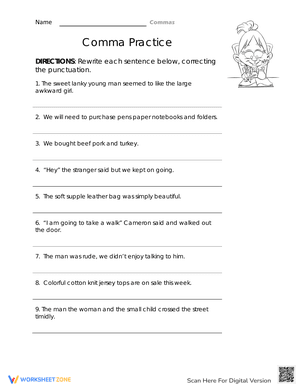
These commas with coordinate adjectives printable worksheets for 6th grade give teachers a focused, reusable tool for one of the comma decisions students most often get wrong. Each worksheet moves through a clear sequence: students identify the adjective pair, mark the noun being modified, apply two quick tests—reverse the order and insert and—then use that reasoning to add, remove, or confirm a comma. The set also asks students to put their reasoning in writing, which closes the gap between answer-marking and genuine understanding of the rule.
Skills Each Worksheet Builds
The identification work starts narrow. Students underline adjective pairs, mark the noun, and test whether both adjectives describe that noun equally or whether one adjective is defining the noun's type or category. That distinction—equal description versus fixed hierarchy—is the whole rule. Phrase-level practice comes first on each worksheet, which keeps the number of variables low before students move into full-sentence editing where sentence structure adds more to track.
- Identifying coordinate and noncoordinate adjective pairs in noun phrases and complete sentences
- Applying the reverse-order test and the and-insertion test as a two-step check
- Distinguishing coordinate pairs (cold, rainy morning) from noncoordinate ones (three rainy days, small wooden desk)
- Inserting, removing, or confirming commas based on what both tests show
- Writing brief explanations of each punctuation decision
- Editing sentences that mix both types of adjective pairs
Where Sixth Graders Go Wrong With Adjective Commas
The most consistent error at this level is comma addition by feel. Students who have absorbed the general message that "commas sometimes go between adjectives" start inserting them after the first adjective whenever the phrase carries strong description. A student who correctly punctuates a long, difficult climb will still write a bright blue sky with a comma between "bright" and "blue"—because both words sound like genuine descriptors, and nothing in a quick read flags the error.
The harder cases involve an adjective that names quantity, age, material, or category. Phrases like several large boxes, old brick house, and blue cotton shirt look like comma candidates to students who haven't used the reverse test. When they try "brick old house" or "cotton blue shirt" out loud, the awkwardness usually settles the question—but that only works if students have practiced applying both tests deliberately rather than reading through sentences and guessing.
There is also a pattern with students who skip the tests entirely and trust their ear when reading silently. Requiring a written explanation—even one sentence—makes that habit visible fast. When a student writes "it sounded right," that is a diagnostic moment. When a student writes "I reversed them and it still made sense," the rule is doing its job.
How to Fit These Worksheets Into Daily Grammar Instruction
A six-sentence warm-up at the start of a grammar lesson is the most common use. Three coordinate pairs, three noncoordinate pairs—students correct them independently, then compare with a partner on the one or two they were least certain about. That 10-minute block surfaces disagreement naturally, and the sentences that generate the most discussion are usually the ones worth projecting for a whole-class explanation.
These commas with coordinate adjectives printable worksheets for 6th grade also fit well into small-group instruction when students need more guided support. Project one sentence, model both tests aloud, then ask a student to try the next sentence using the same language: "I reversed them and it still worked, so the comma stays." That teacher-to-student-to-independent progression gives students a reusable sentence frame before they are expected to apply the rule on their own during revision.
For exit tickets, one sentence with a written explanation is enough. Students mark the comma decision and write one line defending it. Those responses sort into three groups in about two minutes—correct reasoning with correct punctuation, correct punctuation without reasoning, and incorrect—which gives a precise picture of where the class stands before the next lesson without requiring a formal quiz.
Standard Alignment
Under CCSS L.6.2, sixth graders demonstrate command of standard English punctuation across their writing, which in classroom terms means applying comma rules accurately during drafting and editing—not just recognizing them on grammar exercises. The coordinate adjective comma rule is one of the more nuanced applications within that standard, and it is exactly the kind of skill that slips without repeated exposure in real editing contexts. Teachers who pair these worksheets with drafting work are directly addressing the expectation that students transfer punctuation knowledge into their own sentences rather than treat grammar as a subject that lives only in worksheets.
Reaching Different Learners With the Same Set
For students still building confidence with the basic concept, phrase-level identification reduces the number of decisions they have to make at once. Short contrasting pairs—cold, rainy night versus three rainy nights—give students enough difference to work through both tests without parsing a full sentence. Building in the habit of saying the reverse-order version aloud before writing an answer is worth making explicit for this group; students who skip that step are nearly always the ones still guessing.
For students who move through identification quickly, the editing and revision tasks in the set provide more challenge. The most useful extension is asking those students to apply the two tests to sentences from their own writing—find any two-adjective combination, run the checks, and confirm or fix the punctuation. Using commas with coordinate adjectives printable worksheets for 6th grade as a bridge into student drafts rather than a standalone drill is where the rule tends to become durable. Students who only practice the rule in worksheets tend to remember it until the quiz; students who apply it to their own sentences carry it into the next writing unit.
Students who rely too heavily on rhythm and sound benefit most from the written explanation step. When they must write "I reversed them and it sounded wrong, so no comma," the requirement is specific enough that a vague sense of the phrase can't substitute for the actual test. These students are easy to identify in exit tickets—their explanations will either be blank or circular—and a targeted five-minute review using the two-test language is usually enough to redirect them.
Frequently Asked Questions
What makes adjectives "coordinate," and why does that matter in 6th grade editing?
Coordinate adjectives each describe the same noun independently—both apply directly to the noun rather than one modifying the other. Cold, rainy morning is the standard example: "cold" applies to the morning and "rainy" applies to the morning, so they coordinate and take a comma. Sixth grade is the point where students shift from recognizing grammar rules in isolation to applying them during revision of their own writing, which makes this comma rule practical rather than abstract.
How do the two tests work in practice?
Students reverse the adjectives and then try inserting and. If a long, difficult climb works as a difficult, long climb and a long and difficult climb, both tests pass and the comma belongs. If a blue cotton shirt becomes a cotton blue shirt or a blue and cotton shirt and sounds wrong, the tests fail and no comma is needed. Students who apply both tests in writing—not just in their heads—internalize the check significantly faster.
Can these worksheets be used without direct teacher instruction beforehand?
Each worksheet is structured so students can work through it independently: identify the adjective pair, apply both tests, punctuate, and explain. That stable task sequence makes each worksheet practical for homework, substitute plans, and morning warm-ups. The explanation step benefits from brief teacher modeling the first time a class encounters it, but after that initial introduction, students manage it without guidance.
Do these worksheets connect to actual student writing, or do they stay in grammar-drill territory?
These commas with coordinate adjectives printable worksheets for 6th grade connect directly to descriptive writing, which is exactly where students produce the richest two-adjective combinations. When students write about a setting or a character, they naturally generate phrases like a tall, narrow hallway or two old oak chairs—the same cases the rule governs. Teachers who assign one worksheet during a descriptive writing unit and then ask students to return to their drafts with the same two tests give the grammar practice an immediate purpose that isolated drill rarely provides.















 Interactive Worksheet Maker
 Quiz Maker
 Word Search Maker
 Crossword Puzzle Maker
 Word Scramble Generator
 Sentence Scramble Generator
 Handwriting Worksheet Generator
 Name Tracing Generator
 Fill In The Blank Generator