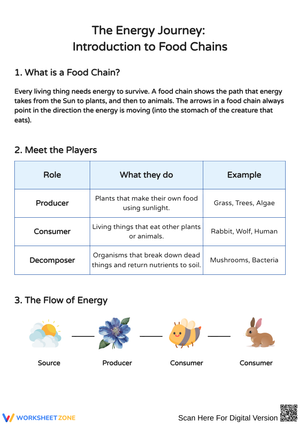
These 5th grade food chains printable worksheets give students something to label, cut, sort, and explain rather than another vocabulary list to copy. The set moves from naming producers and consumers to reasoning about what happens when one organism drops out of the chain — the harder thinking that fifth graders are ready for.
The Science Skills Each Worksheet Builds
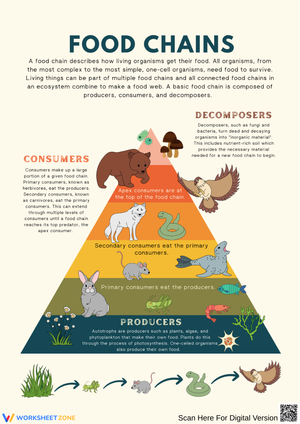
Fifth graders are expected to do more than point at a hawk and call it a carnivore. They need to trace energy from the sun through producers, primary consumers, and on up, and they need to say why the arrows point the direction they do. The worksheets target that progression directly.
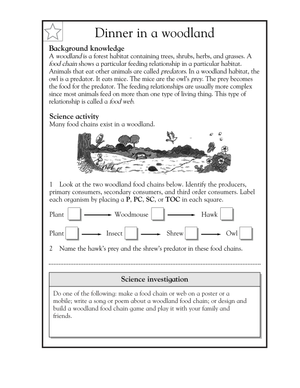
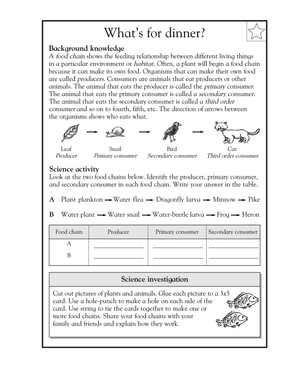
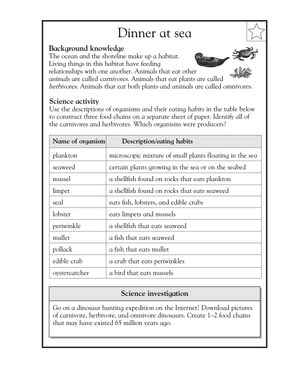
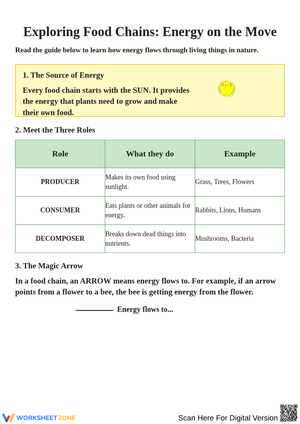
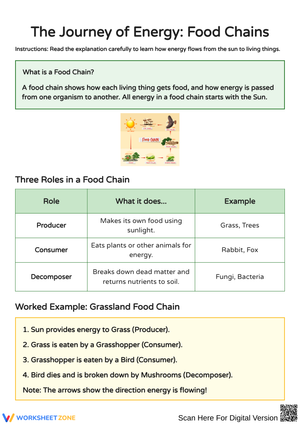
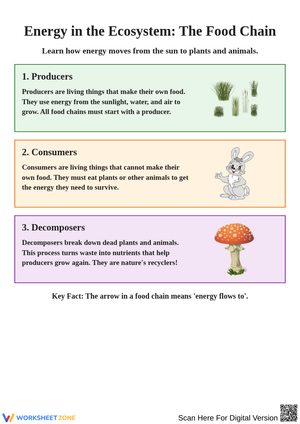
- Labeling tasks where students mark producers, consumers, and decomposers in a given chain
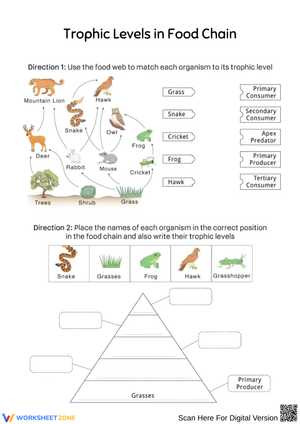
- Sequencing work that asks students to order organisms by who eats whom
- Cut-and-sort activities matching plants and animals to their ecosystem role
- Short reading passages paired with food chain questions
- Cause-and-effect prompts: if the grasshoppers disappear, what happens to the snakes?
The decomposer step is where the real understanding shows up. Students who breeze through grass-to-rabbit-to-fox often stall when asked where a dead fox's nutrients go. The worksheets keep returning to that question so decomposers stop feeling like an afterthought tacked onto the end of the chain.
Frequent Student Errors Worth Watching For
The most common mistake in fifth-grade food chain work is drawing arrows backward. Students will draw the arrow from the fox to the rabbit because, in their words, "the fox eats the rabbit, so it points to the rabbit." The arrow actually follows the energy, from the eaten to the eater. We correct this every year, and it sticks better when students narrate "energy goes to" as they draw rather than "eats."
A second error is treating the sun as a producer. Plenty of students label the sun as the first living thing in the chain because it comes first visually. The sun supplies energy but isn't an organism, and the worksheets that separate "energy source" from "producer" head this off before it hardens into a misconception.
The third one shows up when chains get longer. Students assume removing a top predator only affects the animals above it, and miss that the population below — say, the rabbits the fox used to eat — can balloon. Working through these 5th grade food chains printable worksheets with a complete chain in front of them, then crossing out one organism, makes that ripple visible instead of abstract.
Working These Worksheets Into a Science Sequence
Rather than handing out the whole set at once, spread it across a short ecosystems unit. Day one, project a simple chain and use a labeling worksheet to introduce the core roles. Day two, hand pairs a cut-and-sort version so they have to argue out loud about whether the worm is a consumer or a decomposer. Day three, move to a habitat-specific worksheet — pond, forest, desert, ocean — where students build a chain themselves. Day four, use a written-response worksheet that asks what happens when a population shifts.
One move that pays off: keep a single local ecosystem posted on the board for the whole cycle. When students return to the same meadow or pond on every worksheet, they stop burning energy decoding a brand-new setting and put that effort into explaining the roles and the energy flow instead. For a substitute day, the sequencing and role-matching worksheets run themselves — students know what to do without much front-loading.
Adjusting the Set for a Range of Learners
The science target stays the same across the room; what changes is how much support sits on the worksheet. Students who need more get a word bank, arrows already drawn, and a small picture beside each organism so the reading load doesn't block the science. On-level students label the roles, complete the chain, and answer one explanation question.
For students ready to push further, ask them to turn a single chain into a small food web and explain why one rabbit might have two predators, or to predict the full chain reaction of removing a producer. This is also where the 5th grade food chains printable worksheets work well in an intervention block — same topic, lighter text, more picture cues — without singling anyone out.
Standard Alignment
These worksheets support NGSS 5-LS2-1, which asks students to develop a model describing the movement of matter among plants, animals, decomposers, and the environment. That standard lands in fifth grade because students are finally ready to model a system rather than memorize isolated facts — they can hold the idea that matter and energy keep cycling rather than disappearing. The labeling and arrow work builds the model-reading skill, while the cause-and-effect prompts get at the "movement of matter" piece the standard emphasizes. The food-chain-to-food-web extension also touches 5-LS2-1's expectation that students recognize multiple feeding relationships in one ecosystem.
Frequently Asked Questions
How do I explain food chains versus food webs without confusing students?
Start with a chain as one path of energy, then show that most animals eat more than one thing. A food web is several chains overlapping in the same ecosystem. The cleanest way to make it click is to have students finish a chain first, then add a second food source for one animal — they watch the chain become a web themselves.
Which worksheets work best for science centers?
The cut-and-sort and sequencing worksheets are strongest at centers because they invite conversation and are fast to check at a glance. Students physically move organisms into roles, which surfaces their reasoning in a way a fill-in-the-blank never does. For homework, the short reading-and-response worksheets travel well since families don't need extra materials.
How early in the unit can I use these?
Day one. The labeling worksheet with a word bank works as an introduction right after you project an example, and the cut-and-sort version fits naturally once students know the three roles. Save the population-change and food-web worksheets for later in the week once the basic vocabulary is solid, since those depend on students already trusting the direction of the arrows.












 Interactive Worksheet Maker
 Quiz Maker
 Word Search Maker
 Crossword Puzzle Maker
 Word Scramble Generator
 Sentence Scramble Generator
 Handwriting Worksheet Generator
 Name Tracing Generator
 Fill In The Blank Generator