


























Views
Downloads

Essential Grade 5 Food Chains at Sea Science Worksheet
Paste this activity's link or code into your existing LMS (Google Classroom, Canvas, Teams, Schoology, Moodle, etc.).
Students can open and work on the activity right away, with no student login required.
You'll still be able to track student progress and results from your teacher account.
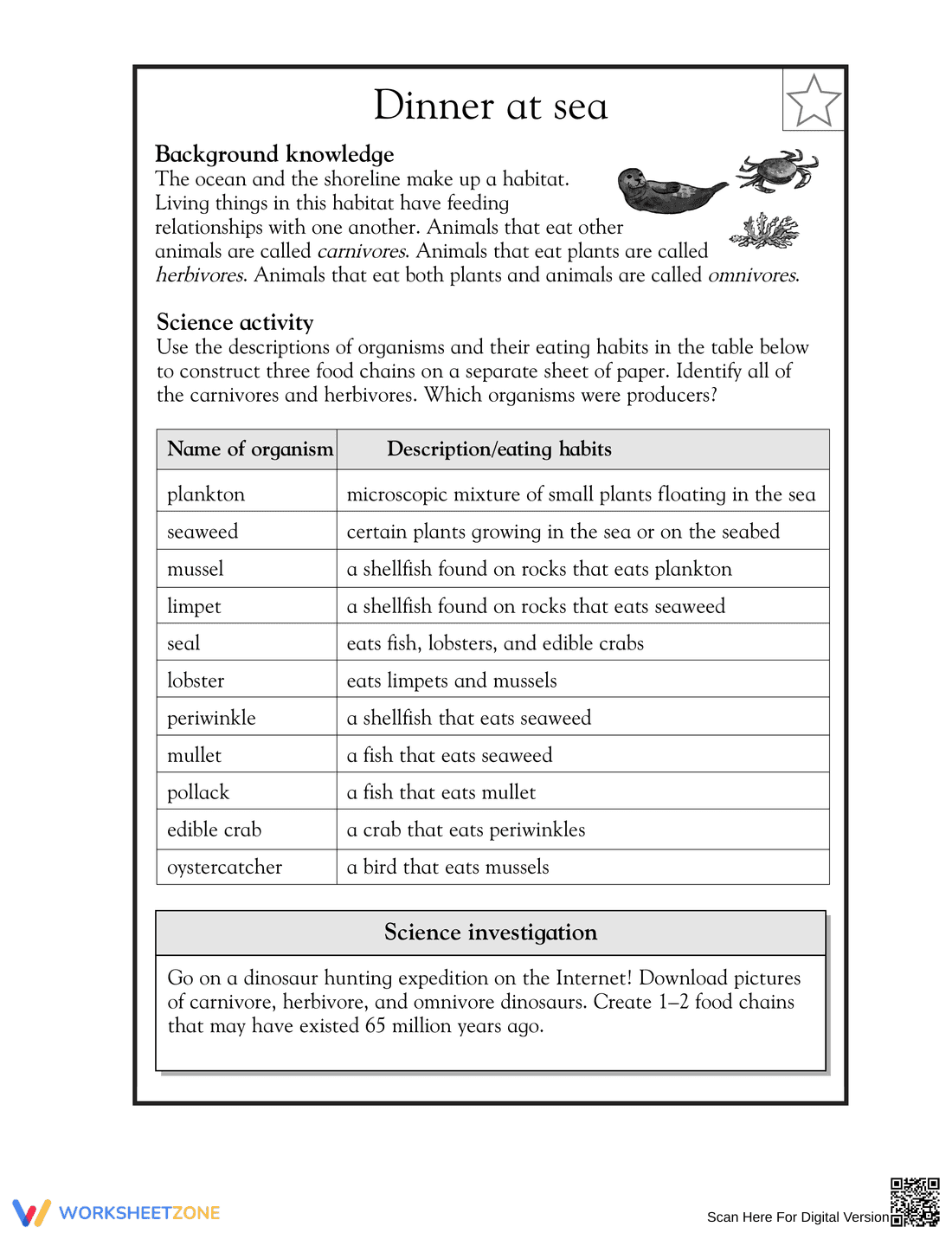
Identify and model the flow of energy in marine ecosystems with this comprehensive Grade 5 science worksheet. Students transition from reading informational text about aquatic habitats to actively constructing three distinct food chains using a detailed data table of sea organisms. This activity ensures learners grasp the fundamental roles of producers, herbivores, and carnivores in nature.
At a Glance
- Grade: 5 · Subject: Living Things
- Standard:
5-LS2-1— Develop a model to describe the movement of matter among organisms- Skill Focus: Food Chain Construction
- Format: 1 page · 11 organisms · Answer key included · PDF
- Best For: Independent practice or science centers
- Time: 20–30 minutes
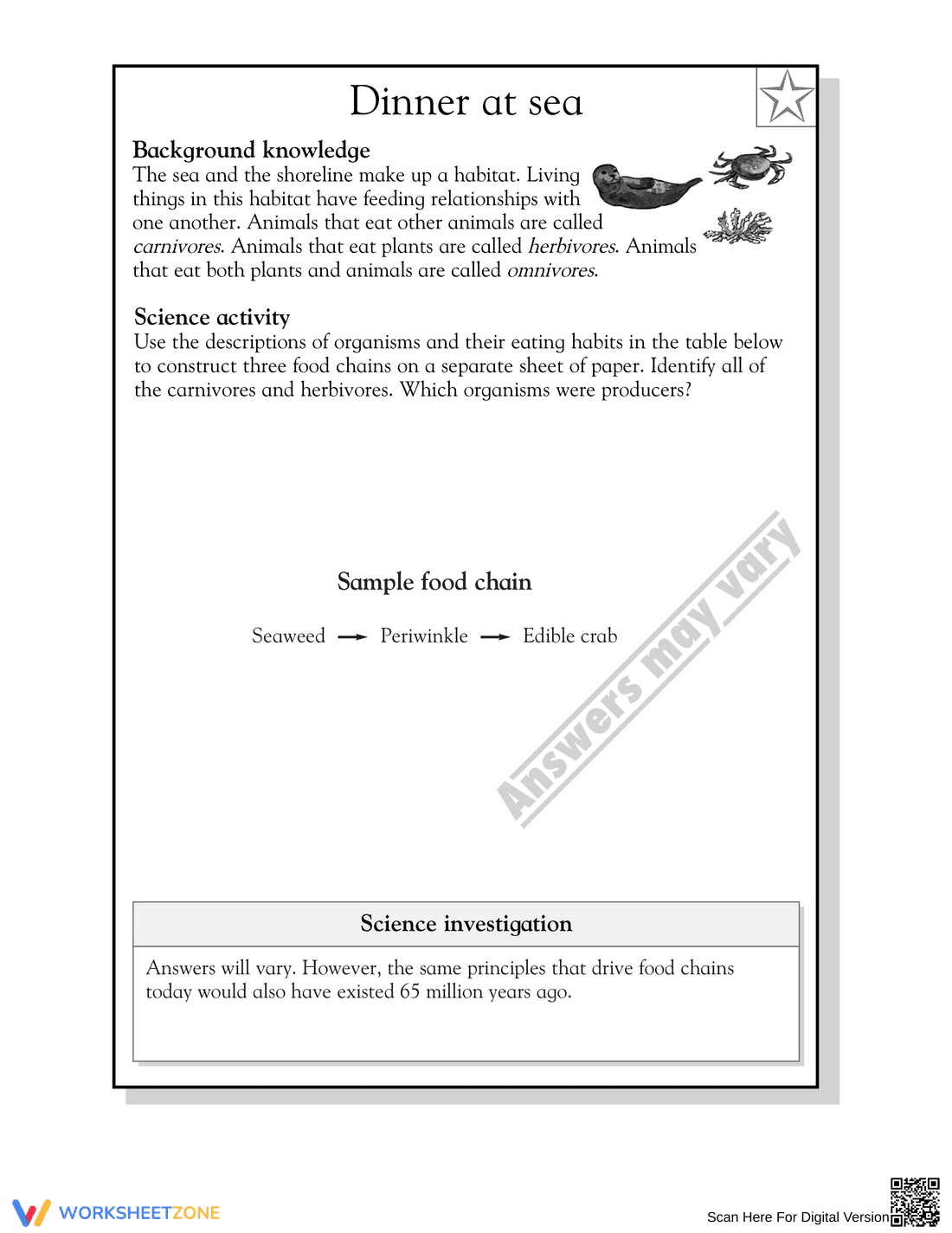
This single-page worksheet includes a "Background Knowledge" section defining carnivores, herbivores, and omnivores. The "Science Activity" provides an 11-row data table of marine organisms and their eating habits. Students use these facts to construct three unique food chains. An extension tasks students with researching prehistoric food chains.
Zero-Prep Workflow
Designed for a high-impact, zero-prep experience, educators simply print and distribute. Students read background text and organism tables (approx. 5 min), then construct three food chains (approx. 20 min). Ideal for emergency sub plans or quick formative assessments in a life science unit.
Standards Alignment
This resource is directly aligned to 5-LS2-1: "Develop a model to describe the movement of matter among plants, animals, decomposers, and the environment." By requiring students to interpret eating habits and organize them into linear models, the worksheet provides concrete practice in illustrating how matter and energy circulate through an ocean habitat. Both standard codes can be copied directly into lesson plans, IEP goals, or district curriculum mapping tools.
How to Use It
Deploy this worksheet during the "Explain" phase of a lesson on ecosystems. As a formative assessment, observe if students correctly identify plankton and seaweed as producers first. For a collaborative extension, have students compare their food chains in pairs to see if they discovered different combinations from the 11 provided organisms. This allows for a natural transition into discussing more complex food webs and the interconnectedness of marine life.
Who It's For
This activity is designed for fifth-grade students exploring life science and ecology. It is particularly effective for visual learners who benefit from seeing data organized in tables before translating it into diagrams. For differentiation, provide struggling learners with the first link of each food chain to scaffold the construction process. It pairs naturally with an anchor chart on trophic levels or a short video on marine biodiversity.
Understanding food chains is a critical prerequisite for grasping broader ecological concepts like biodiversity and sustainability. This Grade 5 worksheet applies research findings by presenting 11 marine organisms in a clear format that helps students focus on the logic of energy transfer. By identifying the specific roles of plankton, herbivores, and carnivores, learners build foundational skills for meeting the 5-LS2-1 standard. This exercise moves beyond rote memorization, requiring students to synthesize information and develop their own models of the natural world, fostering long-term skill mastery. Educators can rely on this resource as a validated tool for classroom-ready science instruction.


