


























Views
Downloads


Essential Grade 5 Food Chain Worksheet | Science Aligned
Paste this activity's link or code into your existing LMS (Google Classroom, Canvas, Teams, Schoology, Moodle, etc.).
Students can open and work on the activity right away, with no student login required.
You'll still be able to track student progress and results from your teacher account.
Essential Grade 5 Food Chain Worksheet
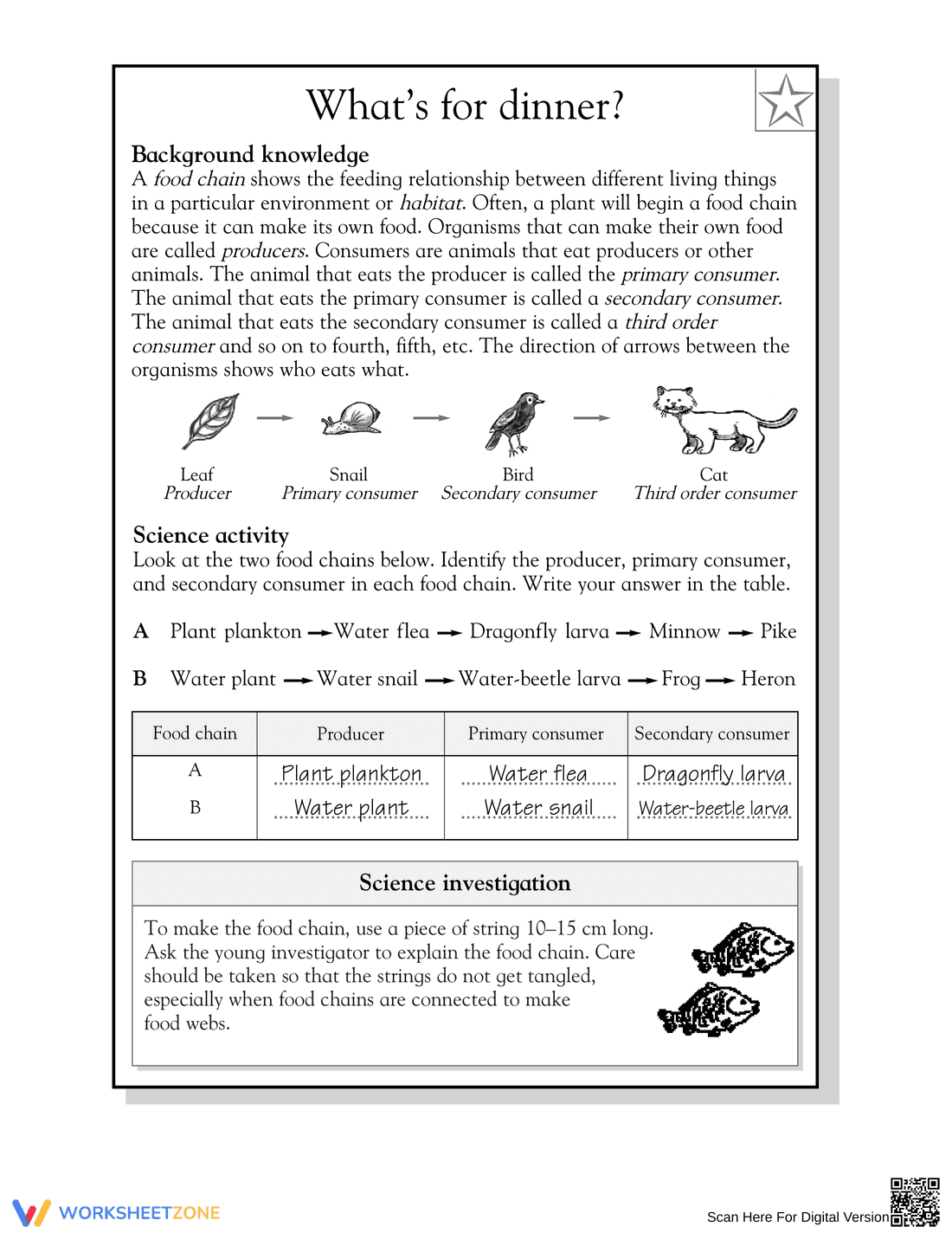
This Grade 5 science worksheet enables students to master the foundational concepts of energy transfer by identifying producers and consumers within specific biological ecosystems. Students will learn to distinguish between primary, secondary, and tertiary consumers through structured analysis and a hands-on investigation that reinforces the interconnectedness of habitats. It is a perfect addition to any life science unit focusing on ecological relationships.
At a Glance
- Grade: 5 · Subject: Living Things
- Standard:
5-LS2-1— Develop a model to describe the movement of matter among plants and animals- Skill Focus: Food Chain Component Identification
- Format: 1 page · 7 tasks · Answer key included · PDF
- Best For: Independent practice or introductory science lesson
- Time: 15–25 minutes
Inside this resource, you will find a comprehensive background knowledge section that defines key vocabulary like habitat, producer, and primary consumer. The worksheet features two distinct food chain scenarios (aquatic and terrestrial) for students to analyze in a tabular format. It concludes with a creative science investigation task requiring students to construct their own physical food chain models using cards and string, encouraging collaboration and verbal explanation.
The zero-prep workflow for this resource is designed for maximum classroom efficiency. Print the single-page PDF, distribute, and allow students to begin immediately. Review with the answer key during the last five minutes to check for understanding and clarify any trophic level confusion.
This worksheet is aligned to the Next Generation Science Standards, specifically 5-LS2-1, which requires students to describe how matter and energy move through an ecosystem. This standard can be copied directly into lesson plans or curriculum mapping tools for instructional compliance.
Integrate this resource as a formative assessment after a direct instruction lesson on ecosystems. Teachers can observe students as they fill out the identification table to identify misconceptions. Expect students to complete the analysis portion in 15 minutes, with an additional 10 minutes for the planning phase of the science investigation. This works perfectly as a quiet transition activity or a reliable substitute plan for a science block.
This resource is designed for Grade 5 students but remains accessible for Grade 4 enrichment or Grade 6 review. It is particularly effective for visual learners who benefit from clear diagrammatic representations. Pair this worksheet with a short non-fiction passage about local wildlife or an anchor chart displaying trophic levels to deepen student engagement and long-term retention of these critical scientific concepts.
According to ScienceDirect TpT Analysis, structured science worksheets that combine theoretical background with practical application significantly improve student retention of ecological hierarchies. This Grade 5 resource addresses the 5-LS2-1 standard by requiring students to model the movement of matter through producers and consumers. Identifying specific roles within aquatic and terrestrial food chains develops a concrete understanding of energy transitions. The inclusion of a hands-on investigation supports higher-order thinking by asking students to synthesize their knowledge into a physical model, which aligns with research suggesting that multisensory learning reinforces scientific vocabulary and concept mastery. This self-contained module provides a rigorous yet accessible path to ecological literacy, ensuring students can accurately describe feeding relationships in any given habitat. The clear definitions and structured tasks make it a reliable tool for both primary instruction and targeted intervention in the upper elementary science classroom.


