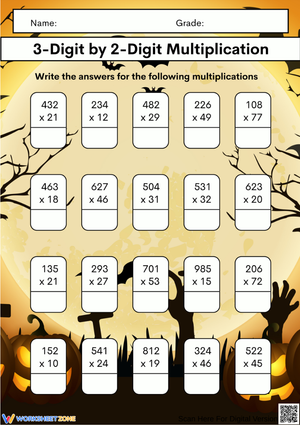
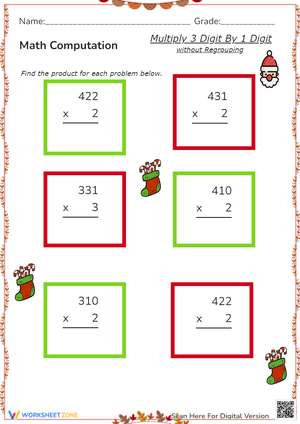
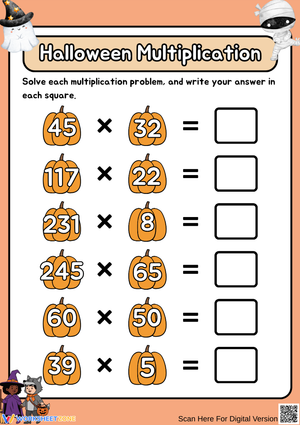
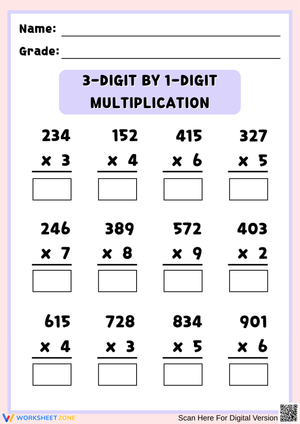
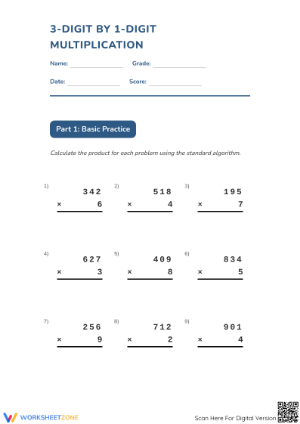
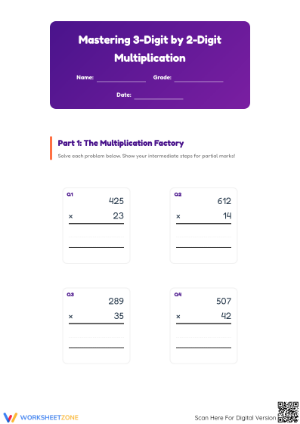
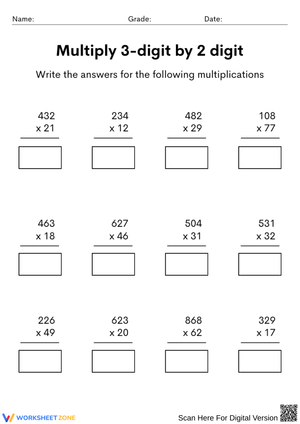
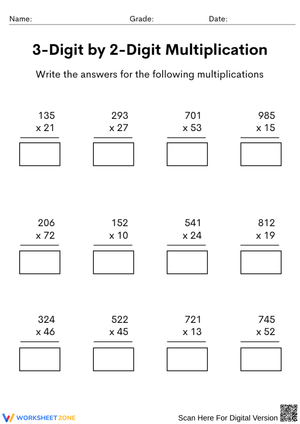
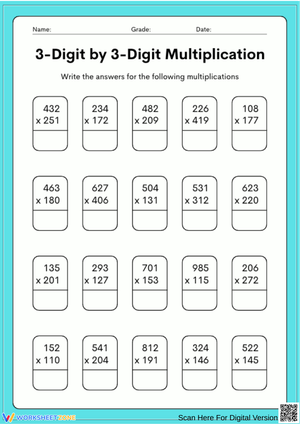
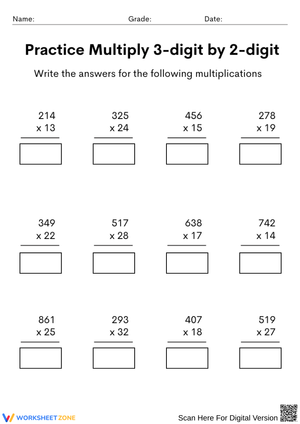
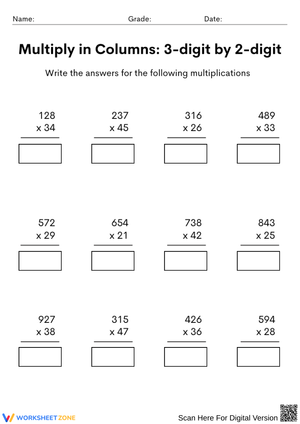
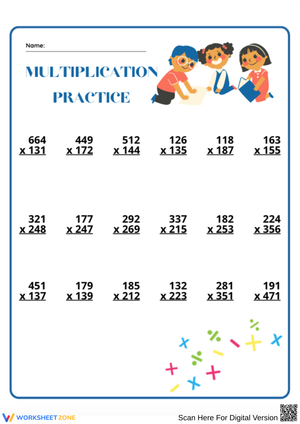
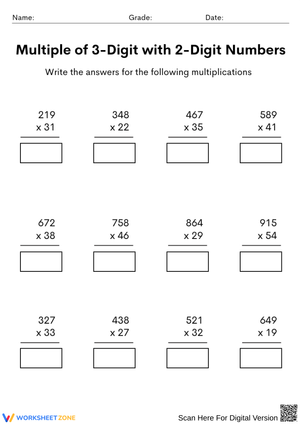
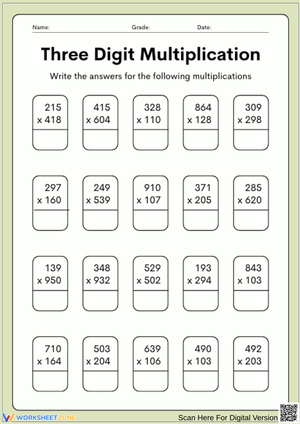
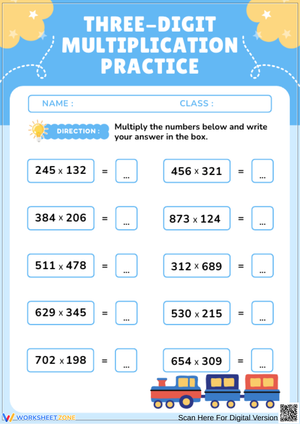
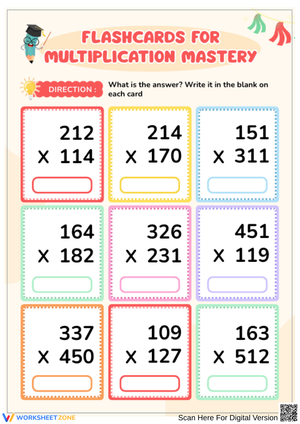
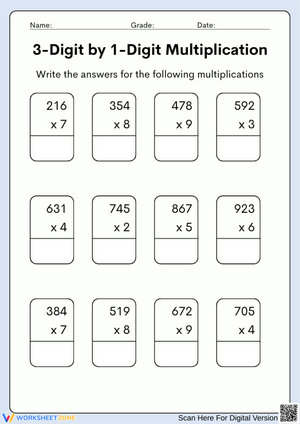
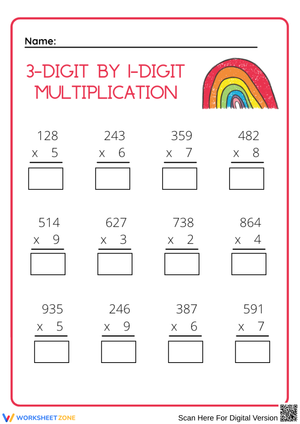
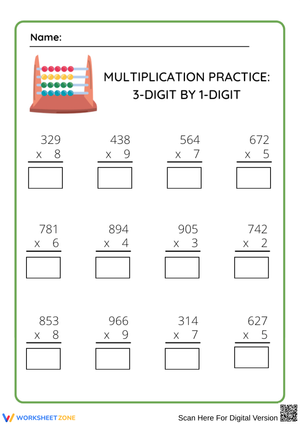
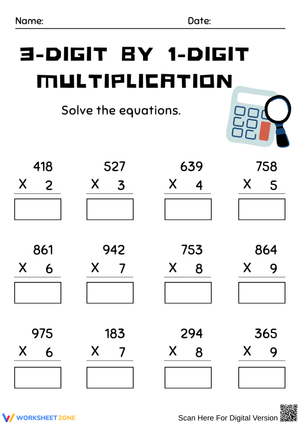
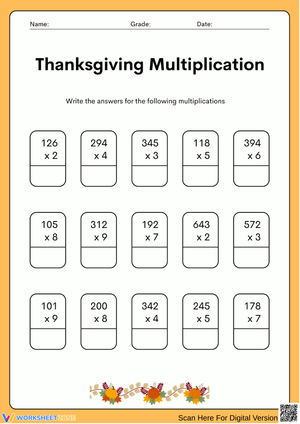
These 3 digit multiplication pdf worksheets for 5th grade give teachers a print-ready practice sequence that moves students from partial-product reasoning into fluent standard algorithm work — without requiring extra planning time to build the progression yourself. The set spans early supported practice through more independent, mixed-format problems, covering the full arc of what Grade 5 students need before multi-digit multiplication becomes automatic.
The Specific Skills Covered Across the Set
Each worksheet targets a concrete step in the multiplication progression rather than stacking every skill onto every problem set. Across the set, students work through:
- Multiplying a 3-digit number by a 1-digit factor with each partial product recorded in a labeled row
- Applying the standard algorithm to 3-digit by 2-digit multiplication, including accurate regrouping across place-value positions
- Using expanded form to keep place-value reasoning visible before compressing into the compact method
- Solving multi-step and word-problem items that ask students to choose and apply the right computation
The word-problem worksheets are worth flagging specifically. A student who multiplies 342 × 26 correctly in a bare computation format but blanks when the same numbers appear inside a context problem has a transfer gap — not a fluency gap. Including application problems in the set helps teachers distinguish between those two things before the unit ends.
Mistakes Students Make That Teachers Should Anticipate and Address
The most diagnostic error to watch for is the misplaced partial product. When a student multiplies 347 × 24, they may calculate the second partial product correctly — 347 × 20 — but record it starting in the ones column instead of shifting left to reflect the tens-place multiplier. The digits are right; the position is wrong. From a distance it looks like a facts error. Up close it is a place-value control problem, and treating it as a facts problem will not fix it. A worksheet sequence that keeps partial products in separate labeled rows for an extra week or two catches this pattern before it hardens.
The dropped zero in the second row of 2-digit multiplication is equally consistent. Students learn that the second row shifts left but many treat that as a procedural quirk rather than understanding why the shift occurs. When the tens digit of the multiplier is zero — as in × 30 or × 50 — the error rate climbs because students second-guess whether to apply the rule at all. Seeing several of these problem types in sequence, before the format changes, moves the correct procedure from tentative to automatic.
Fitting These Worksheets Into a Week of Instruction
The most natural entry point is the independent practice block that follows whole-group modeling. One worksheet gives students ten to fifteen focused problems while the teacher pulls a small group — and because the format is familiar after the first session, students stay on task without constant check-ins. That is not a small thing during a 50-minute block where the teacher is managing multiple groups at once.
Teachers who use 3 digit multiplication pdf worksheets for 5th grade as a center rotation find that the self-contained format keeps students focused on computation rather than on decoding multi-part instructions. Pairing one of these worksheets with a fluency card game or a review task makes for a solid rotation. For homework, each clean PDF worksheet gives families a direct model of the written method students are expected to use — which reduces the "my parent showed me a faster way" confusion that surfaces the next morning during warm-up.
Reteach groups benefit from returning to the partial-products worksheets even after the class has moved to the compact algorithm. Students who are still losing column control almost always stabilize faster when they spend a few more sessions writing out every sub-product in a labeled row before compressing. The set makes it easy to pull just those worksheets for a small group without rebuilding any materials from scratch.
Standard Alignment
The central standard is 5.NBT.B.5, which requires Grade 5 students to fluently multiply multi-digit whole numbers using the standard algorithm. Fluency at this grade level means accuracy, efficiency, and flexible application — not just memorized steps. Illustrative Mathematics Grade 5 materials, specifically the Unit 4 lessons on partial products in diagrams, make clear that efficient algorithm use is built through place-value understanding first. Students who jump directly to the compact method without that foundation tend to produce errors that are difficult to untangle during reteaching.
The worksheets in this set are ordered to match that instructional arc. Early worksheets keep partial products visible and labeled. Later ones move into the compact algorithm with decreasing built-in support. That ordering means the same set can cover introductory instruction and end-of-unit review depending on where in the unit a teacher enters.
Adapting the Set for Mixed-Ability Classrooms
For students still consolidating place value, the partial-products worksheets provide a structured intermediate step: sub-products for the hundreds, tens, and ones positions are written in separate rows before being summed. This reduces the number of simultaneous demands on working memory — which is where most students who struggle with multiplication are actually breaking down, not in the recall of basic facts.
The 3 digit multiplication pdf worksheets for 5th grade in this set include enough range that teachers can select by readiness level rather than printing everything for every student. Students approaching mastery benefit from worksheets that mix standard algorithm problems with a short word-problem section, keeping the practice from feeling mechanical and giving the teacher a quick read on whether computation skill transfers to applied contexts. For early finishers, the multi-step worksheets extend the work without requiring anything extra from the teacher. For students who need more repetition, the computation-focused worksheets hold up across multiple sessions because the numbers vary across each worksheet in the set.
Frequently Asked Questions
What standard do these worksheets address?
The primary standard is 5.NBT.B.5, which calls for Grade 5 students to fluently multiply multi-digit whole numbers using the standard algorithm. The sequence across the set — partial products first, standard algorithm with decreasing support second — reflects how Illustrative Mathematics and other research-aligned Grade 5 materials build toward that fluency expectation rather than starting with the algorithm cold.
Can these worksheets function as a diagnostic tool?
Yes. Because the worksheets keep partial products organized and visible, teachers can look at student work and see exactly where the calculation broke down — a wrong basic fact, a misaligned column, a missing placeholder zero. That information is far more useful for planning small-group instruction than a single wrong final answer, and it makes the next reteach session considerably easier to prepare.
Are these appropriate for both early instruction and unit review?
The range across the set makes both uses workable. Partial-products and expanded-form worksheets fit early instruction, when students need to see the place-value reasoning before it gets compressed. Compact algorithm and mixed-format worksheets fit review and pre-assessment. The 3 digit multiplication pdf worksheets for 5th grade in this set can serve at multiple points across the unit rather than functioning only as end-of-unit practice.
How do these fit into homework assignments?
The computation-focused worksheets tend to work best for homework — they are narrow enough that students can complete them independently, and the format is already familiar from class. Word-problem worksheets are better reserved for class time, where students can ask clarifying questions. Each clean PDF worksheet also shows families exactly how the written method should look, which cuts down on method-confusion the following morning.














 Interactive Worksheet Maker
 Quiz Maker
 Word Search Maker
 Crossword Puzzle Maker
 Word Scramble Generator
 Sentence Scramble Generator
 Handwriting Worksheet Generator
 Name Tracing Generator
 Fill In The Blank Generator




 BACK TOSCHOOL