Printable 3-Digit by 3-Digit Multiplication Practice for Grade 5
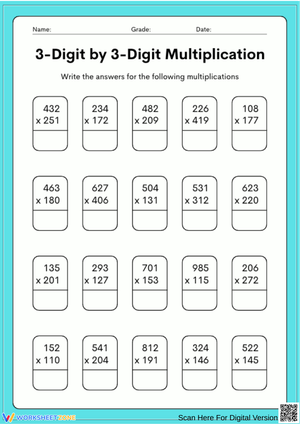
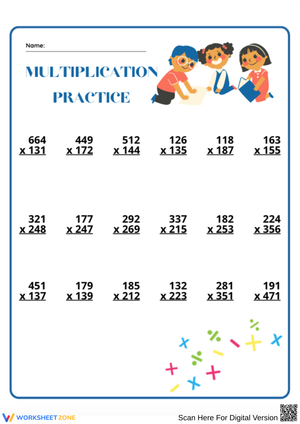
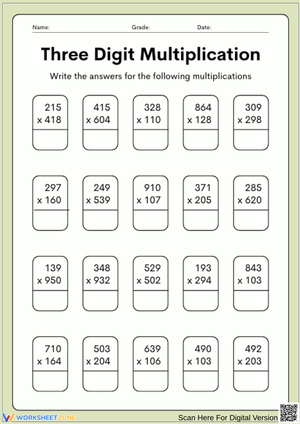
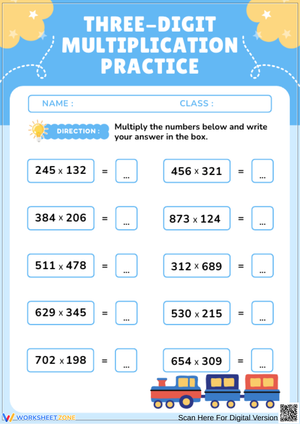
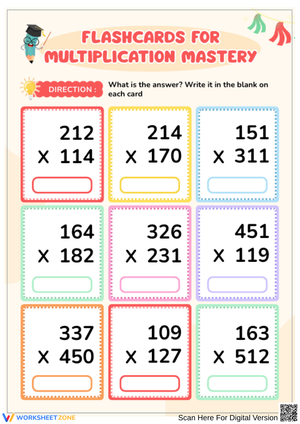
These 5th grade 3 by 3 worksheets give teachers exactly what the grade-level standard calls for: printable, column-format practice where students multiply a 3-digit number by another 3-digit number using the standard algorithm. The format moves from screen to student desk without extra prep — print, distribute, and the algorithm work begins. For classes in the middle of a multi-digit multiplication unit or heading into a unit review, these resources slot cleanly into the instructional sequence.
The Specific Skills Each Worksheet Builds
A 3-digit by 3-digit multiplication problem in column form asks students to manage four connected operations at once: reading the place value of each digit in the multiplier, multiplying across ones, tens, and hundreds in sequence, regrouping accurately at each stage, and combining partial products without losing alignment. Students who know their multiplication facts cold can still stumble here — not because the math is beyond them, but because the written process requires sustained precision across more steps than they have handled before.
The 5th grade 3 by 3 worksheets format — column layout, clear workspace, consistent problem structure — puts that full process on paper in a way that makes errors visible and addressable. A student who gets the ones row right but drops a zero in the tens row has not forgotten the algorithm; they have lost track of place value mid-problem. That is a different instructional need than a student misremembering basic facts, and a worksheet that captures all the written work exposes that difference cleanly.
For most fifth graders, the leap from 2-digit by 2-digit to 3-digit by 3-digit multiplication is not about learning a new method. It is about sustaining accuracy over more steps without losing focus. That distinction matters whether the class is in initial instruction, intervention, or end-of-unit review.
Student Mistakes Worth Catching Early
The most persistent error in 3-digit by 3-digit multiplication is not in the multiplication facts — it is in the recording. When students multiply the top number by the tens digit of the multiplier, they must shift the partial product one place to the left before writing it down. Many write the second row starting directly beneath the ones column, exactly where they placed the first row, and the resulting sum is off by a factor of ten. The final answer looks plausible but is consistently too small — close enough that students who are not checking for reasonableness will move on without noticing.
Regrouping compounds the problem. A student working the hundreds row carries a digit from the tens place, shifts focus to multiply the next digit, and the carry goes unrecorded. This is easy to miss on a quick scan because the rest of the row is correct. Teachers reviewing work should check specifically whether carries are written and then actually added in — not just whether the multiplication facts are right. When most errors in a class cluster in the second and third partial product rows rather than the first, the issue is procedural recording, and that points toward a focused reteach on written layout rather than fact drill.
Fitting These Resources Into Your Instructional Week
The most reliable place to fit a 5th grade 3 by 3 worksheets into instruction is the second half of a lesson — after explicit modeling and at least one guided problem — when students are ready to work independently while the teacher pulls a small group. By that point the algorithm is familiar enough that students do not need step-by-step support at their desks; what they need is focused repetition. Assign five or six problems, circulate for the first few minutes to flag alignment errors before they become habits, then use the remaining time to reteach in a small group while the class finishes.
For centers, each worksheet works well as the written component of a rotation — paired with a fact fluency activity at another station or a place-value estimation task. The problems are uniform enough that students can work without teacher support, which matters when the teacher is occupied elsewhere in the room. For homework, the format is self-contained: no materials, no setup, nothing a student needs to explain to a parent before starting.
- Post-lesson independent practice after two or three modeled examples with the class
- Small-group reteach with a shortened problem set — three problems, full written work required for each
- Math center written component, paired with a fact fluency or estimation activity
- Homework during the multi-digit multiplication unit when families need a clear print format
- Sub plans or end-of-unit review days — distribute without additional setup or explanation
Standard Alignment
These worksheets address CCSS 5.NBT.B.5, which requires fifth graders to fluently multiply multi-digit whole numbers using the standard algorithm. The standard sits in the Number and Operations in Base Ten domain and typically appears in the first half of fifth grade, after students have consolidated 2-digit by 2-digit multiplication and before instruction shifts to multi-digit division and decimal operations. "Fluently" in this standard means accurate, efficient, and consistent — not occasionally correct under close supervision. Repeated practice with 3-digit by 3-digit problems is one of the clearest routes to that fluency target because the algorithm stays constant while the number of steps increases enough to reveal exactly where precision breaks down.
Adjusting the Set for Different Learners in the Room
Students who are not yet steady with the full 3-digit by 3-digit algorithm benefit from a modified approach that keeps the grade-level target in place. Assign fewer problems — three or four rather than a full set — and let students refer to a completed example on the board or in their notes for the step sequence. Penciling in faint column lines before starting gives a visual anchor without doing any of the math for them. The skill stays at grade level; the reduction in cognitive load comes from limiting how many simultaneous decisions students manage at once, not from lowering the expectation.
Students ready for more can add a mental estimation step before each problem: round both factors to the nearest hundred, multiply, and write that estimate before computing the exact product. When their written answer lands well outside that range, they go back and find the error. This builds a checking habit that transfers directly to assessment contexts and later math work. For partner comparison, have students complete the same 5th grade 3 by 3 worksheets independently, then compare final products and trace any discrepancy back to a specific row or step. That kind of targeted side-by-side analysis tends to correct a misconception faster than a whole-class error review.
Frequently Asked Questions
What does "3 by 3 multiplication" mean in fifth-grade math?
It means multiplying a 3-digit whole number by another 3-digit whole number using the standard written algorithm. Students multiply the top number by the ones digit of the multiplier, then by the tens digit — shifting one place left — then by the hundreds digit — shifting two places left — and finally add all three partial products for the answer. The challenge is not any single multiplication fact; it is maintaining alignment and accurate regrouping across all three rows.
Are these worksheets aligned with grade 5 Common Core standards?
Yes. This skill maps directly to CCSS 5.NBT.B.5, which expects fifth graders to multiply multi-digit whole numbers fluently using the standard algorithm. The 3-digit by 3-digit format is a direct application of that standard — not enrichment — once students have built the place-value understanding the algorithm depends on.
What if students are still making errors with 2-digit by 2-digit problems?
Resolve that first before moving to this set. Students who have not stabilized the 2-digit algorithm carry those same errors into 3-digit problems, and the added complexity makes individual errors harder to isolate and fix. A short focused session with 2-digit by 2-digit practice — specifically targeting partial product placement and regrouping — typically closes the foundational gap more efficiently than pushing forward into harder problems.
Can these worksheets be used for homework or substitute plans?
Yes. The column format and consistent problem structure make each worksheet usable without teacher support on-site. Students who understand the algorithm can work independently, and the task requires nothing beyond pencil and paper. For substitute plans, the straightforward directions mean no additional verbal explanation is needed — the sub distributes the set and students know what to do.
Clear All