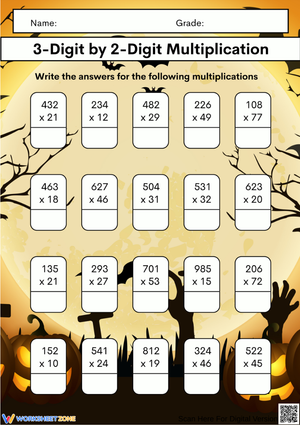
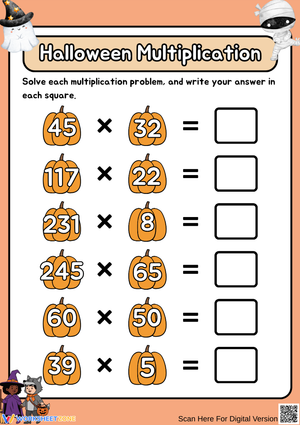
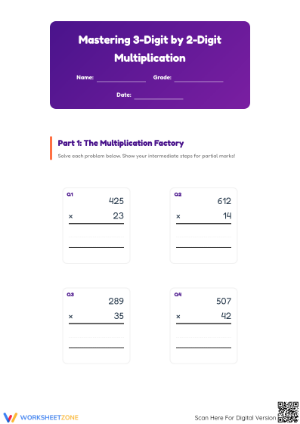
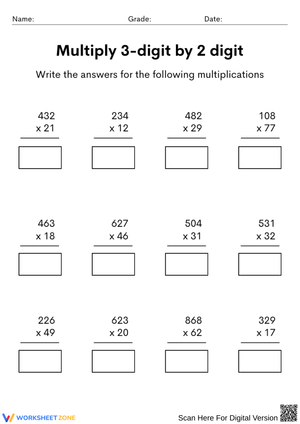
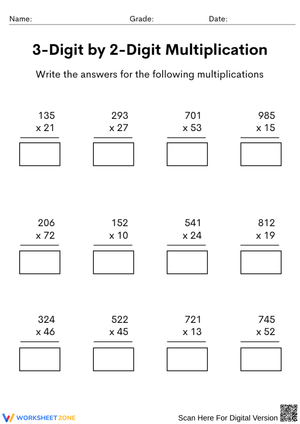
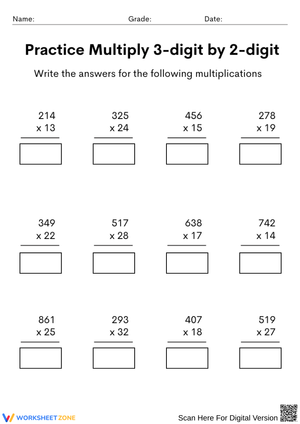
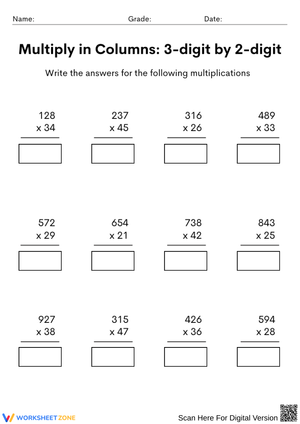
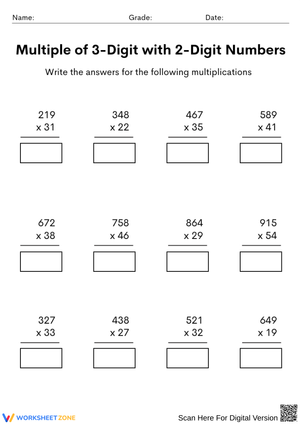
These 5th grade 3 digit 3 by 2 printable worksheets target a specific computational threshold — the moment when students move from relying on area models and partial product charts into executing the standard algorithm with accuracy and independence. The set keeps every problem the same type deliberately: one 3-digit factor, one 2-digit factor, full standard algorithm expected. That consistency is what makes the resources useful for diagnosis, not just drill.
The Specific Skills Targeted
Multiplying a 3-digit number by a 2-digit number asks students to coordinate several things at once. They must read each factor correctly, compute two separate rows of partial products, position the second row shifted one place to the left, manage regrouping across multiple columns, and then add the partial products without losing track of the tens or hundreds column. Most fifth graders can handle each of those steps in isolation. The breakdown appears when they have to run all of them in sequence without losing the thread.
The problem type also surfaces place-value reasoning that a mixed-operation review won't reveal as cleanly. When a student solves 347 × 26 and treats the 2 as another ones digit — producing two rows of equal magnitude — the written work shows something specific: they don't yet understand that the tens digit in the multiplier represents a value ten times larger, and that every product in that row shifts accordingly. A consistent problem type makes that gap visible faster than a broad unit test would.
Mistakes Students Make That These Worksheets Help You Catch
The most persistent error in this computation type is a misaligned second row. Students understand they are "doing something different" for the tens digit, but writing that second partial product starting directly under the ones column is common enough to plan for in advance. When you look at a class set and see that second row beginning under the ones column every time, that's a signal the shift was never fully understood — only watched once and assumed absorbed.
A separate pattern involves regrouping abandonment. Students who regroup correctly on two-digit by two-digit problems sometimes drop the carried value entirely when the problem grows longer. They work through the second or third column of the top factor, mentally carry a digit, then lose it by the time they've tracked back to their position in the row. Some students physically erase the regrouped digit after using it, unsure whether it carries forward. Watching for erased or overwritten carry marks tells you exactly where the cognitive load peaks for each student.
A third issue — less dramatic but worth anticipating — is factor transcription error. A student reads 473 × 28, writes 437 × 28, and solves the new problem correctly. The arithmetic is fine; the setup is wrong. One classroom fix: teach students to box each factor before starting any written work.
Standard Alignment
This set aligns directly with Common Core State Standards for Mathematics 5.NBT.B.5, which expects fifth graders to fluently multiply multi-digit whole numbers using the standard algorithm. The standard's placement at Grade 5 is deliberate: students have spent earlier grades building conceptual understanding of place value and multiplication properties, and the expectation now shifts toward efficient, reliable execution. A 3-digit by 2-digit problem is neither trivial nor unreasonably complex at this level — it requires enough steps to reveal whether the algorithm is understood structurally or performed by rote.
In classroom terms, 5.NBT.B.5 shows up in both core instruction and intervention contexts. Teachers planning a multi-digit multiplication unit typically introduce the standard algorithm through partial products, then work toward the compact form. Planning around 5th grade 3 digit 3 by 2 printable worksheets fits the second half of that arc, when students need volume practice under the full algorithm rather than continued work with visual models.
Building These Worksheets Into Your Lesson Plans
Tight routines produce better results with computation practice than open-ended assignments. The most effective use of each worksheet is usually within a clearly defined window — eight to twelve minutes of focused work followed by immediate error review. Bell ringers work well here: four problems at the start of math class, corrected together before the day's lesson begins, give you a running read on which students are holding the algorithm and which are slipping on regrouping or row alignment.
- During initial instruction, assign three to four problems and ask students to label each partial product row as they write it — for example, "row 1: multiply by 4; row 2: multiply by 30."
- In math centers or workshop, use each worksheet as a self-contained task while you pull a small group. The format requires no additional materials or setup time.
- For exit tickets, two problems are enough to confirm whether row alignment and regrouping are holding up under independent conditions.
- In small-group intervention, model the first problem on a teacher copy, then have students complete the next two independently and compare their written steps to the model line by line.
- After a unit assessment, identify the specific error type first, then assign a relevant worksheet as the reteach entry point rather than starting with a full new lesson.
One practical caution: avoid sending these home for homework before students have practiced the standard algorithm in class with teacher feedback. Students who go home uncertain about the second row's shift often build a confident but incorrect habit overnight, and correcting that habit takes longer than addressing the original gap would have.
Differentiating the Set for Mixed-Ability Classrooms
For students still building fluency with the standard algorithm, reduce the assigned count to three or four problems per session and pair each worksheet with a step-by-step reference card showing the procedure. That reference prevents students from practicing an incorrect procedure repeatedly — which is the real risk when struggling learners work independently on multi-step problems. Once a student completes three worksheets accurately with the reference in hand, pull the card and reassign. These 5th grade 3 digit 3 by 2 printable worksheets are narrow enough in scope that you can track that progression clearly without losing sight of individual students in a busy classroom.
Students who are moving quickly and accurately can extend their work by estimating the product before solving, then explaining the gap between their estimate and the exact answer. That estimation step surfaces place-value reasoning that the standard algorithm alone doesn't require. Another option: ask these students to solve one problem two ways — standard algorithm and expanded partial products — and reconcile any discrepancy between the two results. That comparison reinforces why the procedure works, not just how to execute it.
For English learners or students with working memory differences, label the place-value columns on the first two problems in each worksheet and reduce visual density by spacing problems further apart on the assigned set.
Frequently Asked Questions
Are these worksheets appropriate for both core instruction and intervention groups?
Yes, though they function differently in each setting. In core instruction, use the resources for volume practice after the algorithm has been introduced and modeled. In intervention, reduce the problem count, slow the pace, and prioritize error analysis over completion speed. The 5th grade 3 digit 3 by 2 printable worksheets work in both contexts because the problem type stays constant — you can give the same worksheet to a student in a pull-out group and an on-level student working independently, and each gets appropriate practice at their current pace.
What if students haven't fully mastered the standard algorithm yet?
Start with explicit partial products before moving to the compact form. Ask students to write out each row in full — "347 × 6 = 2082, then 347 × 20 = 6940" — before stacking and adding. Once that reasoning is secure, transition to the compact algorithm. Students who skip this step and try to memorize the procedure without understanding it often reach the second partial product row and lose track of why it shifts left.
How many problems per session give useful data without overwhelming students?
Four to six problems give a clear picture of whether the algorithm is stable. Fewer than four can hide inconsistency — a student might produce correct answers on two problems by luck and stumble on the third. More than eight problems in a single session tends to push students toward rushing, which means careless arithmetic errors start to dominate over structural errors, and the diagnostic value of the work drops sharply.
Do these worksheets include answer keys?
Check the individual listing on Worksheetzone for answer key details — each worksheet specifies what's included. For classroom use, having the answer key makes quick peer-correction routines possible, which reinforces the algorithm because students have to trace a classmate's written work step by step to locate the error.














 Interactive Worksheet Maker
 Quiz Maker
 Word Search Maker
 Crossword Puzzle Maker
 Word Scramble Generator
 Sentence Scramble Generator
 Handwriting Worksheet Generator
 Name Tracing Generator
 Fill In The Blank Generator




 BACK TOSCHOOL