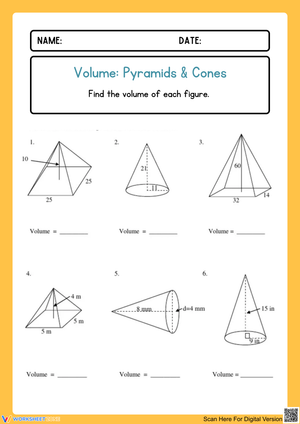
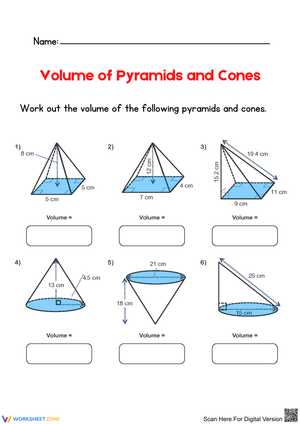
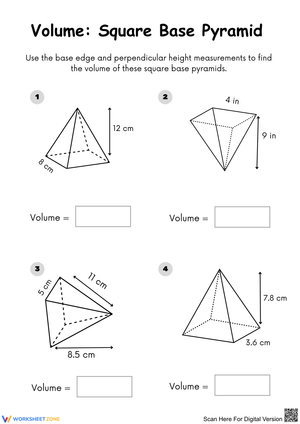
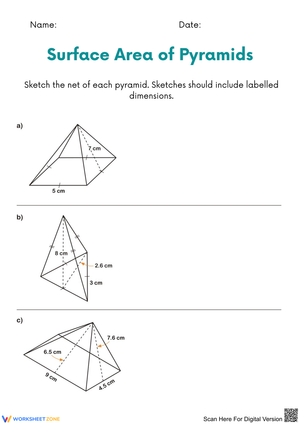
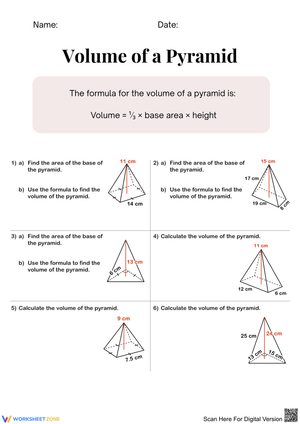
Pyramid printable worksheets for 5th Grade
These pyramid worksheets for 5th grade give teachers a focused set of practice materials for one of the trickier corners of solid geometry — the point where students have to stop relying on visual gut feelings and start reasoning from attributes. Each worksheet targets a specific skill: identifying a pyramid from a field of 3D figures, naming it by its base, counting faces and edges and vertices, and writing an explanation using accurate vocabulary.
What's Inside the Set
The worksheets concentrate on a small cluster of closely related skills, which is intentional. Fifth graders are not just learning what a pyramid looks like — they are building the habit of reading a solid by its parts rather than its overall silhouette. Each worksheet addresses one or more of the following:
- Identification: Students mark or circle the pyramids in a mixed set of solids that includes prisms, spheres, cylinders, and cones — exactly the figures students reach for when guessing.
- Naming by base: Students look at the base polygon and write the correct pyramid name — triangular, square, rectangular, or pentagonal.
- Attribute counting: Students record the number of faces, edges, and vertices for a given pyramid and check whether the numbers shift when the base changes.
- Pyramid-vs.-prism comparison: Students complete a side-by-side comparison that targets the specific confusion between these two solid types.
- Vocabulary in sentences: Students finish sentence frames that require them to use terms like apex, base, triangular face, and vertex in accurate, complete statements.
Standard Alignment
These worksheets align to CCSS 5.G.B.3, which requires students to understand that attributes belonging to a category of figures also belong to all subcategories of that figure. In practice, this means students need to see that a square pyramid is still a pyramid — and still carries all pyramid attributes — even though it has a square base rather than a triangular one. The worksheets build this understanding incrementally by asking students to confirm shared attributes across differently named pyramids before asking them to explain why those pyramids belong to the same category. That sequence reflects how gradual release works in a geometry unit: recognition before naming, naming before comparing, comparing before generalizing.
Frequent Student Errors Worth Anticipating Before You Teach This
The pyramid-vs.-prism confusion is well documented, but the specific mechanism matters for instruction. Students who sort correctly when the shapes are positioned upright often fail when a pyramid is rotated so a triangular face is resting on the surface — suddenly it "looks like a triangle," and they stop reading for the base. A worksheet that presents pyramids in multiple orientations catches this error before it calcifies into a habit.
A second pattern shows up in attribute counting. Students frequently give a square pyramid four faces instead of five because they are not counting the base — the base reads as the "ground" rather than a face of the solid. The worksheets prompt students to color each face as they count, which makes the base visible as a surface in the same way the triangular faces are. Students who skip this step and count from memory are the ones who consistently land at the wrong number.
There is also a vocabulary gap that does not announce itself until students try to explain. Many fifth graders can point to the apex without knowing the word, and they substitute "the top" or "the pointy part" in writing. That substitution signals recognition without precision — a distinction that matters when students are asked to justify an answer rather than just select one.
How to Build These Worksheets Into Your Lesson Plans
The worksheets work at three different moments in a geometry unit. Early in the unit, before students have solid identification fluent, use the identification worksheet as a whole-group activity under the document camera. Model the "base-first" read-aloud: name the base polygon, check whether the side faces are all triangles meeting at one point, then assign the name. Students follow along on their own copy and annotate as you annotate.
Mid-unit, the comparison and attribute-counting worksheets fit naturally into a math center alongside a set of physical solid models. Students pick up a solid, match it to the drawn figure on the worksheet, and complete the attribute table. Having the physical model removes one layer of abstraction and lets students physically rotate the solid to find the base — which addresses the orientation confusion before it appears on paper alone.
Late in the unit, the sentence-frame worksheets work well as a Monday warm-up or a five-minute Friday review block. Students who have the concept fluent can complete them independently in about eight minutes. Students who are still uncertain will surface that uncertainty in their writing, which makes these worksheets more useful as formative data than a multiple-choice exit ticket would be.
Adjusting the Worksheets for a Range of Learners
For students who are still developing confidence with 3D vocabulary, narrow the task. On the identification worksheet, reduce the field to four solids instead of eight, and pre-label the base on each figure so students are practicing naming rather than simultaneously locating the base and naming it. That single adjustment reduces cognitive load enough that students can focus on the reasoning rather than the scanning.
For students working above grade level, the comparison tasks extend cleanly. Ask them to write a general rule: if the base has n sides, how many faces, edges, and vertices does the pyramid have? Students who find the pattern — faces = n + 1, edges = 2n, vertices = n + 1 — are doing early algebraic generalization directly from geometry. That extension requires no additional materials; it is a prompt added to the bottom of a worksheet they have already completed.
Students who process language more slowly often do well when they can point before they write. Pair the vocabulary worksheet with a labeled anchor chart so students can cross-reference terms before committing them to a sentence. This is not scaffolding that lowers the task — it is the same strategy teachers use when they leave a word wall up during a vocabulary quiz.
Frequently Asked Questions
Do these worksheets cover pyramids with different base shapes, or only square pyramids?
Each worksheet includes multiple base types — triangular, square, and rectangular pyramids appear across the set, and some worksheets also include pentagonal pyramids. Limiting practice to square pyramids is one of the more reliable ways to produce students who cannot identify a triangular pyramid on a test, so the set deliberately varies the base throughout.
My students already recognize pyramids by sight. Are these worksheets still useful?
Visual recognition and attribute reasoning are different skills. Students who recognize a square pyramid instantly will often still assign it the wrong edge count or write "the pointy thing at the top" instead of "apex." The worksheets push past recognition into explanation, which is where most fifth-grade assessment items — and real geometric reasoning — actually live.
How long does a typical worksheet take to complete?
For most students working independently, eight to twelve minutes. The sentence-frame worksheets tend to run longer for students who struggle with academic language — closer to fifteen minutes — which can actually be useful information for teachers tracking writing development alongside geometry understanding.
Can I use these worksheets before students have had direct instruction, or do they need to come after a lesson?
The identification worksheets work reasonably well as a pre-assessment before instruction — they will surface what students already know and reveal the specific errors worth addressing in your lesson. The comparison and vocabulary worksheets assume students have encountered the terms, so those work better after at least one direct-instruction session or a shared reading of a geometry anchor chart.
Clear All