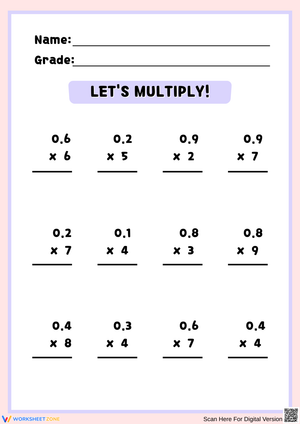
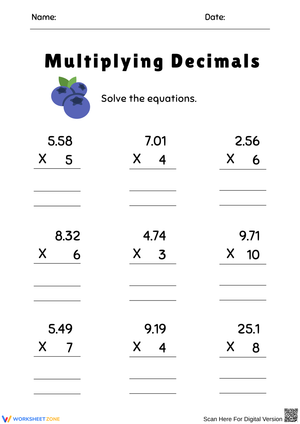
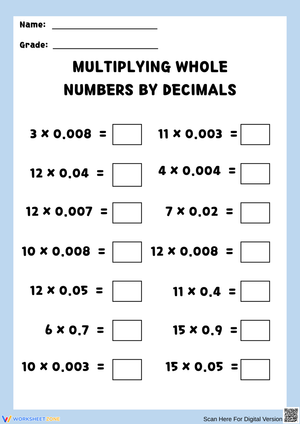
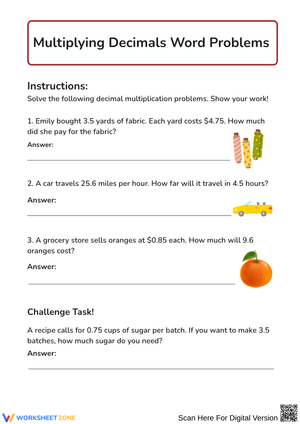
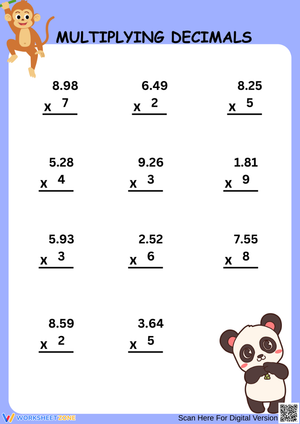
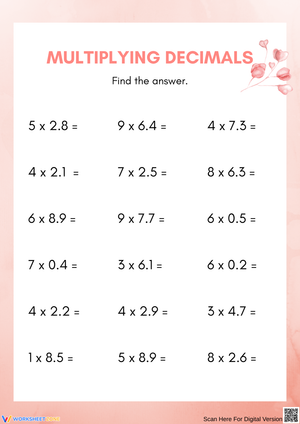
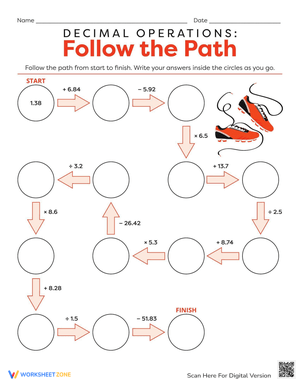
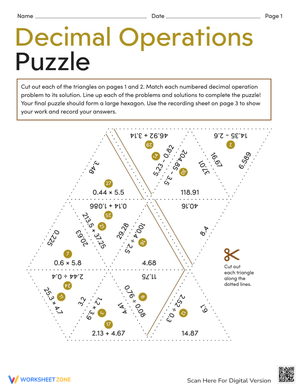
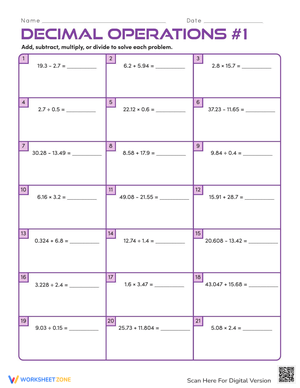
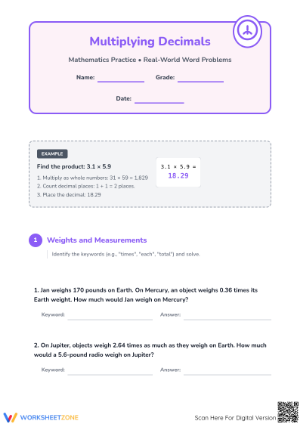
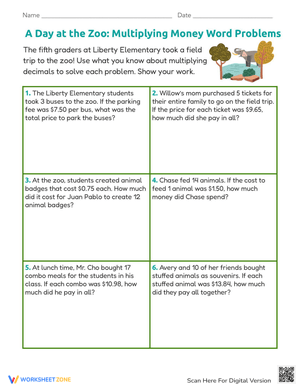
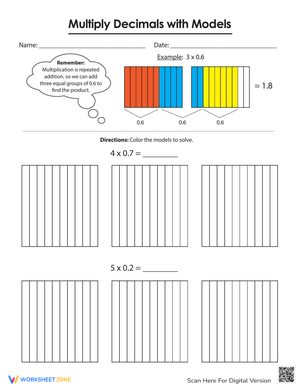
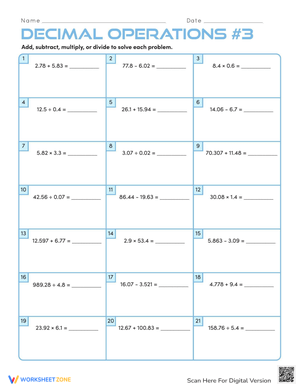
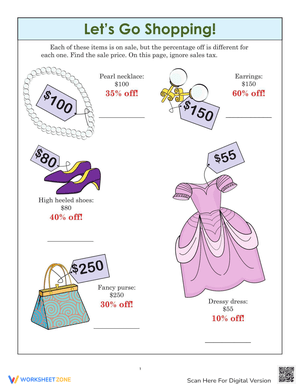
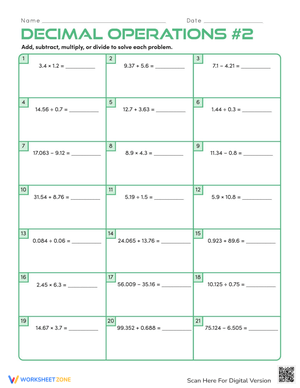
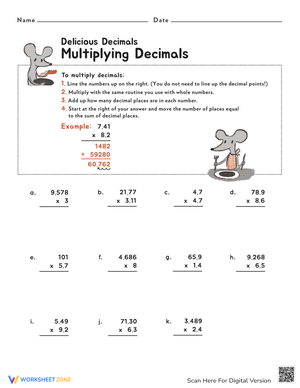
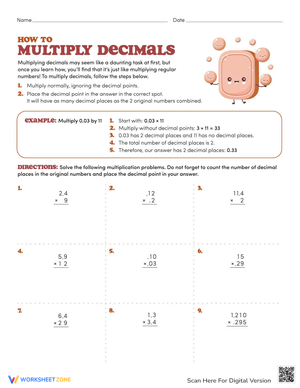
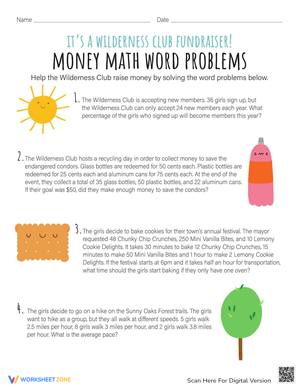
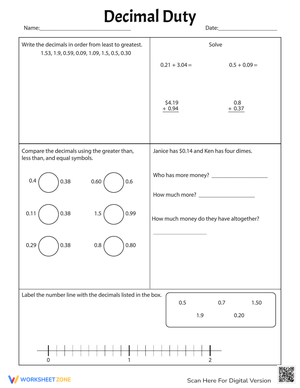
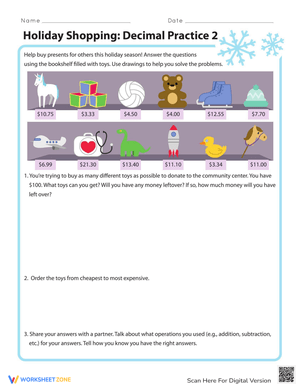
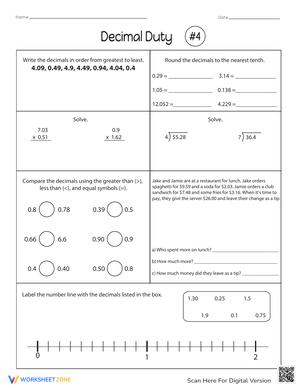
These 5th grade multiplying decimals printable worksheets give teachers a progression that starts at place-value reasoning and builds toward confident decimal-by-decimal computation — each worksheet focused on one target so it's easy to slot into a warm-up, a center rotation, or a small-group pull-out without reorganizing the whole lesson. The set covers multiplying decimals by whole numbers, multiplying decimals by decimals, estimation before solving, and short word problems tied to money and measurement contexts. The sequencing matters: students who understand why the product of 0.4 × 3 equals 1.2 make far fewer placement errors than students who learned the procedure cold.
What the Set Covers Across the Decimal Multiplication Sequence
The worksheets build across three distinct phases. The first phase asks students to use place-value language and powers of 10 to predict products — if 6 × 4 = 24, what should 6 × 0.4 equal and why? That pattern-noticing work keeps decimal placement from becoming an arbitrary rule students forget over a weekend. The second phase moves into written computation, beginning with decimal-by-whole-number problems before introducing decimal-by-decimal products. The third phase mixes problem types, requires estimation, and adds short application items where the decimal answer has a real-world unit attached — which forces students to ask whether their answer is sensible, not just correct.
- Powers of 10 patterns and place-value prediction tasks
- Decimal by whole-number computation with explanation prompts
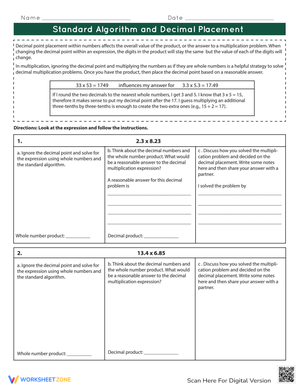
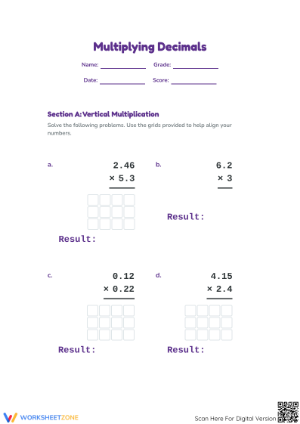
- Decimal by decimal products, including tenths by tenths and tenths by hundredths
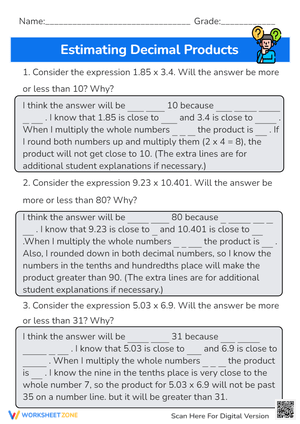
- Estimation before solving — students write a reasonable range, then compute and compare
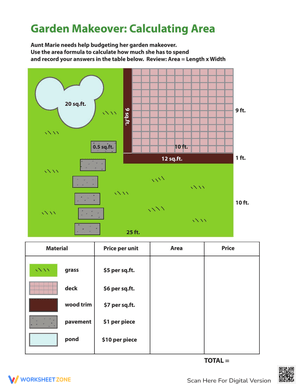
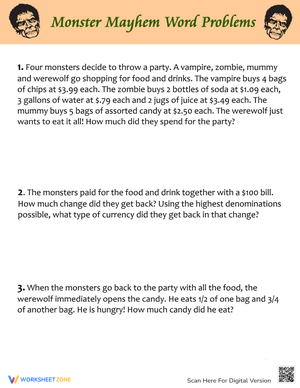
- Money and measurement word problems that require a decimal product
- Mixed review that asks students to choose a method without prompting
Errors That Surface in Student Work — and What They Actually Signal
The most common error in fifth-grade decimal multiplication is not a computation mistake — it's a placement mistake that reveals the student never developed a sense of magnitude. A student who solves 0.6 × 0.4 and writes 2.4 instead of 0.24 usually multiplied 6 × 4 correctly but skipped the check that would have caught the error: six tenths of four tenths must be less than one whole, so any product greater than one is already wrong before you check the arithmetic. That sense-making step is what separates procedurally fragile students from students who can catch their own mistakes. The estimation tasks in these worksheets address that directly — not as filler warm-ups, but as a required step before written computation begins.
A second pattern worth watching: students who place the decimal correctly on straight computation problems will often misplace it inside a word problem. The added reading load and the need to identify what is actually being multiplied break the automaticity they built during isolated practice. That's why the word problems in this set are kept short and paired with a single clear decimal product — not multi-step scenarios that introduce additional operations before students have solid placement habits in place.
Building These Worksheets Into Your Weekly Lesson Plan
The most reliable use for these worksheets is right after a whole-group lesson, when students need six to eight problems to consolidate a just-introduced method while the steps are still fresh. A worksheet that mirrors the format of the modeled example reduces confusion about directions and lets students put their attention on the math itself — a basic cognitive load consideration that matters most in the first two days of any new decimal topic. For small-group time, choose a narrower worksheet targeting one skill, such as multiplying a decimal by a whole number, so you can hear student explanations and address place-value language in real time while the group is still working.
For Thursday or Friday review blocks, the mixed-format worksheets work well as a quick cumulative check. Assign four to six problems and spend the last five minutes comparing answers aloud — students who placed the decimal incorrectly often self-correct the moment they hear a classmate's reasoning. For homework, send only worksheets with familiar problem types. Introducing a new format at home, when no teacher is present to clarify, usually generates more confusion than practice. For substitute plans, the review worksheets with printed directions and a mix of decimal-by-whole-number and decimal-by-decimal items are the most self-sufficient options in the set.
Standard Alignment
These worksheets align to CCSS.MATH.CONTENT.5.NBT.B.7, which requires students to multiply decimals to hundredths using strategies based on place value, properties of operations, and the relationship between operations — and then to explain the reasoning used in relation to a written method. The explanation component is easy to skip in a computation-heavy unit, but it's written explicitly into the standard. Several worksheets include prompts asking students to write a sentence explaining why a product is less than one whole or why multiplying by a tenth shifts the value one place to the right. Those tasks go directly at the "explain the reasoning" clause, not just the calculation requirement.
Teachers in states using alternate frameworks will find the same instructional logic at work: place-value reasoning before written computation, estimation as a built-in accuracy check, and problems that move beyond pure calculation into real-world application. The 5th grade multiplying decimals printable worksheets in this set are sequenced to reflect the standard's expectation that conceptual understanding and procedural fluency develop together — not in separate units separated by weeks of drill.
Adjusting the Worksheets Across Different Readiness Levels
In a typical fifth-grade class, some students are ready for decimal-by-decimal products on day two while others still confuse tenths and hundredths in written notation. Handling that range doesn't require separate units — it requires matching different worksheets from the set to different entry points. Students who need more time with foundational ideas start with the place-value pattern worksheets and the decimal-by-whole-number tasks. Students with solid whole-number fluency and a clear grasp of decimal notation move directly into the decimal-by-decimal worksheets. Both groups are working on multiplication of decimals; they're just entering the sequence at different points and moving at a different pace.
A practical adjustment that doesn't require separate materials: change the response demand rather than the topic. Students who need additional support solve fewer problems and explain one answer in writing using place-value terms — something like "the product is less than one because both factors are less than one." Students who are ready for more compare two solution methods on the same worksheet, write an estimate before each problem, or work through the measurement word problems where context adds a layer of interpretation. The 5th grade multiplying decimals printable worksheets in this set support that kind of flexible assignment because they're organized by skill rather than by an undifferentiated difficulty ranking — which makes it straightforward to assign different worksheets to different groups within the same lesson block.
Frequently Asked Questions
Do students need to know area models before using these worksheets?
No, but students who have used area models or place-value charts to multiply whole numbers will find decimal content easier to reason through. If most of your class hasn't worked with area models, start with the powers-of-10 pattern worksheets and spend a lesson connecting that pattern to what students already know about multiplying by 10 and 100 before moving into written decimal computation.
How many worksheets from this set make sense for a standard decimal multiplication unit?
A typical fifth-grade decimal multiplication unit runs two to three weeks. Using one or two worksheets per lesson — one for guided or partner practice, one for independent work or homework — means most units draw on somewhere between eight and fifteen worksheets across the full sequence. That distribution keeps practice spread out rather than concentrated in one or two heavy review sessions, which tends to produce better retention than massed work right before an assessment.
Are the word problems grade-appropriate in reading level?
The word problems use straightforward sentence structures and contexts students recognize — grocery prices, track distances, recipe measurements. They're not oversimplified to the point of being unrealistic, but they're not pulling double duty as a reading comprehension task either. In the patterns we see in actual student work, struggles with the word problems almost always trace back to decimal placement, not to difficulty reading the prompt.
Can these worksheets support test preparation?
The 5th grade multiplying decimals printable worksheets in this set cover the computation and reasoning skills that appear on most state assessments — decimal products to hundredths, estimation, place-value explanation, and real-world application. They aren't formatted as multiple-choice practice, but the underlying skill work matches what assessments test. For students who also need exposure to specific question formats, use these worksheets for the skill development and a separate resource for question-type familiarity.














 Interactive Worksheet Maker
 Quiz Maker
 Word Search Maker
 Crossword Puzzle Maker
 Word Scramble Generator
 Sentence Scramble Generator
 Handwriting Worksheet Generator
 Name Tracing Generator
 Fill In The Blank Generator




 BACK TOSCHOOL