




























1 / 2
0
Views
0
Downloads


0.0
0
Save
0 Likes
Share
Decimal Placement with Algorithm Worksheet
0 Views
0 Downloads

Paste this activity's link or code into your existing LMS (Google Classroom, Canvas, Teams, Schoology, Moodle, etc.).
Students can open and work on the activity right away, with no student login required.
You'll still be able to track student progress and results from your teacher account.
Information
Description
What It Is:
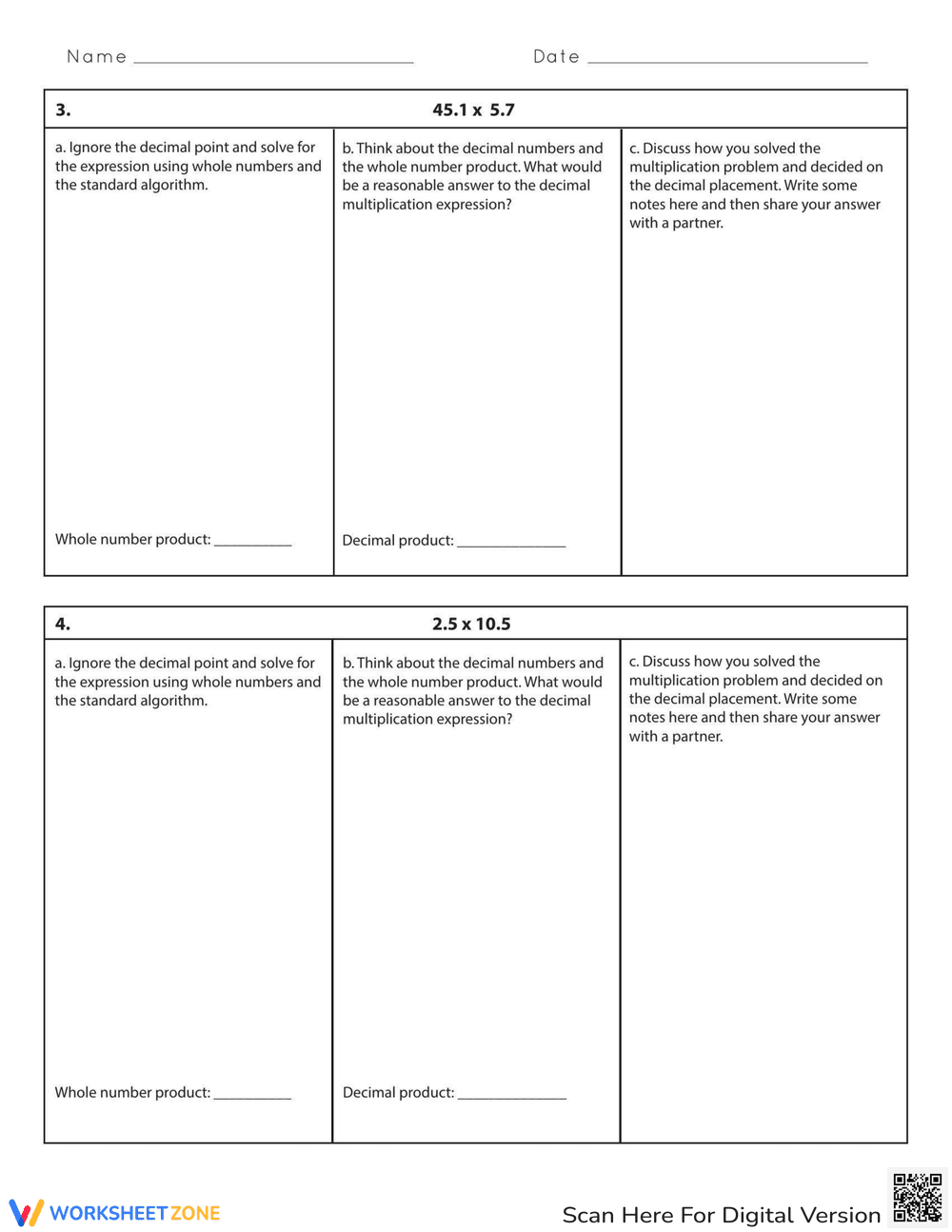
This is a math worksheet focused on teaching standard algorithm and decimal placement in multiplication. It presents two multiplication problems: 2.3 x 8.23 and 13.4 x 6.85. For each problem, there are three steps: solving ignoring the decimal, estimating a reasonable answer for decimal placement, and discussing the solution process with a partner. The worksheet includes space for students to write their whole number products, decimal products, and notes about their problem-solving approach.
Grade Level Suitability:
This worksheet is suitable for grades 5-7. It assumes students have a basic understanding of multiplication and are ready to learn or reinforce the concept of decimal placement within the standard algorithm. The estimation and discussion aspects make it suitable for developing mathematical reasoning and communication skills at this level.
Why Use It:
This worksheet helps students understand the connection between whole number multiplication and decimal multiplication. It encourages students to estimate reasonable answers, which builds number sense and helps them avoid errors. The collaborative discussion component promotes critical thinking and allows students to learn from each other's strategies.
How to Use It:
Students should first solve the multiplication problems ignoring the decimals. Next, they should think about the placement of the decimal point in relation to the whole number product and estimate a reasonable answer. Finally, they should discuss their solutions and reasoning with a partner, noting their process and final answer.
Target Users:
This worksheet is designed for elementary and middle school students learning about decimal multiplication. It is also useful for teachers looking for a resource to reinforce decimal placement and encourage mathematical discussions in the classroom. It can be used for individual practice, group work, or as a formative assessment tool.
This is a math worksheet focused on teaching standard algorithm and decimal placement in multiplication. It presents two multiplication problems: 2.3 x 8.23 and 13.4 x 6.85. For each problem, there are three steps: solving ignoring the decimal, estimating a reasonable answer for decimal placement, and discussing the solution process with a partner. The worksheet includes space for students to write their whole number products, decimal products, and notes about their problem-solving approach.
Grade Level Suitability:
This worksheet is suitable for grades 5-7. It assumes students have a basic understanding of multiplication and are ready to learn or reinforce the concept of decimal placement within the standard algorithm. The estimation and discussion aspects make it suitable for developing mathematical reasoning and communication skills at this level.
Why Use It:
This worksheet helps students understand the connection between whole number multiplication and decimal multiplication. It encourages students to estimate reasonable answers, which builds number sense and helps them avoid errors. The collaborative discussion component promotes critical thinking and allows students to learn from each other's strategies.
How to Use It:
Students should first solve the multiplication problems ignoring the decimals. Next, they should think about the placement of the decimal point in relation to the whole number product and estimate a reasonable answer. Finally, they should discuss their solutions and reasoning with a partner, noting their process and final answer.
Target Users:
This worksheet is designed for elementary and middle school students learning about decimal multiplication. It is also useful for teachers looking for a resource to reinforce decimal placement and encourage mathematical discussions in the classroom. It can be used for individual practice, group work, or as a formative assessment tool.


