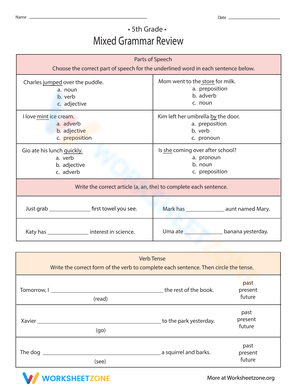
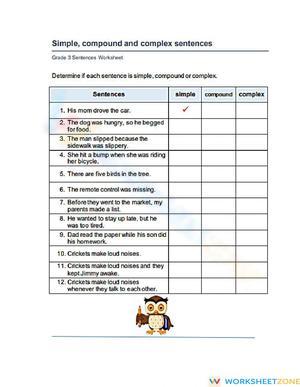
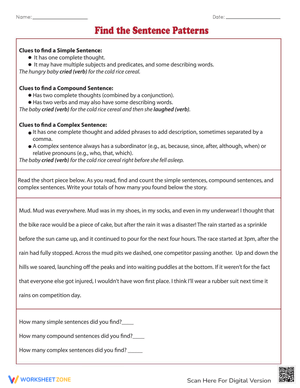
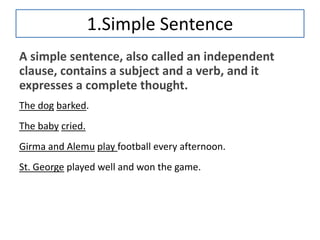
These 5th grade simple compound and complex sentences printable worksheets give teachers something hard to find in one place: a clear progression from sentence identification to clause marking to genuine writing application, without needing three separate resources to get there. Each worksheet targets a specific layer of the skill, so teachers can assign exactly what a lesson needs and move on from what it doesn't.
The Specific Skills Each Worksheet Targets
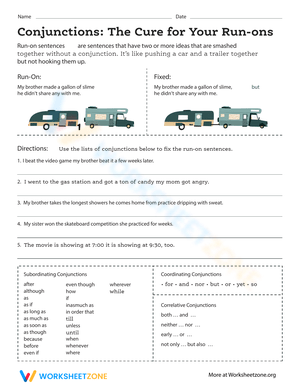
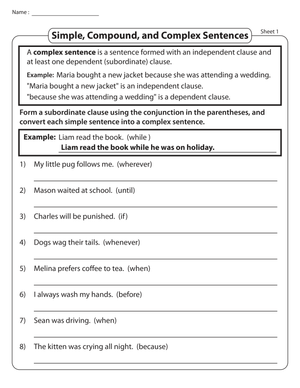
Sentence structure at the fifth-grade level runs through writing workshop, revision conferences, and constructed response tasks all year — it is not a unit teachers finish and close. The 5th grade simple compound and complex sentences printable worksheets in this set ask students to do four distinct things: identify a sentence type and mark the reasoning, underline independent and dependent clauses separately, use coordinating and subordinating conjunctions to combine short statements into richer ones, and revise a short paragraph to show intentional sentence variety. That sequence matters because recognition alone does not transfer to writing. Students need the combining and revision steps to connect the grammar work to choices they actually make in their own drafts.
Each worksheet keeps the reading load contained so students direct their attention to the grammar decision rather than decoding unfamiliar content. The example sentences draw on grade-appropriate topics — weather patterns, historical figures, animal behaviors — which lets the sentence structure stay visible without asking students to carry extra context while they work.
Mistakes Students Make That These Worksheets Help You Catch
The most consistent error at this level is equating sentence length with sentence type. A student who reads "The enormous brown dog with the curly tail ran across the muddy field" will often label it complex because it is long, even though it contains a single independent clause and no conjunction joining another clause. The inverse is equally common: students label "I ran because I was late" as compound because they see two ideas joined together. The word because is a subordinating conjunction — it creates a dependent clause, which makes the sentence complex. That distinction is the crux of clause awareness at grade 5, and it shows up unresolved in student writing all year.
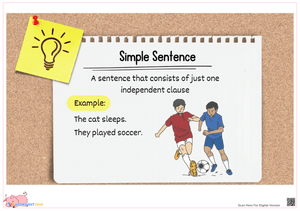
A second error pattern involves the word and. Students quickly learn that compound sentences use coordinating conjunctions, then apply the rule too broadly. A sentence like "Maria and her brother went to the store" uses and to join two nouns, not two independent clauses — it is still simple. Students who do not catch this distinction over-label simple sentences as compound throughout the set. Asking them to underline each clause before classifying the whole sentence slows that error down considerably.
There is also the fragment trap. When students practice isolating the component parts of a complex sentence, they sometimes write the dependent clause as a standalone: "Because I was tired." A brief check — can this clause stand on its own? — builds the clause-awareness habit that prevents this in actual writing. Worksheets that ask students to mark both clauses before labeling the sentence make that check routine rather than occasional.
Building These Worksheets Into Your Weekly Lesson Flow
The most reliable approach is to assign each worksheet with one narrow target per lesson. On a direct-instruction day, use an identification worksheet as a mid-lesson check after the anchor example — three sentences, two minutes, immediate whole-class debrief. On a revision day, use a sentence-combining worksheet as the warm-up, then carry the combining logic directly into the student draft sitting on the desk. That connection between the worksheet and the real writing task is where the practice takes hold.
For center rotations, identification and clause-marking worksheets work well because students can self-check with an answer key once they understand the routine. Combining and revision worksheets work better as teacher-led or partner tasks because students benefit from talking through why one version sounds clearer or more connected. An eight-minute station block handles one identification worksheet comfortably; combining tasks usually need twelve to fifteen minutes if students are writing and comparing their versions aloud.
The 5th grade simple compound and complex sentences printable worksheets also hold up as exit slips when teachers assign a single sentence-combining item alongside one original-writing item — one compound sentence and one complex sentence. That two-item check takes under five minutes and shows whether students can produce the structure or only recognize it.
Standard Alignment
These worksheets align to CCSS.ELA-LITERACY.L.5.3.A, which requires fifth graders to expand, combine, and reduce sentences for meaning, reader interest, and style. That three-part expectation is broader than a sorting task, and it is precisely why the set includes both identification and production work — labeling alone does not satisfy the standard's combine and expand requirements. Teachers administering district writing benchmarks or preparing students for constructed response prompts will find the combining and revision worksheets address the standard's production side directly, while the identification worksheets provide the baseline check teachers need before moving students into that work.
Adjusting the Work for a Range of Learners
For students working below grade level, narrow the task before adding variety. Start with one worksheet focused only on identifying and marking independent clauses. Once students can reliably locate where one idea ends, introduce the second clause. Students who skip that clause-awareness step often confuse conjunction placement with sentence structure and stall when sentence length increases. A sentence frame — "[Independent clause] + [conjunction] + ___" — gives them a structure to work inside without doing the thinking for them.
On-level students move through identification into combining without much adjustment. Where you can differentiate for them is in the conjunction choice — present two or three coordinating or subordinating options and ask students to explain, in one sentence, why they chose that conjunction. That adds a reasoning layer without changing the worksheet itself.
For students ready for extension, the revision tasks offer the most room. Ask them to take a paragraph they have already written — a social studies summary, a literary response — and rewrite it so it includes at least two complex sentences and one compound sentence used with a clear purpose. The judgment call about where those sentences belong is the challenge that goes beyond what any worksheet asks, and that is exactly the kind of thinking that builds durable sentence control over time.
Frequently Asked Questions
What is the difference between a compound sentence and a complex sentence for 5th graders?
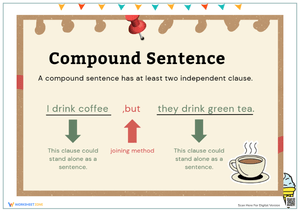
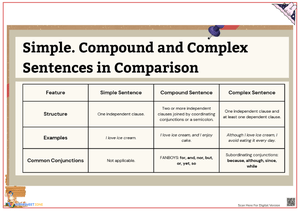
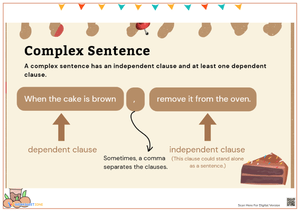
A compound sentence joins two independent clauses — each could stand alone — usually with a coordinating conjunction like but, so, or yet. A complex sentence pairs one independent clause with one or more dependent clauses using a subordinating conjunction like because, although, or when. The dependent clause cannot stand alone. Students most often mix these up when the sentence is long; asking them to mark each clause separately before labeling the whole sentence resolves most of that confusion.
Can these worksheets work for students who are still sorting out what makes a complete sentence?
Yes, but begin with the identification worksheets and hold off on the combining tasks. Students who are still uncertain about complete versus incomplete sentences need to build clause awareness first. The 5th grade simple compound and complex sentences printable worksheets in this set work best when teachers use the identification tasks diagnostically — if students are frequently misidentifying dependent clauses as complete sentences, that signals a specific gap to address before combining practice begins.
How do these worksheets connect to actual writing instruction?
The connection is most direct in the combining and revision tasks. After students complete a combining worksheet, ask them to apply the same move to a sentence in their own draft — take two short statements and join them with a coordinating or subordinating conjunction. That transfer prompt takes under two minutes and converts the grammar task into a real writing decision. Teachers who skip that bridge often find students complete the worksheet correctly but continue writing in repetitive simple sentences in their drafts. The worksheet is the practice space; the draft is where the skill needs to land.
Are these appropriate for 4th or 6th grade as well?
The identification and clause-marking worksheets can work for advanced 4th graders or as a review entry point for 6th graders. The combining and revision worksheets are paced for 5th grade expectations. Sixth grade sentence work typically extends into varying syntax deliberately for style and effect, which goes beyond what this set covers.












 Interactive Worksheet Maker
 Quiz Maker
 Word Search Maker
 Crossword Puzzle Maker
 Word Scramble Generator
 Sentence Scramble Generator
 Handwriting Worksheet Generator
 Name Tracing Generator
 Fill In The Blank Generator