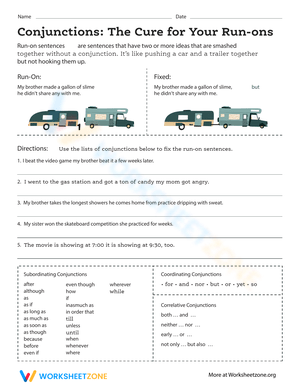
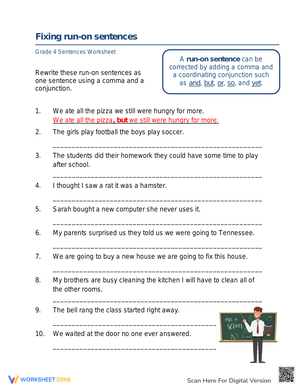
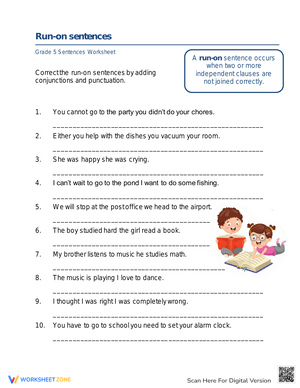
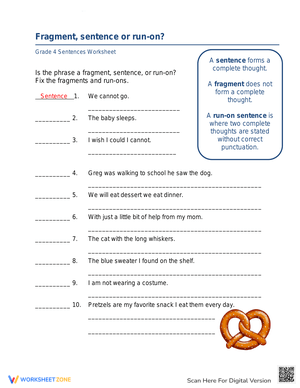
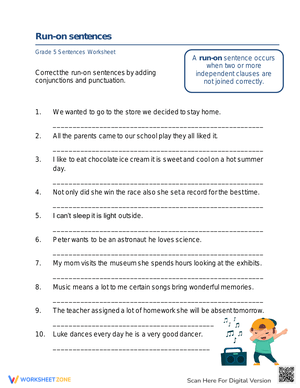
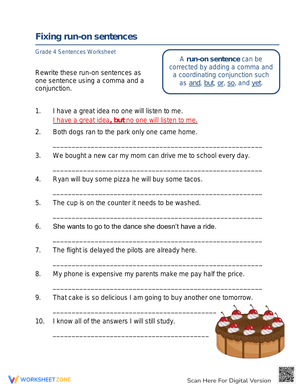
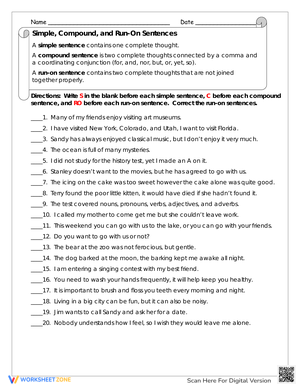
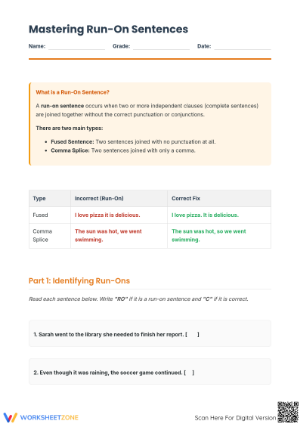
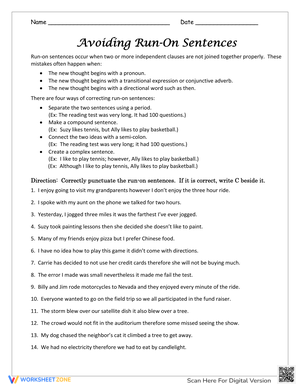
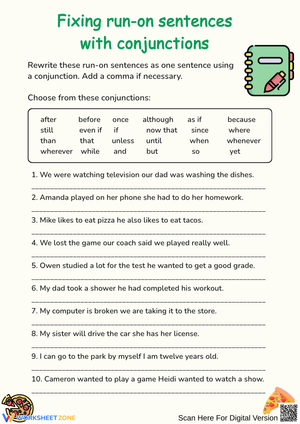
These 5th grade run on sentences worksheets resources give teachers a focused, reusable tool for sentence-boundary instruction: items students identify, mark, and revise without lengthy setup or complicated directions. The set covers error recognition and correction across multiple problem types, from run-ons with no punctuation break to comma splices that still need repair after a comma is inserted. Teachers use them during mini-lessons, writing warm-ups, and targeted small-group reteach sessions throughout the year.
The Specific Skills Each Worksheet Targets
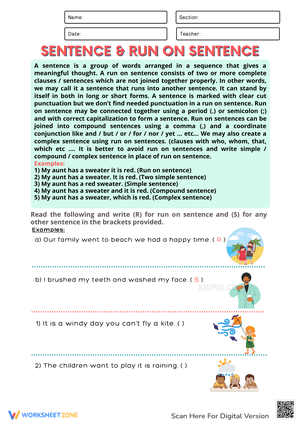
The 5th grade run on sentences worksheets set moves students through a sequence that mirrors how solid grammar instruction actually unfolds: recognition first, then correction, then explanation of the fix. Early items ask students to read a sentence and label it — run-on, comma splice, or correct. That step matters because students need to slow down and examine clause boundaries before they are asked to repair them.
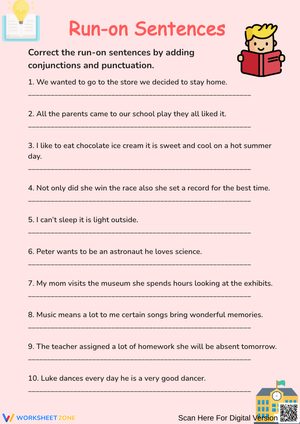
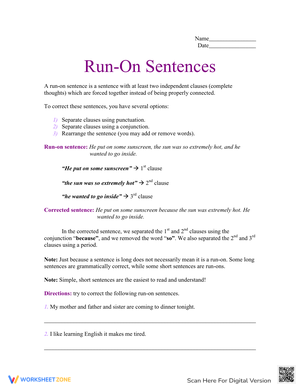
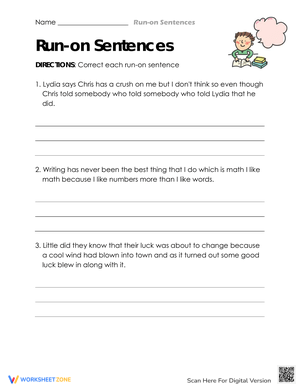
From there, each worksheet builds toward revision. Students mark the boundary between two independent clauses, decide whether a period, a coordinating conjunction, or a semicolon fits the relationship between ideas, and then rewrite the sentence using their chosen fix. The strongest items also ask students to explain the choice briefly — "I used but because the second idea shows a contrast" — which makes their reasoning visible rather than just the answer.
- Identifying independent clauses within longer sentences
- Distinguishing run-on errors from comma splices
- Choosing among a period, a coordinating conjunction (FANBOYS), or a semicolon to repair each sentence
- Rewriting corrected sentences without altering the original meaning
- Editing short passages for multiple sentence-boundary errors
Where Students Go Wrong With Sentence Boundaries
The most persistent error at this level is not carelessness — it is confusion between sentence length and sentence correctness. Fifth graders writing longer narrative and opinion pieces often produce sentences that feel long and therefore feel wrong, even when they are grammatically sound. They will break apart a correct compound sentence looking for a run-on that is not there, while overlooking an actual run-on three lines down. What they need is the concept of an independent clause stated plainly: each complete thought could stand alone as its own sentence. Once that test is clear, students have a reliable tool for checking their own work rather than relying on instinct about whether a sentence sounds off.
The comma-as-cure error runs a close second. Students insert a comma between two independent clauses and consider the problem solved. A student who correctly reads "She was tired she kept going" as a run-on will often rewrite it as "She was tired, she kept going" and stop there, believing the comma has done the work. The difference between that partial fix and a correct one — adding a coordinating conjunction, splitting into two sentences, or using a semicolon — needs to be addressed directly and revisited across several lessons, not corrected once and assumed retained.
There is also a quieter error that appears once students are comfortable identifying run-ons in isolation: they stop catching them in their own drafts. A student who correctly marks the clause break in "The storm hit hard the power went out" on a worksheet will still write "We finished the project it took us three days" in a narrative draft, because spotting an error in someone else's sentence and monitoring clause boundaries while generating text are two different cognitive demands. The most effective classroom routine accounts for that gap by pairing each worksheet with a transfer step — students find one similar error in their own writing notebook after completing the practice.
Standard Alignment
The formal run-on sentence standard, L.4.1f — Produce complete sentences, recognizing and correcting inappropriate fragments and run-ons — enters the curriculum at grade 4. In grade 5, that work is reinforced and extended through L.5.3, which calls on students to use their knowledge of language conventions in writing, speaking, reading, and listening. That placement tells you something important about how to frame the lesson: grade 5 students are not encountering this concept for the first time. They are applying it inside more complex sentence structures — sentences with subordinating clauses, longer noun phrases, and multi-clause constructions that appear regularly in the opinion and narrative writing they produce throughout the year. Framing run-on correction as part of editing for a real reader, rather than as an isolated grammar task, is consistent with how both L.5.3 and the Writing Standards position convention work at this grade.
Lesson-Planning Notes for Making These Worksheets Count
A 20-minute grammar block is enough if the routine is tight. Spend three to four minutes modeling two items on the board — one pure run-on and one comma splice — and narrate the thinking aloud: "I see two complete thoughts here. I'm going to split them with a period and a capital letter." Then release students to work independently through six to eight items. Reserve the last five minutes for a partner comparison where students explain, not just check, what they chose and why.
That partner step does more than verify answers. It surfaces students who arrived at the right answer through instinct rather than understanding. A student who can say "I used and because both ideas go in the same direction" is in a different place than one who says "it just sounded right." Both may have the same item marked correctly, but only one is ready to catch the error in a draft. Hearing that difference during partner talk is faster than waiting for a quiz.
These worksheets also hold up well in centers and substitute plans. In a center rotation, students complete half the items and self-check against a posted answer key before moving on. For sub days, the format is self-explanatory enough that students can work without teacher setup. During intervention, the recommendation is to address one correction strategy at a time — periods only, then conjunctions — before mixing error types within a single worksheet session.
Adjusting the Set for Mixed-Ability Classrooms
Students who are still working to distinguish complete sentences from fragments benefit from a reduced version of the practice: shorter sentences with clear clause breaks, fewer items per sitting, and the option to read each sentence aloud before marking it. Hearing the run-on — the unresolved pause, the sense that the sentence keeps going when it should stop — is often more reliable for these students than reading silently. For this group, holding to one correction method at first keeps the demands manageable while building the core concept.
For students ready for more independence, the 5th grade run on sentences worksheets set can extend into passage-level work: rather than correcting individual sentences, students edit a short paragraph for all sentence-boundary errors, then revise a second time for clarity and flow. A useful follow-up question at this level is "Which of your fixes changed the meaning slightly, and which preserved it exactly?" That question pushes attention toward how conjunction and punctuation choices shape what a sentence communicates, not just whether it passes a grammar check.
Frequently Asked Questions
What should fifth graders be able to do with run-on sentences by end of year?
By the end of grade 5, students should reliably identify both run-ons and comma splices, name the independent clauses in a compound sentence, and apply at least two different correction strategies — a period fix and a conjunction fix — without being told which one to use. The deeper benchmark is transfer: students who catch sentence-boundary errors in their own writing, not only on a worksheet, have moved the skill from identification to internalized editing habit. That transfer is the goal the worksheets are building toward.
How many items per worksheet is the right amount for a focused lesson?
Six to ten items works well for a single grammar block. Fewer than six does not give students enough varied exposure to distinguish error types reliably. More than twelve can flatten attention — students begin answering by pattern rather than actually checking each sentence. The 5th grade run on sentences worksheets format works best when it is short enough to finish and discuss in one sitting, which keeps the lesson anchored to thinking rather than completion.
Can these worksheets double as a formative check?
Yes, with a simple coding system. Mark each item R (run-on), CS (comma splice), or C (correct) as you scan student work. Three or more errors concentrated in a single category — say, all comma splices labeled as correct — indicates a specific gap rather than general confusion. That information is actionable the same day: it is enough to form a reteach group without waiting for a formal quiz at the end of the week.
Do the worksheets cover comma splices, or only run-on sentences?
Both. Comma splices are a sentence-boundary error closely related to run-ons, and the two types appear together in the set because students need to see how they differ. A run-on has no break between independent clauses; a comma splice has a break, but a comma alone is not strong enough to join two complete thoughts. Teaching both side by side prevents the fix-and-done error where students add a comma and move on without checking whether that actually resolves the problem.












 Interactive Worksheet Maker
 Quiz Maker
 Word Search Maker
 Crossword Puzzle Maker
 Word Scramble Generator
 Sentence Scramble Generator
 Handwriting Worksheet Generator
 Name Tracing Generator
 Fill In The Blank Generator