Order of adjectives worksheets for 5th grade give teachers a focused tool for one of the most persistent gaps in upper elementary writing: students who understand what adjectives are but consistently sequence them in ways that sound unnatural. This collection targets that exact problem — moving students from recognizing adjective types to arranging multi-word noun phrases correctly in their own sentences.
Skills Covered in These Order of Adjectives Worksheets
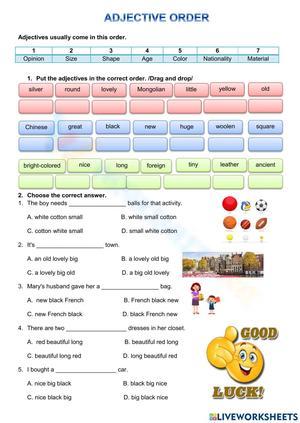
- Adjective category identification — Students label adjectives as opinion, size, age, shape, color, origin, material, or purpose before attempting any reordering, building the categorical thinking the sequencing rule depends on.
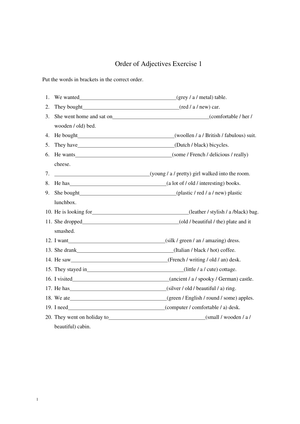
- Scrambled phrase reconstruction — Students rewrite mixed-up adjective strings — such as wooden round small table — into the sequence that sounds natural in standard written English.
- Sentence-level error correction — Students locate and fix a single adjective-sequence mistake inside a complete sentence without rewriting surrounding content.
- Multi-adjective phrase building — Students combine two to four supplied adjectives with a given noun, progressing from simpler pairs to more demanding four-word strings.
- Metalinguistic comparison — Students explain in one sentence why one version of a noun phrase sounds clearer than another containing the identical adjectives — a higher-order demand appropriate for 5th grade.
- Transfer into original writing — Students compose their own noun phrases using chosen adjectives, connecting the isolated grammar skill to authentic sentence production.
Standards Alignment
These materials address CCSS.ELA-LITERACY.L.5.1.A, which requires students to explain the function of conjunctions, prepositions, and interjections, and more broadly L.5.1, which covers the conventions of standard English grammar at the phrase and sentence level. Adjective ordering is embedded in the grade-band expectation that students use language conventions accurately in their own writing — not as isolated trivia but as a production skill visible in revised drafts and short-response work on state assessments.
Why Explicit Sequence Practice Works Better at This Grade Level
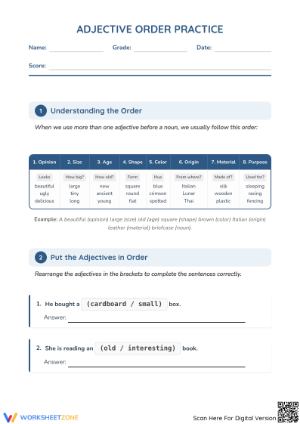
Fifth graders arrive with a working sense that big red barn sounds right and red big barn does not, but that intuition breaks down as soon as a phrase grows to three or four adjectives. At that point, implicit feel-for-the-language is not enough. Students need a visible framework — the OSASCOMP sequence (opinion, size, age, shape, color, origin, material, purpose) — so they can test a phrase systematically rather than guess. Giving them a named, teachable structure converts a vague instinct into a reliable editing strategy they can use during writing workshop revision.
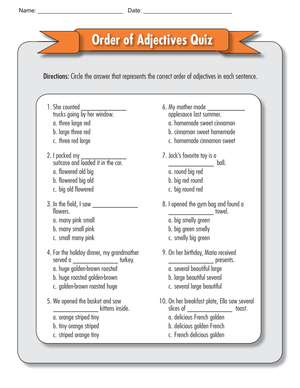
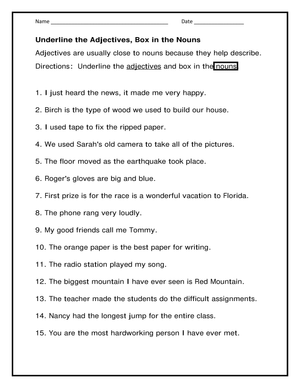
Many grammar worksheets at this level ask students to underline adjectives or circle the correct choice in a multiple-choice pair. Those formats build recognition but skip the harder cognitive move: generating the right order independently. The pages here require students to produce the sequence, not just confirm it. That production demand is exactly what exposes gaps — and closes them — before adjective-order errors migrate permanently into student writing drafts.
Common Adjective Order Errors These Worksheets Target
- Placing a material adjective before a color adjective — writing leather brown belt instead of brown leather belt — the most frequent inversion seen in 5th grade narrative drafts.
- Inserting an opinion adjective after size or age, producing phrases like old beautiful cottage when the student means beautiful old cottage.
- Stacking two adjectives from the same category without a comma — writing small tiny box rather than recognizing both words are size descriptors and that one is redundant.
- Placing origin or nationality after material — wooden Italian table instead of Italian wooden table — an error that appears when students overapply a partially remembered rule.
- Treating purpose adjectives (sleeping, running, cooking) as verbs and repositioning them after the noun: shoes running new rather than new running shoes.
- Dropping the article when a long adjective string is added — omitting an or the because managing four adjectives at once consumes working memory.
Differentiation Options
- Below grade level — Provide a labeled OSASCOMP reference strip students keep at their desks; limit initial tasks to two-adjective pairs with familiar nouns (classroom objects, animals, clothing) so category identification is the only new demand.
- On grade level — Work with three-adjective strings and sentence-correction tasks; students use the mnemonic as a checking tool after writing, not as a crutch during the initial attempt.
- Above grade level — Remove the category reference and require students to write two original noun phrases of their own, then annotate each adjective with its OSASCOMP category — a task that demands both production and metalinguistic awareness simultaneously.
Frequently Asked Questions
1. What order do adjectives follow in English, and do 5th graders need to know all the categories?
The standard classroom sequence runs opinion — size — age — shape — color — origin — material — purpose, often abbreviated as OSASCOMP. Fifth graders do not need to recite all eight from memory; the goal is accurate production in two- to four-adjective phrases. Students who can correctly write small old wooden box are demonstrating the skill even if they cannot name every slot in the sequence.
2. How is adjective order best introduced at the 5th grade level?
Begin with two familiar noun phrases and ask students which version sounds natural — most will hear the difference immediately. From there, name the categories, model the sequence with one or two examples, and move directly into a short sorting or scramble task. Students retain the pattern better through immediate application than through extended note-taking.
3. Why do students who understand adjectives still write them in the wrong order?
Knowing that a word is an adjective and knowing where it belongs in a multi-word string are separate skills. When students manage two or three adjectives at once, working-memory demand increases sharply, and the sequencing rule is the first thing to slip. Repeated, short practice tasks — not longer worksheets — rebuild that automaticity.
4. Which worksheet formats are most effective for this skill?
Category sorts before any reordering, scrambled-phrase reconstruction, and targeted sentence correction consistently outperform fill-in-the-blank or multiple-choice formats because they require students to produce the correct sequence rather than recognize it. Cut-and-paste or card-sort versions add a physical manipulation layer that works especially well in centers and small-group instruction.












 Interactive Worksheet Maker
 Quiz Maker
 Word Search Maker
 Crossword Puzzle Maker
 Word Scramble Generator
 Sentence Scramble Generator
 Handwriting Worksheet Generator
 Name Tracing Generator
 Fill In The Blank Generator