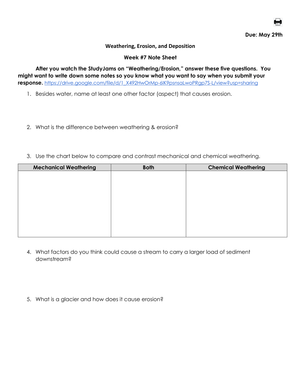
When teachers search for 4th grade weathering erosion and deposition printable worksheets, they need something they can use the same day for science block, centers, homework, or a quick reteach group. This topic can sound vocabulary-heavy at first, but grade 4 students understand it better when they sort concrete examples and talk through what changed, what moved, and what settled. That is why printable practice works well here. It gives students repeated chances to connect words to visible changes on Earth’s surface.
Worksheetzone’s Grade 4 science page places this topic inside weather and climate resources, which makes it practical for teachers planning a broader unit on Earth’s systems. Instead of treating weathering, erosion, and deposition as isolated definitions, you can use the printables to help students observe how rainwater, wind, ice, and plant roots shape land over time. In a fourth grade classroom, that shift matters. Students are more likely to remember the ideas when the worksheet points them back to a riverbank, beach, dune, or muddy patch on campus after a storm.
Help students tell weathering, erosion, and deposition apart
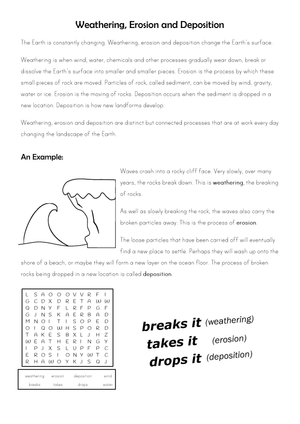
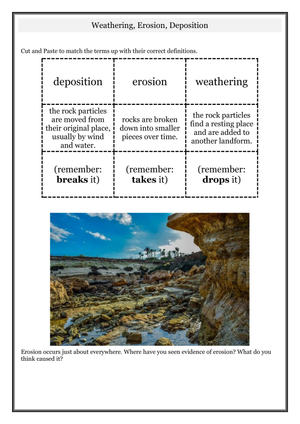
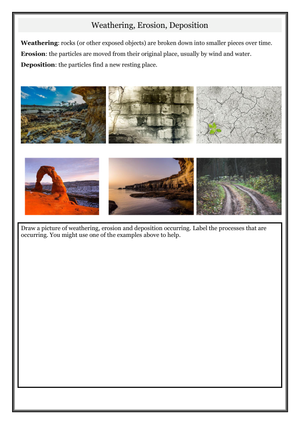
One of the biggest sticking points in grade 4 science is that students mix up breaking, moving, and dropping. A strong printable slows that confusion down. Weathering means rock is broken down in place. Erosion means the broken material is carried somewhere else. Deposition happens when the transported sediment is dropped and begins to build up in a new location. When students can sort examples across those three actions, the topic becomes much easier to teach and assess.
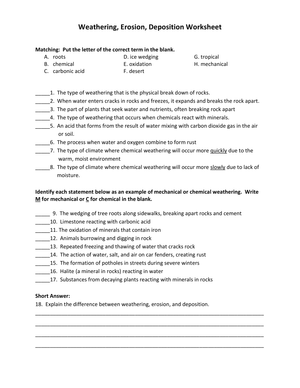
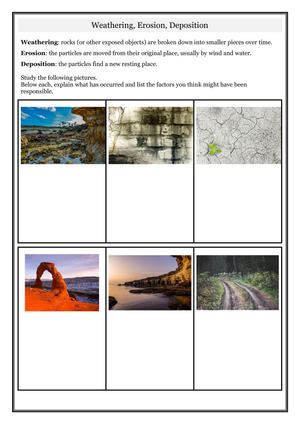
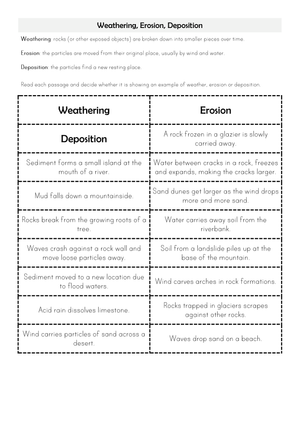
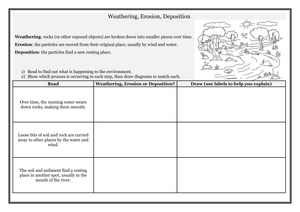
Teacher-facing printables are especially useful when they include labeled diagrams, cut-and-sort tasks, or short scenarios. A sentence such as "Tree roots crack the sidewalk" points students to weathering. "Fast water carries sand downstream" points to erosion. "Sediment builds up where the stream slows" points to deposition. Those distinctions are small, but they support stronger discussion later when students explain how water, wind, ice, or vegetation can change landforms over time.
- Use a three-column sort so students classify examples before writing full explanations.
- Add arrows or simple sketches to show whether material stays in place, moves, or settles.
- Revisit the same examples orally before independent worksheet work to reduce vocabulary overload.
Connect the worksheet set to NGSS 4-ESS2-1
Teachers often need printables that are easy to align with standards-based planning, not just pages with matching terms. In this case, the strongest fit comes from observation tasks. Students should look at evidence, describe what happened, and support the category they chose with details from a picture, diagram, or local example.
According to Next Generation Science Standards: 4-ESS2-1 Earth's Systems, fourth graders should make observations or measurements about weathering or erosion caused by water, ice, wind, or vegetation. That standard is a good instructional filter for worksheet selection because it keeps the task focused on evidence and Earth surface change, not memorized vocabulary alone.
In classroom practice, the most productive misconception check is to ask what happened first and what happened next. If a printable only asks students to label an image, many will choose erosion anytime they see water. If it asks them to sequence break, move, and drop, teachers can quickly see whether the student understands process, not just surface clues.
You can also use the printables to mirror simple measurement or observation routines. Students might compare two pictures of a streambank, note where soil is missing, circle where sediment gathered, or explain how plant roots might reduce movement of soil. Even when the worksheet is short, it can still support the kind of evidence-based thinking expected in grade 4 science.
Use local landform examples that make the vocabulary stick
Fourth graders rarely need dramatic geology stories to understand this topic. They need nearby, visible examples. Riverbanks, beaches, playground slopes, puddle runoff near sidewalks, and sand piled by wind all help students see that Earth changes in ordinary places. A printable becomes more useful when it leaves room for those familiar examples instead of staying abstract.
National Geographic Education: Weathering and National Geographic Education: Erosion both help frame this idea for classroom instruction because they center physical processes students can picture. A creek cutting into a bank, waves shifting sand, or rain carrying soil downhill all give students an image they can transfer to worksheet questions. The printable then becomes a bridge between hands-on observation and written science language.
Classroom Implementation
These printables are flexible enough to use across the week, but they work best when each format has a specific job in the lesson. During a lesson launch, a teacher can project or distribute a short sort that asks students to decide whether an example shows weathering, erosion, or deposition. During independent practice, a labeled diagram or matching page can reinforce the vocabulary. During closure, one short scenario can act as an exit ticket that reveals who still confuses movement with settling.
- Use one-page sorts for centers or science notebooks after a mini-lesson.
- Assign diagram labeling for homework when families can discuss visible examples near home.
- Keep a short scenario sheet ready for small-group reteach after a quiz or lab.
- Pair enrichment students with an applied prompt that asks them to explain more than one process in the same scene.
Because the Worksheetzone page is printable and grade-specific, it also fits substitute plans and intervention folders. Teachers can select one page for quick review or combine several pages into a short packet for test prep. The key is not the number of questions. The key is whether the worksheet asks students to use evidence from pictures, descriptions, or diagrams to explain what changed on Earth’s surface.
Build review, intervention, and enrichment from the same resource
For class review, you might choose a mixed page that cycles through all three terms.
For intervention, you can isolate one process at a time and revisit the same visuals with more teacher support.
For enrichment, students can explain how more than one force, such as water and vegetation, affects the same location over time.
If you are building a short assessment, printable pages from this topic also work well as formative checks. Students can sort, label, and justify in a few minutes, which gives teachers immediate evidence about whether they understand that weathering breaks down rock, erosion moves sediment, and deposition leaves it behind somewhere new.
Frequently Asked Questions
1. What is the difference between weathering, erosion, and deposition for 4th grade?
Weathering breaks rock or soil down in place. Erosion moves that broken material by water, wind, ice, or gravity. Deposition happens when the moved material is dropped and starts to collect in a new place. Fourth graders learn the difference faster when they sort pictures and short scenarios instead of memorizing definitions by themselves.
2. How do these worksheets support NGSS 4-ESS2-1?
They support the standard when students use observations from diagrams, photos, or local examples to explain what water, wind, ice, or vegetation did to Earth’s surface. That keeps the work tied to evidence and visible change, which is the heart of grade 4 Earth systems instruction.
3. What classroom examples make this topic easier for elementary students?
Teachers usually get strong results with riverbanks, beaches, sand dunes, rain carrying soil across a slope, or roots cracking rock or pavement. Those examples are concrete, easy to picture, and close to the kinds of scenes students may already know from their community or school grounds.
4. Can these printables work for review, homework, or small-group intervention?
Yes. They are useful for all three when the task is clear and short. A sort or labeling page works well for review, a diagram page can travel home for homework, and scenario-based pages are effective in intervention groups because they let teachers hear how students explain each process aloud.












 Interactive Worksheet Maker
 Quiz Maker
 Word Search Maker
 Crossword Puzzle Maker
 Word Scramble Generator
 Sentence Scramble Generator
 Handwriting Worksheet Generator
 Name Tracing Generator
 Fill In The Blank Generator