


























0
Views
0
Downloads

0.0
0
Save
0 Likes
Share
Weathering, Erosion, and Deposition Study
0 Views
0 Downloads
Paste this activity's link or code into your existing LMS (Google Classroom, Canvas, Teams, Schoology, Moodle, etc.).
Students can open and work on the activity right away, with no student login required.
You'll still be able to track student progress and results from your teacher account.
Information
Description
What It Is:
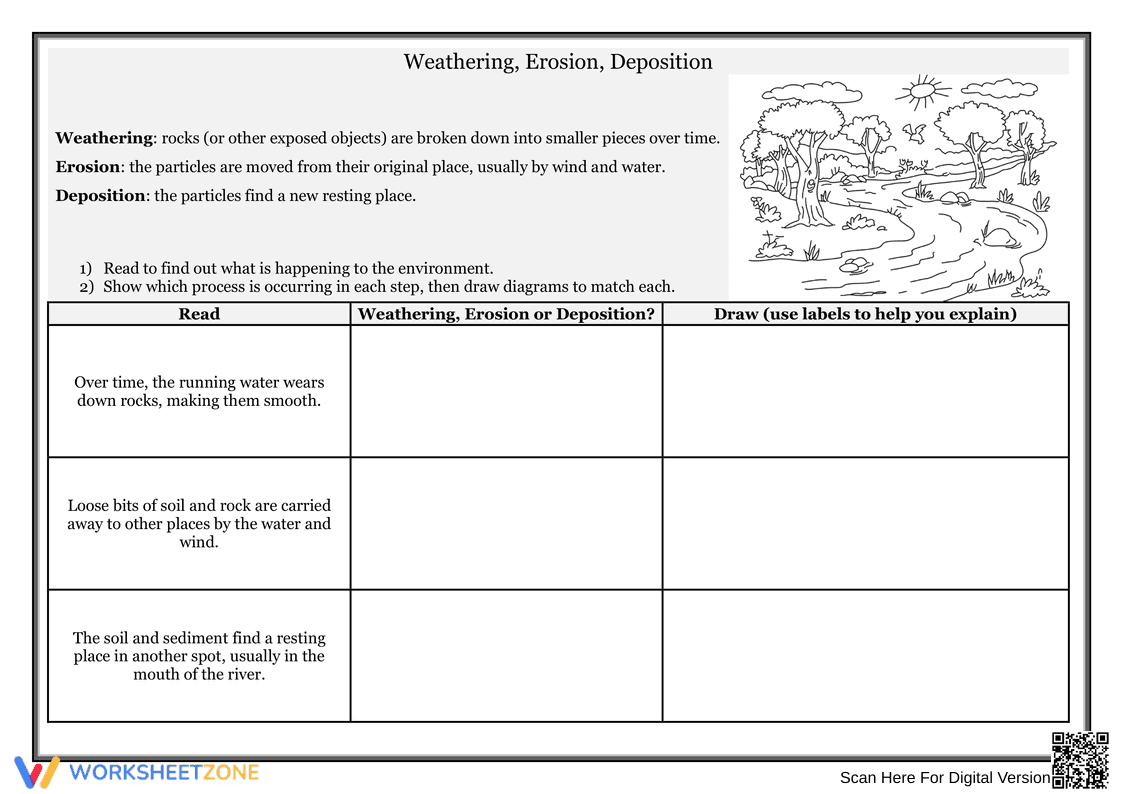
This is an educational worksheet focused on the concepts of Weathering, Erosion, and Deposition. It provides definitions of each term and then presents three scenarios describing each process. Students are asked to read each scenario, identify which process (Weathering, Erosion, or Deposition) is occurring, and then draw a diagram with labels to illustrate the process. A visual aid of a river landscape is included at the top of the worksheet.
Grade Level Suitability:
This worksheet is suitable for grades 3-5. The definitions are straightforward, and the scenarios are relatively simple to understand. The drawing and labeling activity requires critical thinking and comprehension of the processes, making it appropriate for this age range.
Why Use It:
This worksheet helps students understand the key differences between weathering, erosion, and deposition. It reinforces learning through reading comprehension, critical thinking, and visual representation. The drawing activity promotes deeper understanding and retention of the concepts.
How to Use It:
First, review the definitions of Weathering, Erosion, and Deposition with the students. Then, have them read each scenario carefully. Students should identify the process described in each scenario and write it in the corresponding column. Finally, they should draw a diagram illustrating the process and label the key elements.
Target Users:
This worksheet is ideal for elementary school students learning about earth science and the processes that shape the Earth's surface. It is also beneficial for teachers looking for engaging and hands-on activities to reinforce these concepts.
This is an educational worksheet focused on the concepts of Weathering, Erosion, and Deposition. It provides definitions of each term and then presents three scenarios describing each process. Students are asked to read each scenario, identify which process (Weathering, Erosion, or Deposition) is occurring, and then draw a diagram with labels to illustrate the process. A visual aid of a river landscape is included at the top of the worksheet.
Grade Level Suitability:
This worksheet is suitable for grades 3-5. The definitions are straightforward, and the scenarios are relatively simple to understand. The drawing and labeling activity requires critical thinking and comprehension of the processes, making it appropriate for this age range.
Why Use It:
This worksheet helps students understand the key differences between weathering, erosion, and deposition. It reinforces learning through reading comprehension, critical thinking, and visual representation. The drawing activity promotes deeper understanding and retention of the concepts.
How to Use It:
First, review the definitions of Weathering, Erosion, and Deposition with the students. Then, have them read each scenario carefully. Students should identify the process described in each scenario and write it in the corresponding column. Finally, they should draw a diagram illustrating the process and label the key elements.
Target Users:
This worksheet is ideal for elementary school students learning about earth science and the processes that shape the Earth's surface. It is also beneficial for teachers looking for engaging and hands-on activities to reinforce these concepts.


