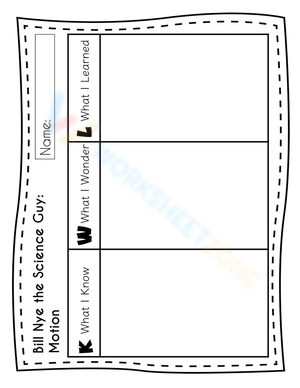
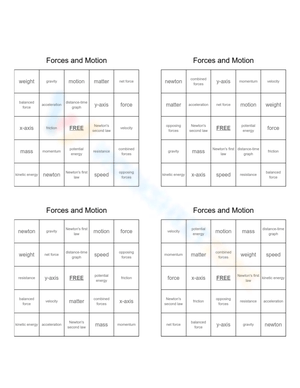
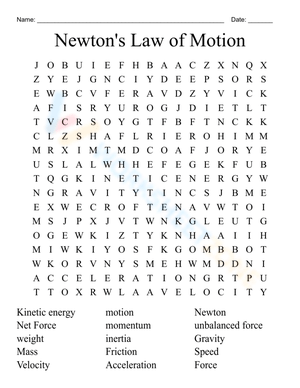
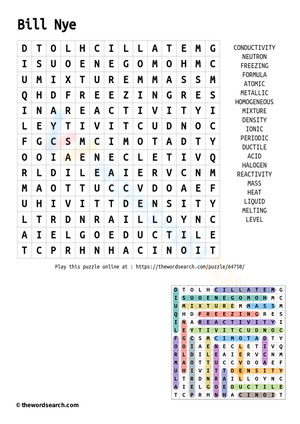
These bill nye motion worksheets for 4th grade give teachers a ready-made structure for turning video time into actual science practice — students watch, record, and explain what they observed rather than sitting passively through a clip. The set focuses on the concepts 4th graders are expected to describe and explain: position, speed, direction, pushes and pulls, gravity, and friction. That's a tight target for a reason, because 4th graders are in the middle of a genuine language shift — moving from "it went fast" to "friction slowed it down" — and these worksheets give them repeated practice making exactly that move.
What the Worksheets Target
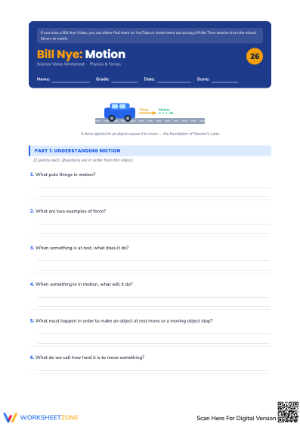
Each worksheet asks students to do three things: notice what is moving, describe how it moves, and explain what caused a change in that motion. Those are the actual science thinking moves behind NGSS physical science expectations at this grade, and they map directly to what Bill Nye covers in his motion episodes — objects in motion, forces that start or stop movement, and everyday examples like balls rolling, bikes braking, and objects in free fall.
The skills covered across the set include:
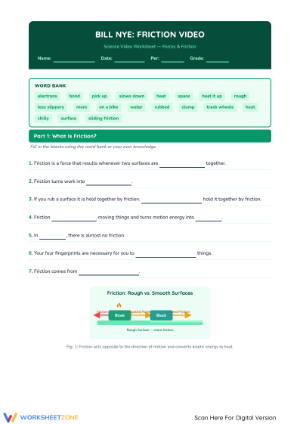
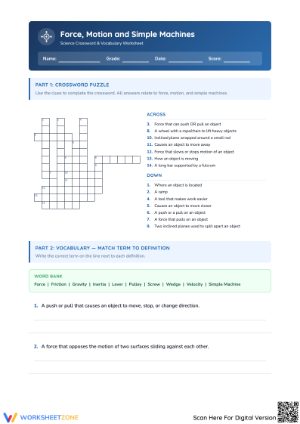
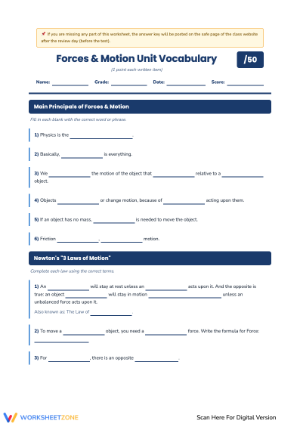
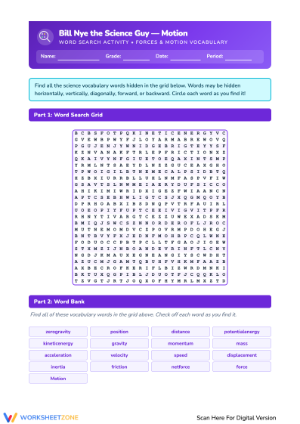
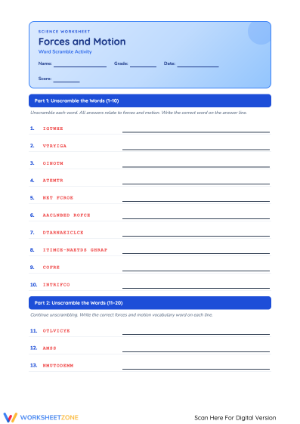
- Vocabulary identification: students match or complete definitions for speed, friction, gravity, direction, position, push, and pull
- Observation recording: during-viewing prompts ask students to write one sentence describing what they saw, not what they remember from prior knowledge
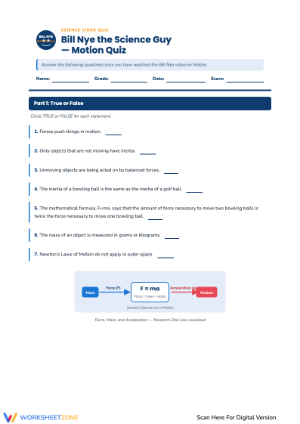
- Cause-and-effect reasoning: short-answer items ask students to name the force and then describe what changed — for example, "friction slowed the bike because the brakes pressed against the wheel"
- Real-world application: follow-up questions connect video examples to everyday motion, such as why a ball rolls farther on a gym floor than on grass
The reading load is kept deliberately low. Questions are direct and spaced generously, which matters when students are also listening and watching simultaneously. Cognitive load is real during video lessons — if decoding the question costs too much attention, students stop attending to what's happening on screen.
Student Errors Worth Anticipating Before the Video Runs
The most persistent error in 4th-grade motion work is conflating a change in speed with a change in direction. Students write that an object "changed its motion" when a ball curves, but they mean direction, not speed — and they don't register the distinction yet. A well-constructed worksheet separates these two ideas across different questions so students are forced to use both terms in context rather than interchangeably.
A second problem: students treat friction as something that only stops objects, not something that gradually slows them. After watching a segment where a toy car decelerates across carpet, many students write "the carpet stopped the car" rather than "friction gradually slowed the car until it stopped." That phrasing difference is the whole science point, and the application questions on each worksheet specifically ask students to describe the process, not just the outcome.
Vocabulary confusion between gravity and friction also shows up frequently. Students who correctly used both terms in whole-class discussion will reverse them on paper, especially when the worksheet question appears late in a session. A brief pre-viewing word wall with one example sentence per term — posted before the clip starts — catches this before students put the wrong answer in writing.
How to Work These Worksheets Into Your Science Block
The most effective use is a three-part routine: spend 4–5 minutes on vocabulary before the video starts, run the clip with one or two planned pause points, and give students 6–8 minutes after viewing to complete the application questions while the content is still fresh. That's a tight 20-minute window that works even when science gets pushed to the last part of the afternoon. With bill nye motion worksheets for 4th grade already printed and vocabulary terms posted on the board, there's no setup lag — students know the structure and settle into it quickly.
For small-group rotations, one group watches a 5-minute clip and fills in the during-viewing section, a second group tests motion using ramps and objects on different surfaces, and a third group works through vocabulary items independently. Groups that haven't seen the clip yet complete the observational questions when their rotation arrives — this works cleanly when pause points are marked on a note left with the other groups.
One move that consistently improves focus: before the clip starts, pre-circle 5 or 6 specific questions on each student's worksheet and tell the class those are the must-answer items. In most 4th-grade rooms this narrows attention in a useful way — students stop trying to capture everything and start listening for the details that actually matter. It also gives you a clean, comparable set of responses to scan after class rather than a worksheet where every student answered different questions.
In a sub plan, use each worksheet as the anchor task for the science period. Leave a note telling the sub to read the first two questions aloud before the video begins and to pause at the 7-minute mark for a quick check on the vocabulary terms.
Standard Alignment
These worksheets align most directly to NGSS 3-PS2-1 and 3-PS2-2, which address how forces affect the motion of objects, and to 4-PS3-1, which asks students to use evidence to connect an object's speed to its energy. Many 4th-grade teachers introduce this video-based work after students have completed hands-on investigation with ramps or surface materials — at that point, the worksheet gives students a second pass at the language using new examples, reinforcing the vocabulary from the lab through spaced retrieval rather than one-time exposure. That second encounter matters: students who met the word "friction" during a ramp investigation and then encounter it again in a video context are more likely to use it accurately in written explanation.
State science standards that follow NGSS framing use nearly identical language, so this set transfers cleanly to most US classrooms. Teachers working under state-specific physical science standards should confirm the exact force-and-motion strand for Grade 4, but the core concepts — push, pull, friction, gravity, change in motion — appear across all major state frameworks at this level.
Adjusting These Worksheets for the Range in Your Room
For students who need reading support, the most useful move is reading each question aloud before the relevant video segment plays. Students who struggle with academic vocabulary in print can still show solid science understanding when they hear the question stated clearly. Pairing each key term with a quick classroom gesture — miming a push or a pull, pressing palms together for friction — gives multilingual learners a physical anchor that's faster and more durable than a written definition alone.
Students who finish early can take on an extension prompt that isn't on the worksheet itself: ask them to describe one motion example they observed at recess or in PE, name the forces involved, and explain what caused the motion to start or stop. That pulls the science thinking out of the video context and into a real experience — a harder thinking move than answering a question about something they just watched on screen.
For students who benefit from more structure, complete the first two items as a class before the video runs. Show exactly how much to write and where to write it — this reduces the mid-video confusion where students aren't sure whether to answer during the clip or after. One honest limitation of the during-viewing format: students who have significant reading difficulties and no paraprofessional support in the room find it genuinely frustrating. The worksheet moves faster than they can process both the audio and the written prompt simultaneously. For those students, assign only the post-viewing application section, using the video as a shared anchor and the written task as a follow-up reflection. Finding bill nye motion worksheets for 4th grade resources available in both print-ready and editable formats lets you make these adjustments directly in the file rather than rewriting items by hand.
Frequently Asked Questions
Can these worksheets be used without showing the full episode?
Yes — and for most class periods, a full episode runs longer than the available time anyway. Use the first 5–8 minutes of the motion episode, pause at a clear example of a force changing an object's motion, and assign only the questions that correspond to what students watched. The vocabulary and application sections of each worksheet hold up on their own without the full video, especially when students have already done hands-on motion investigation earlier in the unit.
What question formats appear across the set?
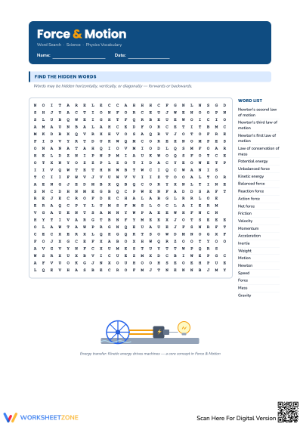
Each worksheet uses short-answer prompts, vocabulary matching, and observation questions tied to specific moments in the video. Responses are one to two sentences — no extended writing. This keeps the task focused on science reasoning about motion rather than paragraph composition, which matters when students are also managing the cognitive demands of watching and listening at the same time.
How do I tell whether a downloaded worksheet is pitched at the right grade level?
The clearest signal is whether the questions ask students to explain forces and their effects rather than simply name them. A prompt aimed at 3rd grade asks "What is friction?" A prompt written for 4th grade asks "What did friction do to the car's speed, and why?" If the questions in a bill nye motion worksheets for 4th grade resource only ask for definitions, the sheet is likely written for a lower grade and won't move students far enough toward scientific explanation — which is the skill 4th-grade physical science is actually building.












 Interactive Worksheet Maker
 Quiz Maker
 Word Search Maker
 Crossword Puzzle Maker
 Word Scramble Generator
 Sentence Scramble Generator
 Handwriting Worksheet Generator
 Name Tracing Generator
 Fill In The Blank Generator