


























Views
Downloads
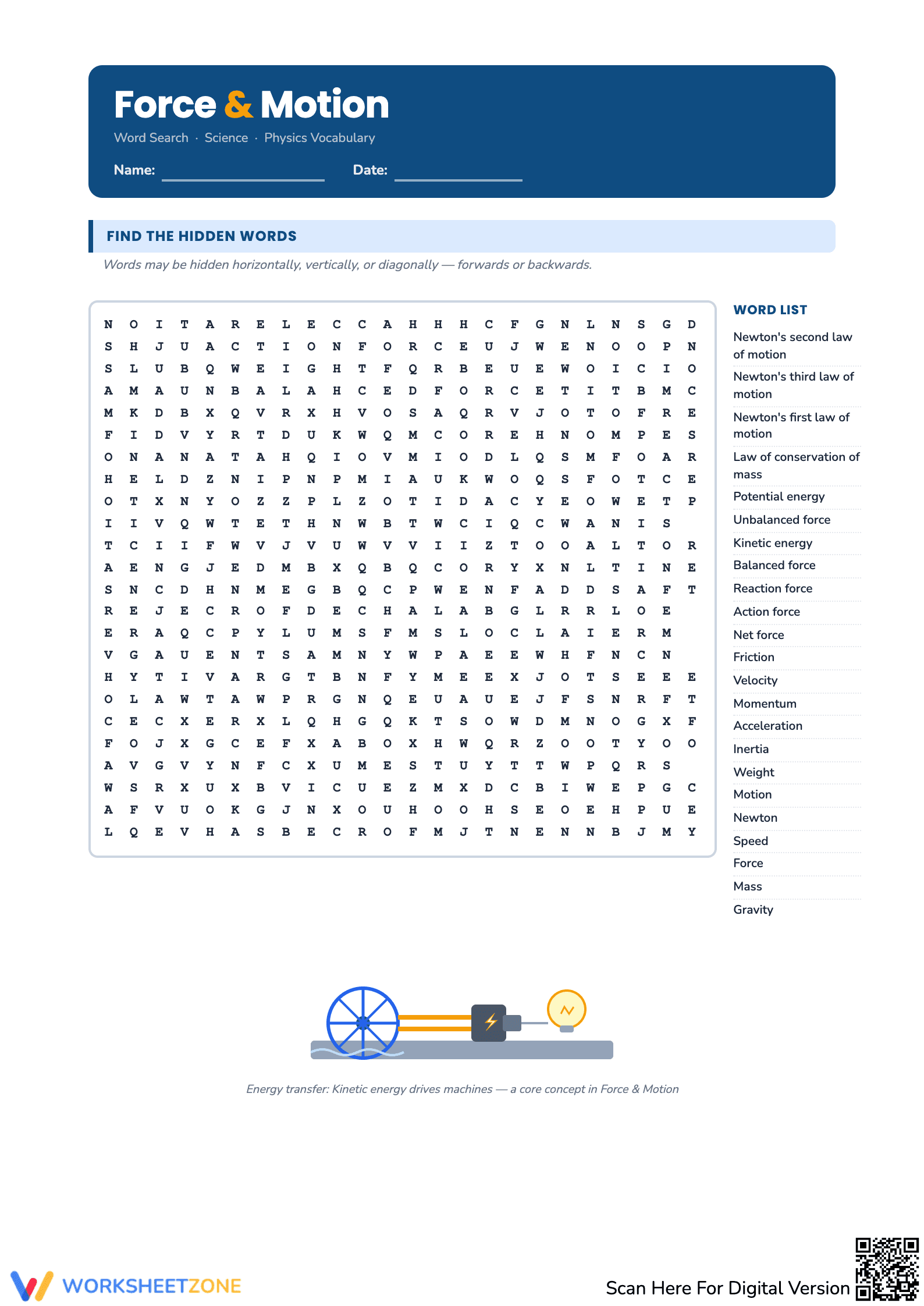

Printable Force & Motion Word Search | Grades 3-5 Science
Paste this activity's link or code into your existing LMS (Google Classroom, Canvas, Teams, Schoology, Moodle, etc.).
Students can open and work on the activity right away, with no student login required.
You'll still be able to track student progress and results from your teacher account.
This force and motion vocabulary worksheet helps students master essential physics terms while applying their knowledge to real-world concepts. By combining a classic word search with targeted reflection questions, learners actively engage with scientific terminology, ensuring they understand the mechanics of movement, energy, and physical forces.
At a Glance
- Grade: 3 · Subject: Science
- Standard:
3-PS2-1— Understand effects of balanced and unbalanced forces- Skill Focus: Force and motion vocabulary
- Format: 2 pages · 7 problems · PDF
- Best For: Independent practice
- Time: 20–30 minutes
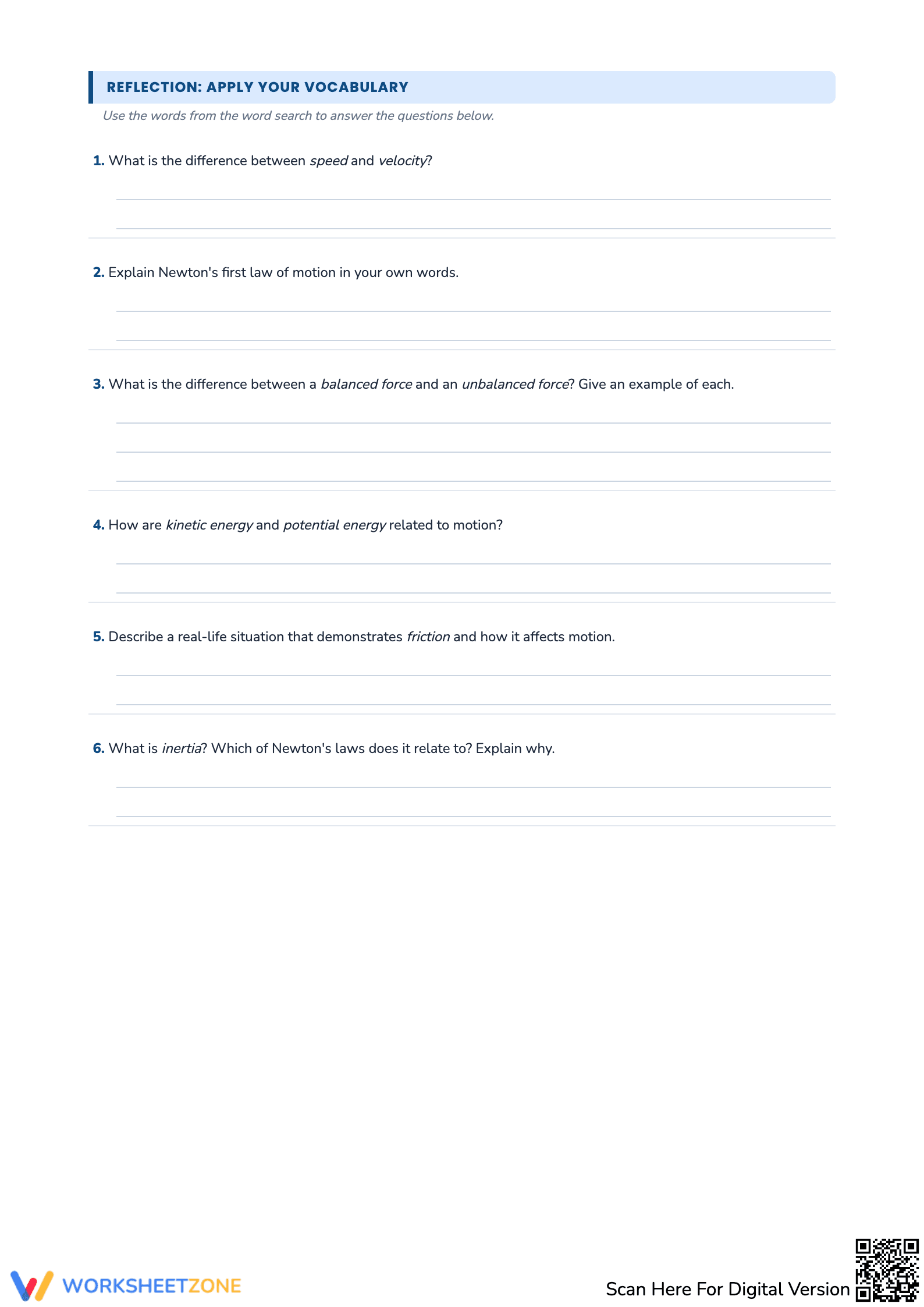
This two-page resource features a comprehensive 22-word vocabulary puzzle on the first page, covering critical terms like inertia, friction, kinetic energy, and Newton's laws. The second page contains six short-answer reflection questions that require students to define concepts in their own words, compare related terms such as speed and velocity, and provide real-life examples of physical forces in action.
Designed for immediate classroom implementation, this resource requires minimal teacher preparation:
- Print (1 minute): Simply print the two-page PDF double-sided to save paper.
- Distribute (1 minute): Hand out the worksheets at the beginning of a science block or as a fast-finisher activity.
- Review (5 minutes): Discuss the reflection questions as a whole class to check for conceptual understanding.
With under two minutes of total prep time, this activity serves as an excellent emergency sub plan or a quiet independent task during science rotations.
This worksheet aligns directly with Next Generation Science Standard 3-PS2-1: Plan and conduct an investigation to provide evidence of the effects of balanced and unbalanced forces on the motion of an object. The reflection questions specifically target the conceptual understanding of these forces. Both standard codes can be copied directly into lesson plans, IEP goals, or district curriculum mapping tools.
Teachers can utilize this worksheet as a formative assessment after direct instruction on Newton's laws. As students complete the reflection questions, educators can observe whether learners accurately distinguish between balanced and unbalanced forces. Alternatively, it functions perfectly as a vocabulary introduction at the start of a physics unit. Students can complete the word search to familiarize themselves with the terminology, then tackle the reflection questions later. Expected completion time ranges from 20 to 30 minutes.
This resource is designed for third, fourth, and fifth-grade science students. The familiar word search format provides a low-barrier entry point for learners who might struggle with complex texts, while the short-answer questions offer an extension for advanced students to demonstrate deeper comprehension. It pairs exceptionally well with hands-on physics experiments.
Mastering scientific terminology is a critical step in developing broader STEM literacy and ensuring students are prepared for advanced coursework. According to a recent ScienceDirect TpT Analysis, integrating vocabulary practice with conceptual application questions significantly improves long-term retention of complex physics principles in elementary classrooms. When students interact with terms like inertia, velocity, and friction in multiple formats—such as locating them in a visual puzzle and then defining them in a written context—they build much stronger cognitive connections. This specific resource supports that evidence-based pedagogical approach by aligning directly with 3-PS2-1, helping students understand effects of balanced and unbalanced forces through targeted reflection. By requiring young learners to articulate the differences between related concepts and provide real-world examples, educators can effectively bridge the gap between rote memorization and genuine scientific inquiry, ensuring foundational physics concepts are firmly established.


