




























Views
Downloads

Bill Nye Science Vocabulary Worksheet | Grade 5 Ready

Paste this activity's link or code into your existing LMS (Google Classroom, Canvas, Teams, Schoology, Moodle, etc.).
Students can open and work on the activity right away, with no student login required.
You'll still be able to track student progress and results from your teacher account.
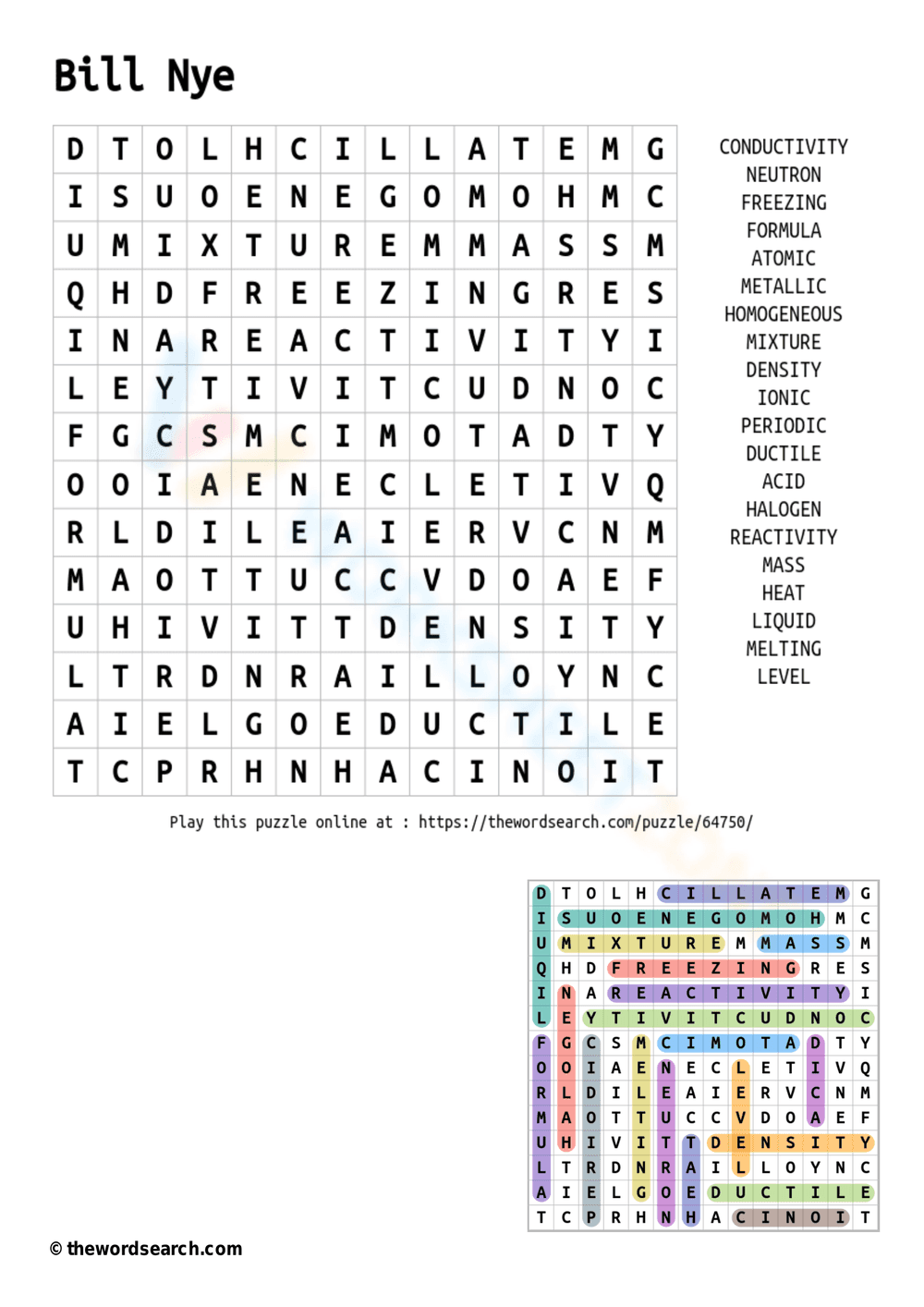
This Grade 5 science worksheet provides a focused vocabulary activity to reinforce key concepts related to matter and physical properties. Students identify 20 essential terms within a structured word search, helping them internalize the language of physics and chemistry. It is an effective tool for building scientific literacy and term recognition.
At a Glance
- Grade: 5 · Subject: Science
- Standard:
5-PS1-3— Make observations and measurements to identify materials based on their properties- Skill Focus: Science Vocabulary Reinforcement
- Format: 1 page · 20 problems · Answer key included · PDF
- Best For: Independent practice or sub plans
- Time: 15–20 minutes
The resource consists of a single-page PDF featuring a high-density word search grid. It includes 20 specific vocabulary words such as density, reactivity, conductivity, and homogeneous. The layout is clean and professional, ensuring readability for middle-grade students. A complete answer key is provided at the bottom of the page, allowing for immediate self-correction or rapid teacher grading.
This worksheet is designed for a zero-prep classroom environment. The workflow is simple: Print the required number of copies (30 seconds), Distribute to students as they enter or after a video segment (1 minute), and Review the definitions of the found words as a whole group (5 minutes). Total teacher preparation time is under 2 minutes, making it an ideal emergency sub plan or transition activity.
This activity aligns with 5-PS1-3, which requires students to identify materials based on their properties. By interacting with terms like "metallic," "ductile," and "mass," students build the foundational lexicon necessary to describe physical and chemical changes. Both standard codes can be copied directly into lesson plans, IEP goals, or district curriculum mapping tools.
Use this worksheet as a supplemental activity immediately following a science video or direct instruction on the periodic table. It serves as an excellent formative assessment tool; observe which students struggle to recognize terms like "neutron" or "halogen" to identify gaps in conceptual understanding. Completion typically takes 15 to 20 minutes depending on student familiarity with the terms.
This resource is tailored for Grade 4 through Grade 6 students studying physical science. It is particularly helpful for English Language Learners (ELLs) who benefit from repeated exposure to technical academic language. Pair this with a physical properties anchor chart or a hands-on lab involving density and conductivity for a comprehensive learning experience.
Vocabulary acquisition in the sciences is a critical predictor of long-term academic success. According to Fisher & Frey (2014), intentional word-exposure activities like this 5-PS1-3 aligned worksheet help students move from surface-level recognition to deep conceptual mastery. By isolating 20 specific terms such as "conductivity" and "reactivity," the resource provides the repetitive cognitive engagement necessary for memory retention. Research indicates that when students interact with domain-specific language in low-stakes formats, they develop the confidence to use those terms in more complex writing and inquiry-based tasks. This worksheet bridges the gap between passive observation and active literacy, ensuring that the language of physics becomes a permanent part of the student's lexicon. It serves as a reliable component of a gradual-release instructional model, supporting the transition from teacher-led explanation to independent student application in various scientific contexts.


