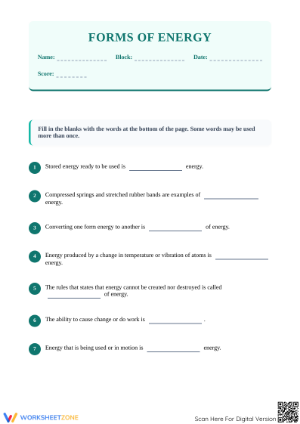
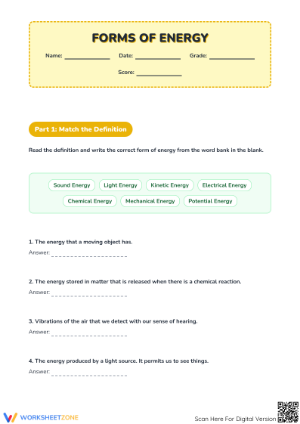
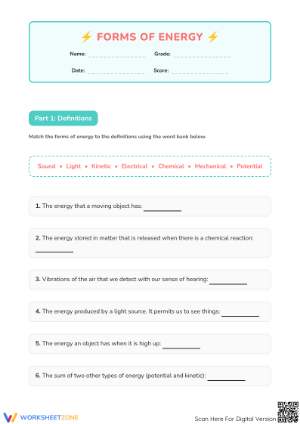
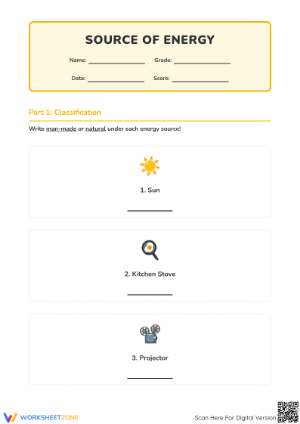
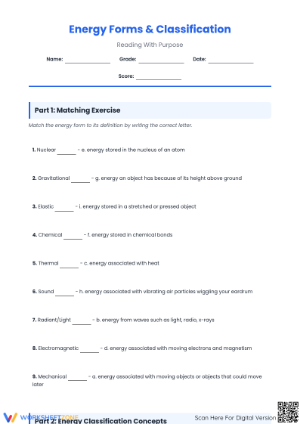
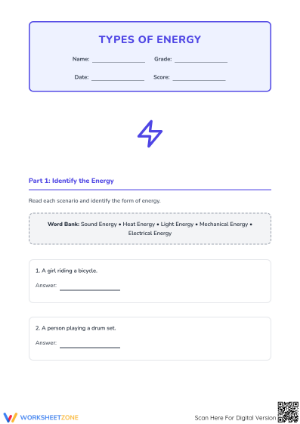
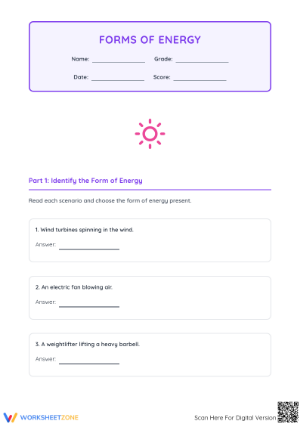
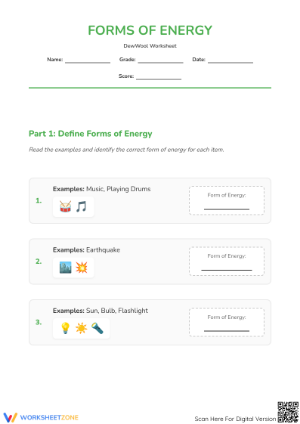
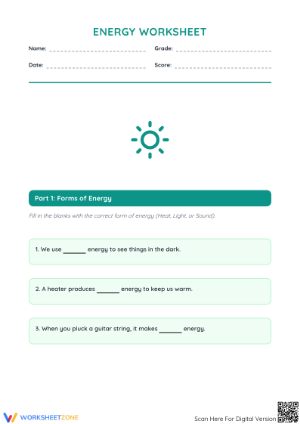
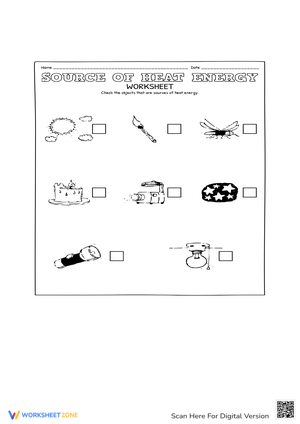
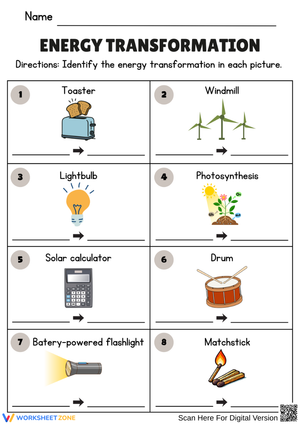
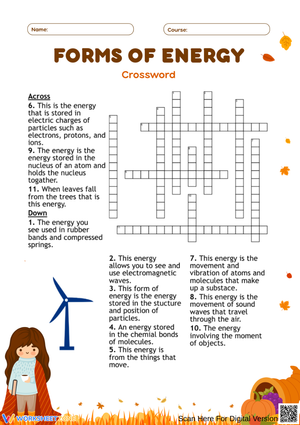
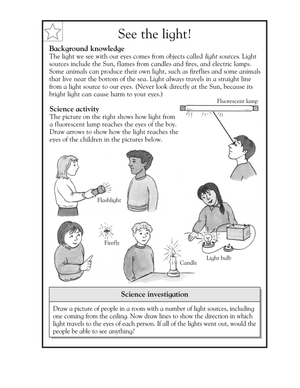
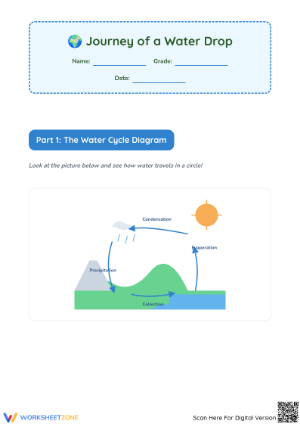
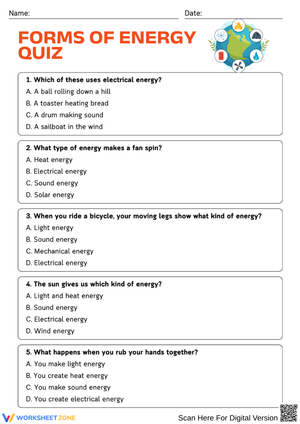
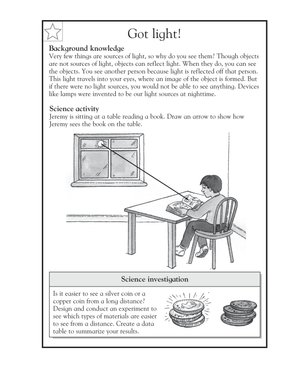
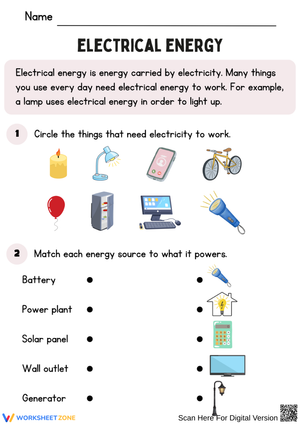
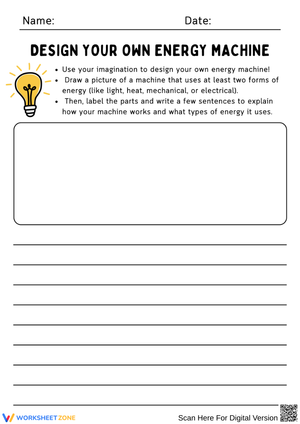
These forms of energy worksheets for 4th grade give teachers a printable, low-prep way to move students past vocabulary recitation and into actual classification work. The set focuses on the four energy forms central to Grade 4 physical science — light, sound, heat, and electrical — using familiar objects as the basis for every task. Students sort, label, match, and explain, which means they use science vocabulary in context rather than just reading it off a word wall.
What Students Practice in This Set
A strong set of forms of energy worksheets for 4th grade keeps tasks close to visible, familiar objects and short, manageable response formats. The skill progression moves from recognition toward reasoning — starting with picture sorts and matching, then building toward labeled diagrams and brief written explanations that require students to apply what they know.
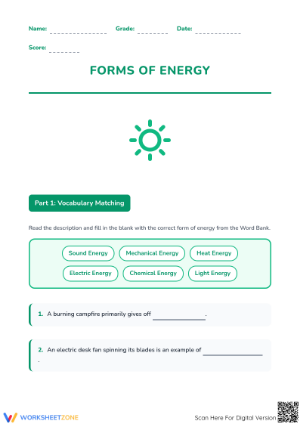
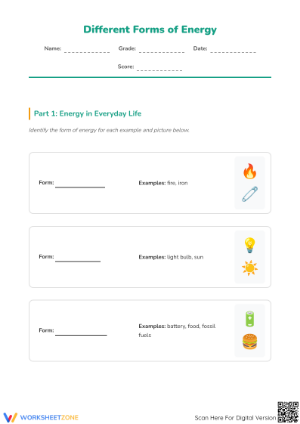
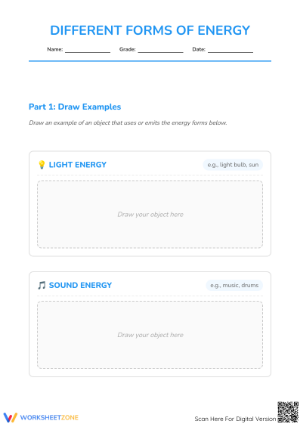
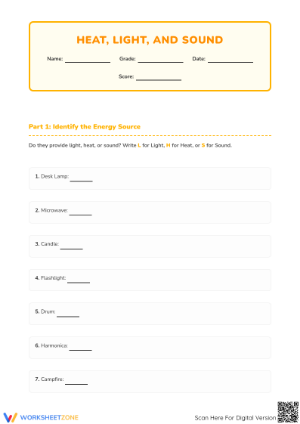
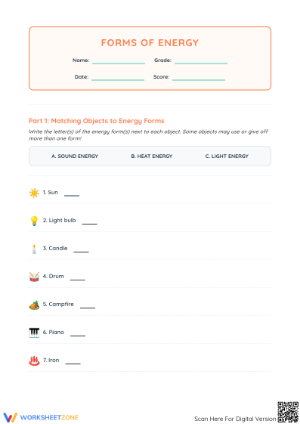
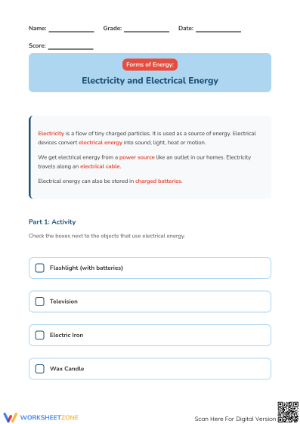
- Sorting tasks: Students group images or written examples under light, sound, heat, or electrical energy — a classification move that demands more active decision-making than matching alone.
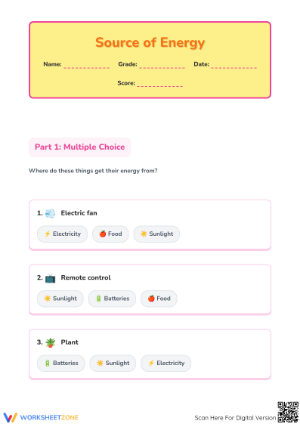
- Source-to-form matching: Students connect objects like batteries, the sun, a candle, and a speaker to the form of energy each produces.
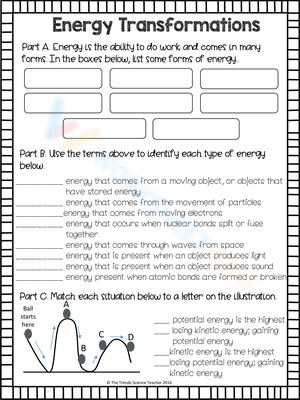
- Diagram labeling: Students annotate simple illustrations with the correct energy term, building both vocabulary and visual science literacy at the same time.
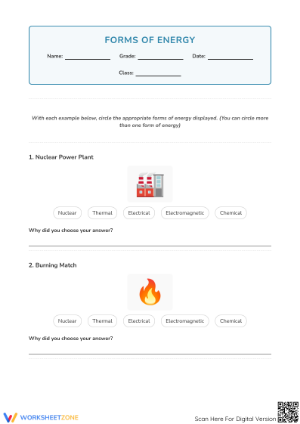
- Short constructed response: Students write one or two sentences explaining how they identified the energy form, putting lesson vocabulary to work in their own words.
That last task type carries the most instructional weight. Written explanation is where teachers find out whether a student understands that a lamp emits light energy because it produces visible light — or whether they wrote "light" simply because a lamp is bright. The surface answer looks correct either way; the reasoning reveals the difference.
Student Mistakes That Surface Every Time You Teach This Unit
The most consistent classification error at this grade level is treating multi-output objects as single-form examples. A lamp produces both light and heat, and students who have been told to associate lamps with light energy will resist adding heat as a second correct answer even when a worksheet explicitly pushes them to think further. The same issue appears with toasters, which students strongly link to heat but which also glow visibly when the coils are hot.
A second pattern involves confusing the source with the form. Students write "sun" instead of "light" or "battery" instead of "electrical energy" because the question asks for an energy form and they answer with the object that produces it. A brief modeling step — pointing to the object, then talking through the chain from source to form — reduces this error substantially before independent practice begins.
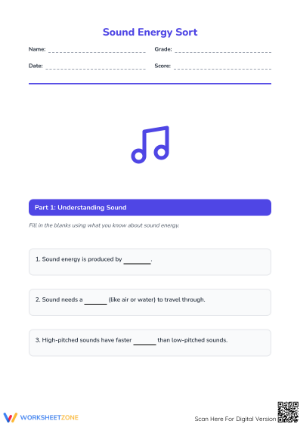
Sound-specific confusion is the third predictable issue. Students experience sound, so they tend to describe it as something that happens to them rather than as energy moving through matter. When a worksheet asks why a ringing bell represents sound energy, many students write "because it makes noise" instead of connecting the bell's vibration to the transfer of energy through the air. That conceptual bridge — vibration, to movement, to energy transfer — takes more than one lesson to build.
Building These Worksheets Into Your Weekly Science Routine
These worksheets do their best work after students have interacted with real objects — not before. A five-minute opening activity where students touch a warm mug, hear a tuning fork vibrate, or track a flashlight beam gives them a sensory anchor that makes subsequent sorting and labeling significantly more accurate. The worksheet consolidates that experience; it doesn't replace it.
For lesson sequencing, a cut-and-sort or matching worksheet runs well as a science center or partner activity on the second day of a lesson sequence. Use day one for direct instruction and hands-on exploration, day two for collaborative classification work, and day three for a short independent worksheet that serves as a formative check. At that third point, asking students to justify a single answer in writing — rather than complete every item — gives clearer evidence of understanding without turning the lesson into a full writing block.
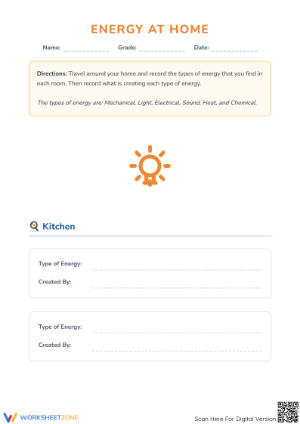
The resources also connect to a classroom object hunt with almost no extra planning. Before students pick up a pencil, ask them to identify one example of each energy form somewhere in the room. Students who locate the projector (light and electrical), the HVAC vent (heat), and the intercom speaker (sound) before they begin classifying on paper make far fewer errors when independent work starts.
Standard Alignment
These worksheets address NGSS 4-PS3-2, which asks students to make observations that provide evidence energy can be transferred from place to place by sound, light, heat, and electric currents. In classroom terms, this standard appears early in a Grade 4 energy unit as the identification and classification phase — before students move into energy transfer and conversion work in later lessons. The tasks here sit squarely in that opening phase: students observe, classify, and explain what type of energy a source produces, which is the foundational reasoning 4-PS3-2 requires before any transfer or conversion concept can take hold.
Differentiating the Set for a Range of Learners
Forms of energy worksheets for 4th grade work across readiness levels when teachers select response formats that match what each student can do independently right now. The classification content stays consistent — light, sound, heat, electrical — but the way students demonstrate understanding varies by task design.
- Picture-supported sorting with a word bank: Reduces reading load and vocabulary retrieval pressure for students who understand the concepts but struggle with written language demands.
- Multiple-choice identification: Allows students to recognize correct answers rather than produce them from memory, which lowers the task barrier while keeping the science content unchanged.
- Cut-and-paste classification: Gives hands-on learners a tactile option that works well in centers or partner stations.
- Short constructed response without a word bank: Pushes students with strong concept knowledge to explain their reasoning and use technical vocabulary without guided support.
- Multi-form labeling tasks: For students ready to go deeper, each worksheet that asks them to list all energy forms a single object produces — not just one — surfaces more sophisticated thinking about energy output.
One practical move: assign a picture-sort version as a paired activity early in the unit, then assign a written-response version independently later that same week. The repeated format reduces task confusion so students spend their attention on the science content rather than figuring out what the worksheet is asking them to do.
Frequently Asked Questions
What energy forms should Grade 4 students be able to identify?
Grade 4 students work primarily with light, sound, heat, and electrical energy — all forms they can observe through everyday objects. The strongest worksheets use items students encounter regularly: lamps, flashlights, speakers, batteries, toasters, the sun. Mechanical energy appears in some Grade 4 units as well, particularly when a lesson connects moving objects to stored or transferred energy, but light, sound, heat, and electrical are the core four for this grade level.
Can these worksheets function as formative assessment tools?
A short matching or labeling worksheet used mid-lesson or at the close of class gives teachers a fast read on vocabulary accuracy. Adding even one sentence of written justification per item makes the check more informative — a student who selects "electrical energy" for a battery and writes "because a battery powers things" is working at a different level than one who writes "because the battery stores energy that converts to electrical current when the circuit closes." Both answers circle the right idea, but the second signals the student is ready to move on.
Are these worksheets appropriate for homework assignments?
When each worksheet uses familiar household objects as examples, homework is a reasonable fit. Students who classify a refrigerator, television, oven, or light switch at home are working with examples that carry genuine daily context. The forms of energy worksheets for 4th grade in this set rely on exactly that kind of everyday scenario, which makes independent homework completion more realistic than worksheets built around technical diagrams students haven't encountered in class. Matching and sorting formats with short, clear directions tend to travel home most successfully.
How many worksheets from this set does a typical unit need?
Most Grade 4 energy units spend three to five days on the identification and classification phase before moving into energy transfer concepts. In that window, two to three worksheets — one for collaborative practice, one for independent work, and one for unit review — cover the instructional ground without repetition. Teachers who want a more extended review period before a unit assessment can pull additional worksheets from the set without repeating the same format twice in a row.












 Interactive Worksheet Maker
 Quiz Maker
 Word Search Maker
 Crossword Puzzle Maker
 Word Scramble Generator
 Sentence Scramble Generator
 Handwriting Worksheet Generator
 Name Tracing Generator
 Fill In The Blank Generator