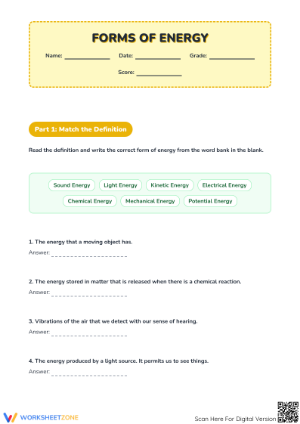
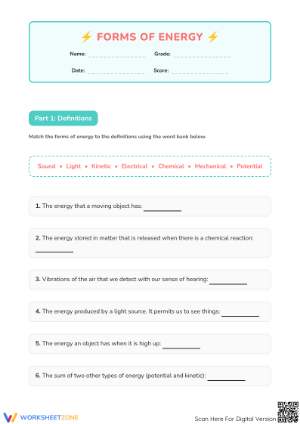
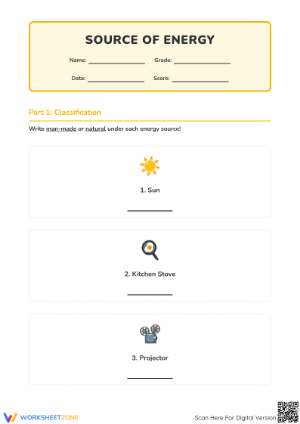
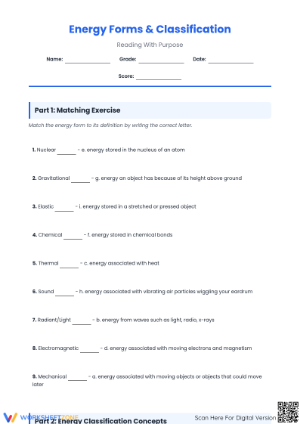
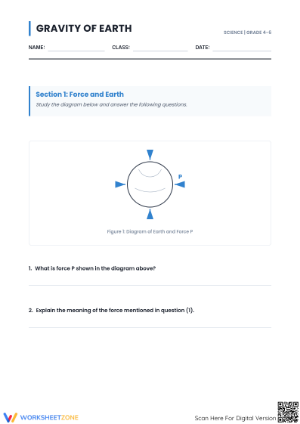
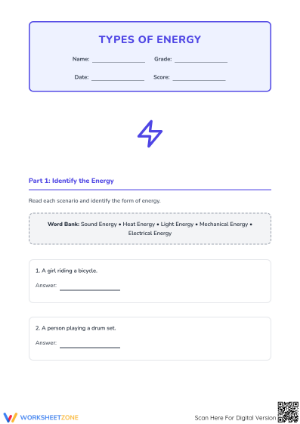
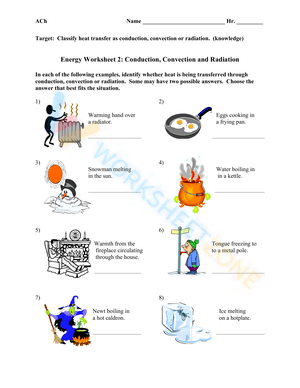
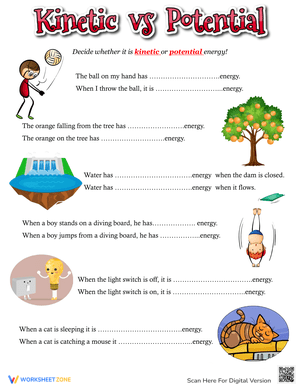
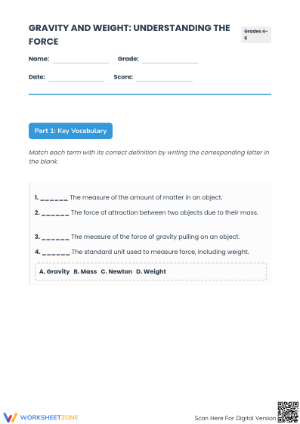
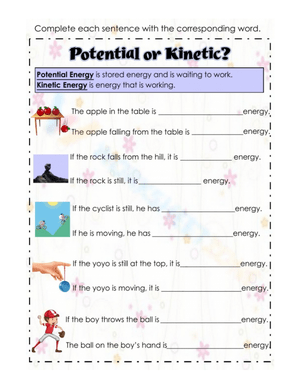
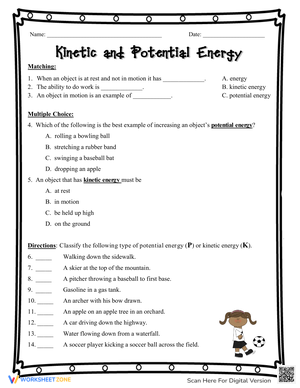
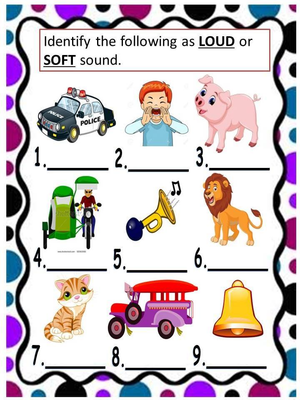
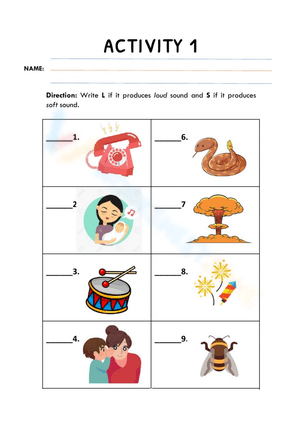
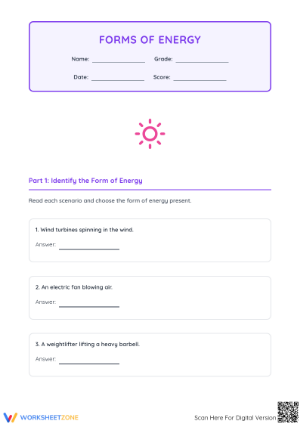
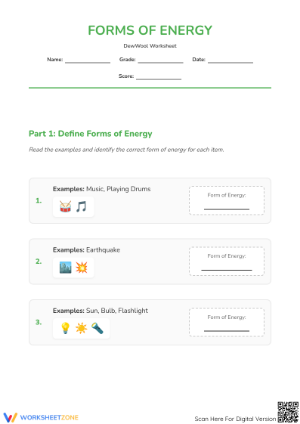
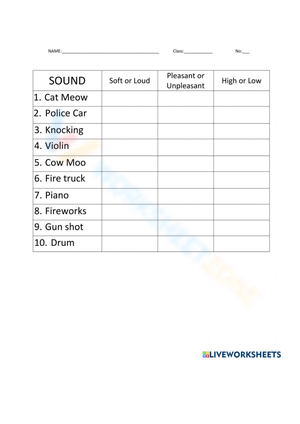
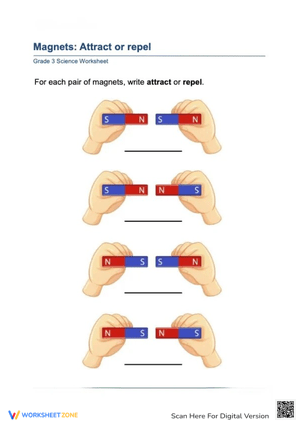
These energy sound and light worksheets for 4th grade give teachers a bank of printable tasks that target specific physics concepts — vibrations, wave behavior, light transmission, and material properties — without requiring extensive prep or special lab equipment. Each worksheet isolates a clear concept so students practice applying science language, not just recalling definitions from a word wall.
What Students Practice Across the Set
The worksheets focus on the concepts fourth graders are expected to explain, not just name. That means students are asked to rewrite an idea in their own words, label a diagram accurately, sort objects by a property, or predict what will happen before they observe it.
- Sound as vibration: Students annotate diagrams showing a vibrating ruler, a plucked guitar string, or a drumhead in motion — connecting the physical movement to the sound produced.
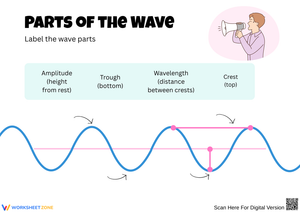
- Volume and pitch: Students compare sounds using wave diagrams, identifying that amplitude relates to volume and frequency relates to pitch — two properties students frequently conflate.
- Light behavior: Students describe and sort examples of reflection, refraction, absorption, and shadow formation using real-world objects as reference points.
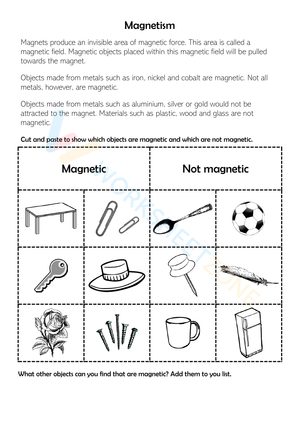
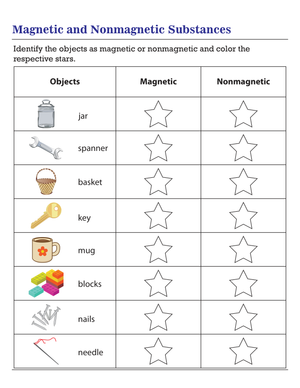
- Material classification: Students sort items — clear plastic wrap, wax paper, cardboard, frosted glass — based on how much light passes through each one, then justify their placement.
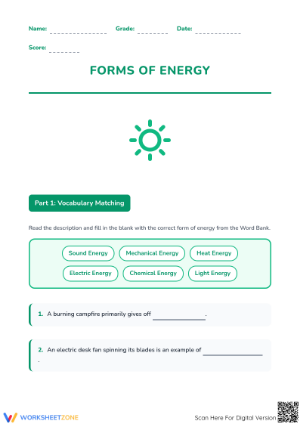
- Real-world application: Students explain how a flashlight, window, mirror, or instrument demonstrates the energy concepts covered in the unit.
One format that consistently produces stronger student work is the predict-observe-explain sequence. Rather than fill-in-the-blank, each worksheet that uses this structure asks students to commit to a prediction first, then record what they observed, then explain the confirmation or discrepancy. That three-step format forces thinking rather than answer-copying.
Mistakes Students Make That These Worksheets Help You Catch
Pitch and volume are the single most reliable source of confusion in this unit. Students know that banging a drum harder makes it louder, so they assume louder and higher-pitched are the same property. A student asked to explain why a piccolo sounds higher than a tuba will often write that the piccolo is louder — not that its vibrations occur faster. A worksheet showing wave diagrams side by side, one with greater amplitude and one with greater frequency, makes the distinction visible in a way that a class discussion alone rarely achieves.
The transparent-translucent boundary is another predictable sticking point. Wax paper is the classic example: students hold it up, see that it's not clear, and mark it opaque — missing that some light does pass through. A sorting worksheet that includes wax paper alongside clear plastic wrap and aluminum foil forces students to test their reasoning rather than rely on first impressions.
A third common error involves what happens to light when it strikes an opaque surface. Many fourth graders write that light "stops" or "disappears." The accurate explanation — that light energy is absorbed and converted — is harder to retain. Short written-response prompts that ask students to explain what happens to the energy, not just what happens to the light beam, catch this gap early enough to address before the unit assessment.
Building These Worksheets Into Your Weekly Science Block
The set works best when a worksheet follows a direct experience rather than precedes it. Pluck a rubber band stretched over a ruler before students complete the vibration labeling worksheet; run a flashlight through wax paper, clear plastic, and cardboard before students sort materials by light transmission. The distance between worksheet answers and observed reality closes quickly when students have something concrete in recent memory — even if the demonstration ran only three minutes.
Within a five-day unit, a useful pacing rhythm puts vocabulary and labeling tasks on Monday, moves into investigation recording sheets Tuesday and Wednesday, then uses matching and sorting tasks Thursday for reinforcement, and closes Friday with a mixed-format review. That structure returns students to the same science vocabulary across the week through different task types — spaced retrieval without designing a separate review activity from scratch.
Energy sound and light worksheets for 4th grade also work in those eight minutes before pickup or right after students return from specials — short labeling or matching tasks that re-anchor the day's concept without launching a new activity. The shorter worksheets in the set are worth keeping accessible for exactly those pockets of time. For centers, pair one task students can finish independently in about ten minutes with a second that requires more extended writing for early finishers. For homework, assign only tasks that rely on observation of household objects: identifying transparent, translucent, or opaque materials at home works reliably; tasks requiring a flashlight and a mirror depend too much on what each student has access to.
Adjusting the Set for a Range of Learners
For students who need more guided support, pair the worksheet with a reference card listing the key vocabulary alongside a small diagram — transparent, translucent, opaque, vibration, reflection, refraction, absorption. The task itself stays the same; the card reduces the cognitive load of holding new terms in working memory while simultaneously applying them. That small addition makes a meaningful difference for students who freeze when science vocabulary accumulates quickly.
Students who move through tasks quickly benefit most from explanation-heavy formats: a worksheet asking them to write their own real-world example for each light behavior, or to describe a simple test that would determine whether an unfamiliar material is transparent, translucent, or opaque. These tasks require going beyond classification and arguing for an answer — and they're harder to fake by glancing at a neighbor's worksheet.
Energy sound and light worksheets for 4th grade are not equally suited to every learner at the same moment in the unit. Students who haven't yet seen a wave diagram will struggle with frequency-amplitude comparisons; students who have just finished a flashlight investigation will handle material classification with far less difficulty. Sequencing tasks to match what students have recently experienced, rather than moving through the set in a fixed order, makes the differentiation less effortful to manage.
Standard Alignment
The worksheets address NGSS 4-PS4 — the fourth-grade Performance Expectations for Waves and Their Applications in Technologies for Information Transfer. Three specific expectations are covered:
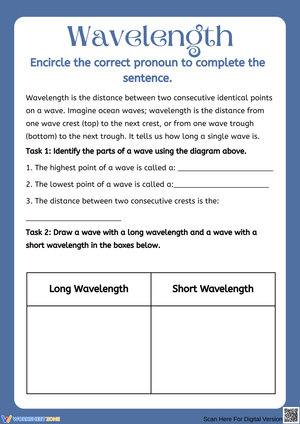
- 4-PS4-1 asks students to develop a model of waves describing patterns in amplitude and wavelength. The wave-diagram labeling tasks and pitch-versus-volume comparison worksheets connect directly to this expectation.
- 4-PS4-2 addresses how light reflecting from objects and entering the eye allows objects to be seen. Reflection, shadow formation, and material-classification worksheets support this standard.
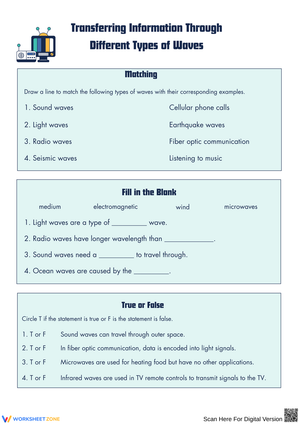
- 4-PS4-3 involves using patterns in wave behavior to transfer information. Vocabulary-focused and reading-response worksheets that connect sound and light to real communication technologies — sonar, mirrors as signals, fiber optics — serve this expectation.
In instructional terms, 4-PS4-1 and 4-PS4-2 typically form the core of the first two weeks, while 4-PS4-3 comes in near the end once students have enough vocabulary to engage with technology applications. Arranging the worksheets accordingly — labeling and sorting first, application and explanation tasks later — matches the progression most district pacing guides follow for this unit.
Frequently Asked Questions
Do these worksheets work if I don't have lab materials on hand?
Most of the set requires only a pencil. The diagram labeling, sorting, matching, and reading-response worksheets all work as independent tasks. The investigation recording worksheets are most useful when paired with a hands-on experience, but teachers have used them successfully as observation-recording practice during a teacher-led demonstration at the front of the room — students observe and record rather than test independently.
How many worksheets fit into a typical fourth-grade sound and light unit?
A two-to-three week unit can absorb roughly eight to twelve worksheets without the unit feeling worksheet-heavy. A useful rule of thumb: one worksheet per lesson segment — one for vocabulary introduction, one for each major concept (vibration, pitch and volume, light behavior, material properties), two to three for investigation recording, and one or two for review. That count also leaves room to skip tasks that don't fit your class's pace without creating gaps in coverage.
Which worksheets translate well into science stations?
Sorting and matching worksheets move into station rotation with minimal setup. A material-classification sort, a pitch-versus-volume wave comparison, and a light-behavior matching task each run about eight to ten minutes and require no adult facilitation once students understand the directions. The energy sound and light worksheets for 4th grade that hold up best in stations are the ones with clear visual examples, since students won't have a teacher nearby to clarify vocabulary mid-task.
How do I use these for formative assessment versus end-of-unit review?
For formative purposes, exit tickets and short explanation prompts — even a single written sentence answering "what caused that sound?" — reveal shaky understanding while there is still time to reteach. For end-of-unit review, mixed-format worksheets that ask students to label, sort, and write an explanation in one sitting give a fuller picture of what has been retained. The practical distinction is timing: formative tasks belong inside the unit, and review-focused worksheets belong at the end.












 Interactive Worksheet Maker
 Quiz Maker
 Word Search Maker
 Crossword Puzzle Maker
 Word Scramble Generator
 Sentence Scramble Generator
 Handwriting Worksheet Generator
 Name Tracing Generator
 Fill In The Blank Generator