




























Views
Downloads

Printable Magnetism Worksheet | Grades 3-5 Science

Paste this activity's link or code into your existing LMS (Google Classroom, Canvas, Teams, Schoology, Moodle, etc.).
Students can open and work on the activity right away, with no student login required.
You'll still be able to track student progress and results from your teacher account.
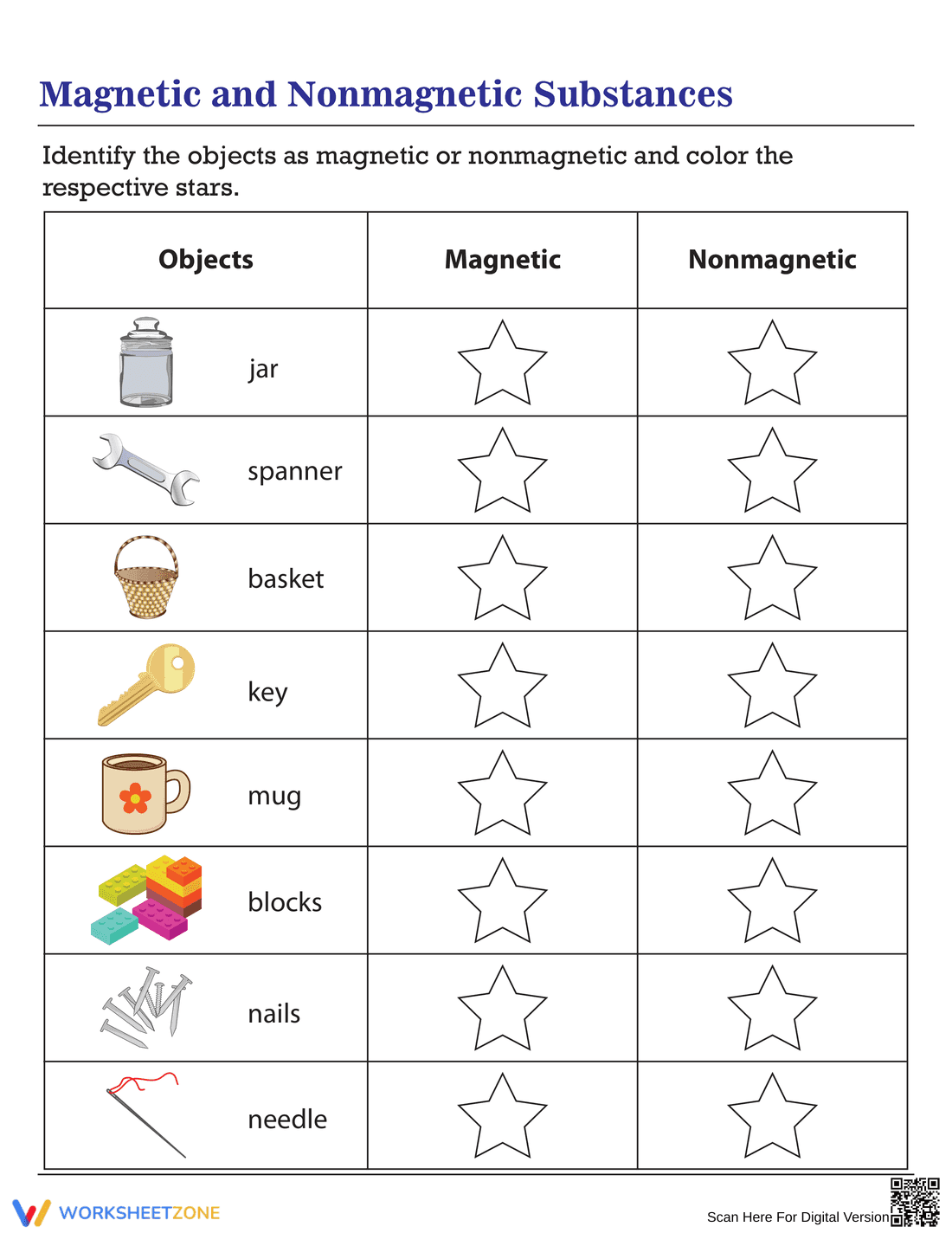
This printable science worksheet helps students identify magnetic and nonmagnetic substances through a simple, engaging classification activity. By evaluating everyday objects, learners build foundational physics knowledge about material properties and magnetic interactions, setting the stage for more advanced physical science concepts.
At a Glance
- Grade: 3-5 · Subject: Science
- Standard:
3-PS2-3— Identify materials that are attracted to magnets- Skill Focus: Classifying magnetic and nonmagnetic objects
- Format: 2 pages · 8 problems · Answer key included · PDF
- Best For: Independent practice or science centers
- Time: 10–15 minutes
This resource features a single-page classification table where students evaluate eight common objects, including a jar, spanner, basket, key, mug, blocks, nails, and a needle. Students color the corresponding star to indicate whether each item is magnetic or nonmagnetic. A complete, color-coded answer key is provided on the second page for quick grading or self-assessment.
Zero-Prep Workflow
- Print (1 minute): Simply print the single-page PDF for each student. No special materials or cutting required.
- Distribute (1 minute): Hand out the worksheets along with crayons or colored pencils for the star-coloring task.
- Review (2 minutes): Use the included visual answer key to quickly check student work or project it on a smartboard for whole-class review. Total teacher prep time is under two minutes, making this an excellent option for emergency sub plans.
Standards Alignment
Aligned to 3-PS2-3: Ask questions to determine cause and effect relationships of electric or magnetic interactions between two objects not in contact with each other. This activity specifically targets the prerequisite skill of identifying which materials respond to magnetic fields. Both standard codes can be copied directly into lesson plans, IEP goals, or district curriculum mapping tools.
How to Use It
Use this worksheet as an independent practice activity following a hands-on magnet exploration lab. It also works perfectly as a quick formative assessment at the end of a physics lesson. While students work, observe whether they correctly associate metals (like the spanner and nails) with magnetism while excluding non-metals (like the basket and blocks). Expected completion time is 10 to 15 minutes.
Who It's For
This worksheet is designed for third through fifth-grade science students learning about physical properties and forces. The visual nature of the objects makes it highly accessible for English Language Learners and students needing reading accommodations. Pair this activity with a physical magnet and a tray of real-world objects for a complete sensory learning experience.
Understanding the physical properties of materials is a fundamental component of early science education. This resource aligns with 3-PS2-3, helping students identify materials that are attracted to magnets. According to a 2024 report by EdReports, providing students with clear, visual classification tasks significantly improves their ability to categorize scientific phenomena and retain vocabulary related to physical properties. By evaluating everyday items like keys and wooden blocks, learners bridge the gap between abstract physics concepts and their tangible environment. This structured practice reinforces critical thinking and observation skills essential for later STEM coursework. The straightforward format ensures that students can focus entirely on the scientific concepts rather than complex instructions, leading to more accurate formative assessment data for educators.


