


























Views
Downloads


Kinetic and Potential Energy Worksheet | Grade 4-5 Ready
Paste this activity's link or code into your existing LMS (Google Classroom, Canvas, Teams, Schoology, Moodle, etc.).
Students can open and work on the activity right away, with no student login required.
You'll still be able to track student progress and results from your teacher account.
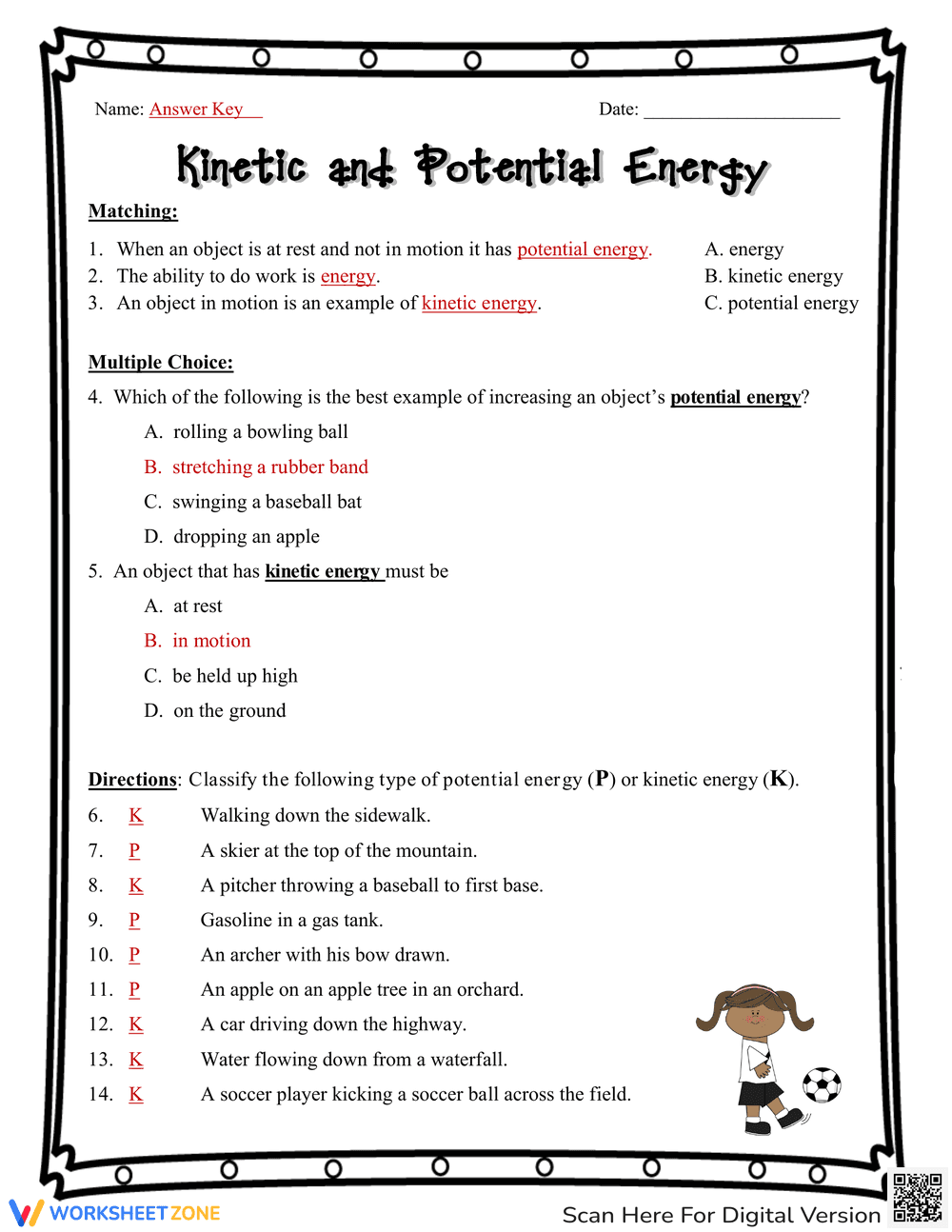
This Grade 4 and 5 science worksheet provides a clear framework for students to identify and differentiate between kinetic and potential energy. By engaging with real-world scenarios, learners develop a concrete understanding of how energy is stored or expressed through motion, ensuring they can accurately categorize various physical states.
At a Glance
- Grade: 4-5 · Subject: Science
- Standard:
4-PS3-1— Use evidence to explain the relationship between an object's motion and its energy- Skill Focus: Kinetic vs. Potential Energy classification
- Format: 2 pages · 14 problems · Answer key included · PDF
- Best For: Independent practice or formative assessment
- Time: 15–20 minutes
The resource contains 14 distinct tasks organized into three logical sections. It begins with a matching exercise to define core vocabulary, followed by multiple-choice questions that require conceptual application. The final section features nine classification items where students must label scenarios—such as a skier at the top of a mountain or a soccer player kicking a ball—as either potential or kinetic energy.
This resource is designed for a zero-prep workflow. Teachers can print the single-page student sheet in under 30 seconds. Distribution takes less than a minute, and the included answer key allows for a rapid 2-minute review or self-grading session. It serves as an ideal sub-plan or a quick check for understanding following a direct instruction lesson on energy types.
Aligned primarily to 4-PS3-1, this worksheet focuses on the foundational definitions of energy (PS3.A). It requires students to observe the state of an object to determine its energy type. Additionally, it supports 5-PS3-1 by reinforcing the concept of stored energy. Both standard codes can be copied directly into lesson plans, IEP goals, or district curriculum mapping tools.
Use this worksheet during the elaborate phase of a lesson cycle to reinforce definitions. It is also effective as a formative assessment exit ticket to gauge student mastery before moving toward energy transfer calculations. Expect students to complete the 14 items in approximately 15 to 20 minutes, depending on their reading level.
This activity is tailored for upper elementary students in general education or inclusive classrooms. The clear layout and varied question types support diverse learners, including those who benefit from structured classification tasks. It pairs naturally with a physical science anchor chart or a hands-on demonstration involving rubber bands and rolling balls.
According to the RAND AIRS 2024 analysis of science instructional materials, high-quality classification tasks are essential for moving students from rote memorization to conceptual application in physical science. This worksheet addresses the 4-PS3-1 standard by requiring students to distinguish between energy of motion and energy of position. By providing 14 specific scenarios, the resource helps bridge the gap between abstract definitions and observable physical phenomena. Research from Fisher & Frey (2014) emphasizes that structured practice with immediate feedback—facilitated here by the included answer key—is a critical component of the gradual release of responsibility model. This resource ensures that Grade 4 and 5 students build the necessary schema to tackle more complex energy conservation laws in middle school. The inclusion of multiple-choice and matching formats further supports test-taking literacy while maintaining a strict focus on the core scientific principles of kinetic and potential energy.


