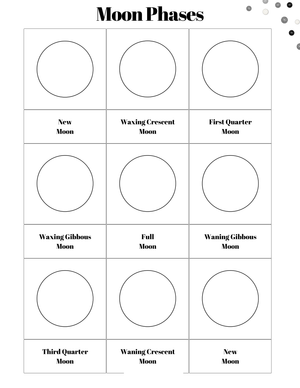
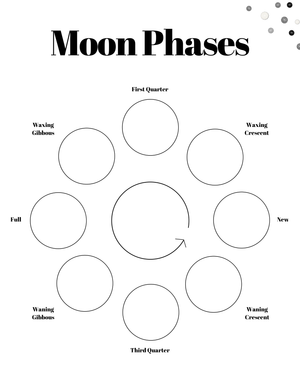
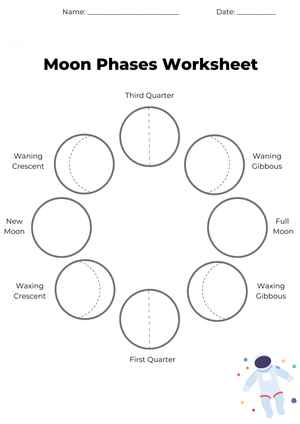
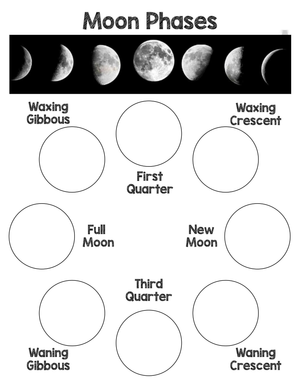
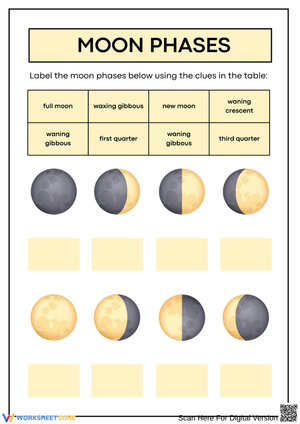
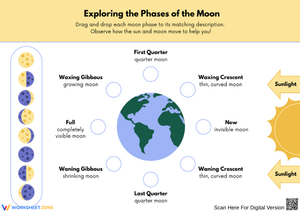
These phases of the moon worksheets for 4th grade cover the four tasks that actually build durable understanding at this level: labeling moon diagrams, sequencing the full lunar cycle, working with vocabulary like waxing, waning, gibbous, and crescent, and writing a brief explanation of why phases happen. Each worksheet stands alone, so teachers can run the full set across a short unit or pull individual resources for warm-ups, center rotations, and review blocks.
The Skills Each Worksheet Targets
The sequence of skills here mirrors how Grade 4 students move from recognition to explanation — a progression that matters because students who can name all eight phases still routinely miss explanation items if they have never practiced connecting the cause-and-effect relationship in writing. Phases of the moon worksheets for 4th grade built around multiple task types give teachers real evidence of understanding at both levels, not just the labeling level.
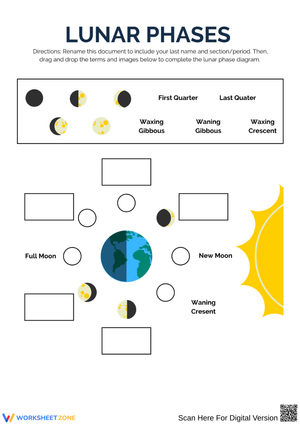
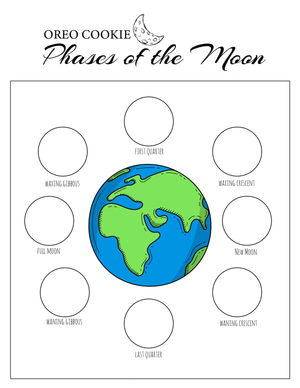
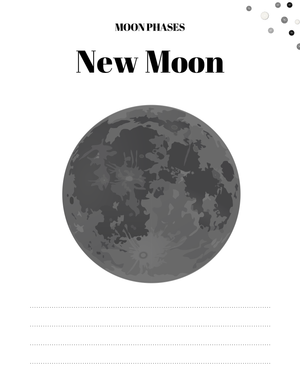
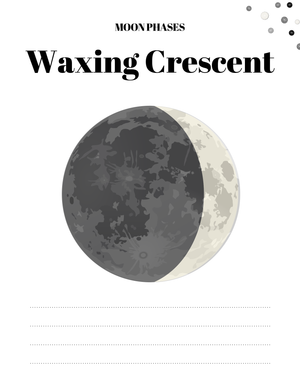
- Labeling worksheets — students write the correct phase name beneath each moon image, choosing from a word bank.
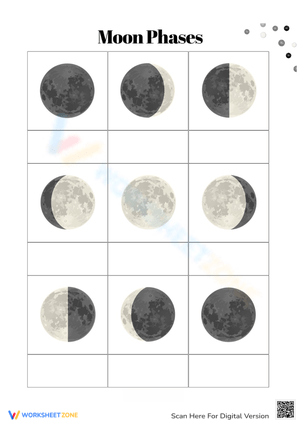
- Sequencing activities — students cut and arrange phase cards from new moon through full moon and back, reinforcing the cyclical pattern rather than a linear list.
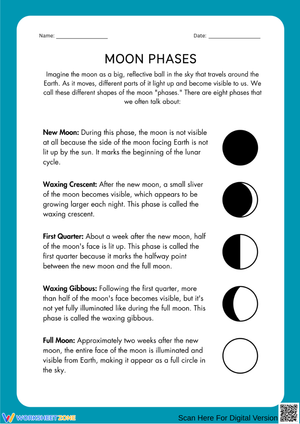
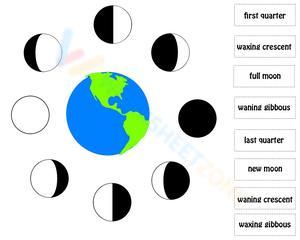
- Matching worksheets — each worksheet links a phase name, its image, and a short definition so students connect all three representations at once.
- Waxing and waning sort worksheets — students group phases by whether the visible lit area is growing or shrinking before any writing is required.
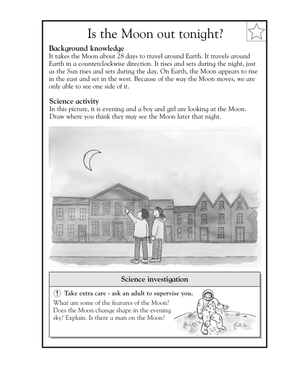
- Observation logs — students record moon images over several evenings or respond to teacher-provided nightly photos, building a pattern to analyze rather than a list to memorize.
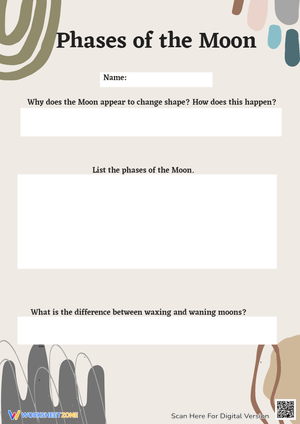
- Short explanation prompts — students write why phases occur, either with a sentence frame or independently, which is where actual understanding becomes visible.
Errors Teachers Should Anticipate and Address
The most persistent mistake at this grade level: students write that Earth's shadow causes the phases. This one shows up constantly, and it is understandable — shadows come up in the same science unit, eclipses sometimes enter the conversation, and the two concepts share enough vocabulary that students conflate them. Labeling worksheets do not surface this error. The explanation prompts are where it appears, which is one reason those short-response items matter more than they might look at first.
The second error worth watching is waxing/waning reversal. Students who sort phase images correctly by the amount of light visible still swap the labels in writing. A worksheet that asks students to circle the correct term and draw a small arrow indicating whether the lit area is increasing or decreasing holds the direction of change alongside the vocabulary word — that paired task reduces the reversal more reliably than vocabulary practice alone.
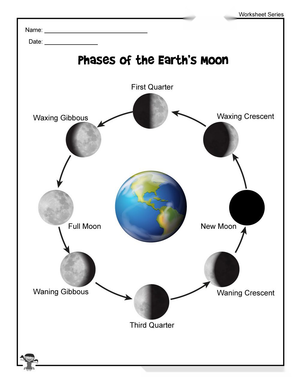
A third pattern appears in sequencing work: students arrange phases correctly from new moon to full moon but describe the cycle as ending there, not continuing back to new moon. Cut-and-paste worksheets that use a circular layout rather than a left-to-right strip make the cycle's return visible in the physical arrangement of the cards, which catches this misconception before it shows up on an assessment.
Building These Worksheets Into Your Science Blocks
Three short science blocks work better than one long session for this material. The first block is whole-group: run a quick physical model — a light source, a foam ball, students rotating slowly around it — and follow it immediately with the labeling worksheet while the model's logic is still fresh in the room. The second block handles sequencing and the waxing/waning sort. The third block is the explanation prompt; by then, students have the phase names and the cause-and-effect relationship in working memory and can produce a written response worth reading.
For station rotations, four stations cover the set cleanly: diagram labeling, card sequencing, reading and matching, and written explanation. Each station produces written work, which gives more to check than activities that end in a sorted pile of cards no one recorded.
One classroom observation worth passing along: students who complete the labeling worksheet before the observation log use noticeably more precise vocabulary in their log entries. Running the resources in that order — name first, observe second — costs nothing in prep time and pays off in discussion quality. Phases of the moon worksheets for 4th grade used in that sequence consistently produce better science writing than the same resources run in reverse.
Adjusting the Set for a Range of Learners
Students who find the full eight-phase sequence overwhelming start in a more manageable place when the first worksheet limits them to four phases: new moon, first quarter, full moon, and third quarter. Those four follow a clean visual pattern — no light, right half lit, fully lit, left half lit — and give students a framework before crescent and gibbous phases enter the picture. The labeling and sequencing worksheets work with a reduced image set without altering anything on the page itself.
For students who move through the material quickly, the explanation prompts are where to push. Ask them to explain why a full moon does not appear every week given a roughly 29.5-day lunar cycle. That question requires connecting the phase pattern to orbital timing — a stronger demonstration of understanding than accurate labeling alone, and one that extends the content without needing a separate worksheet.
Students who can name phases accurately but struggle with written explanation often do better when the prompt includes a sentence frame that separates cause from effect: "The Moon appears _______ because from Earth we can see _______ of its sunlit half." That structure keeps the science logic intact and removes the pressure of generating the whole explanation from nothing — useful for students who know more than their blank paper suggests.
Standard Alignment
This set connects directly to NGSS Disciplinary Core Idea ESS1.B: Earth and the Solar System, which addresses how the orbits of Earth and the Moon produce observable patterns including the Moon's changing appearance over the course of a month. NGSS Performance Expectations formally target this idea at Grade 1 (1-ESS1-1: "Use observations of the sun, moon, and stars to describe patterns that can be predicted") and at middle school (MS-ESS1-1, where students develop models to explain lunar phases). Many state frameworks — including the Texas TEKS and Virginia Science SOLs — place moon phases explicitly at Grade 4, which is why the topic appears in so many fourth-grade science units despite the NGSS grade-band placement. In instructional terms, these worksheets fit after the introductory model lesson and before any independent explanation task or formal assessment.
Frequently Asked Questions
What background knowledge do students need before using these worksheets?
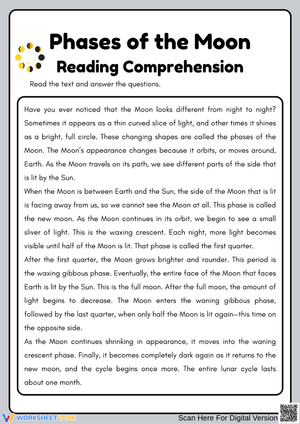
Students should know that the Moon orbits Earth and that the Moon reflects sunlight rather than producing its own light. With those two ideas in place, the phase sequence has a cause behind it. Without them, students treat phase names as arbitrary labels rather than a pattern with an explanation, and the written prompts become much harder.
Can these worksheets replace a physical model of moon phases?
The worksheets work best after a brief physical model, not instead of one. A foam ball and a single light source take about ten minutes to set up and directly answer the question most students carry into the unit: why does the shape of the lit area change at all? Once students have seen that happen in real space, the diagramming and sequencing tasks on each worksheet make considerably more sense.
How many phases do Grade 4 students typically need to know?
Most state standards at this level expect students to identify and sequence the eight main phases: new moon, waxing crescent, first quarter, waxing gibbous, full moon, waning gibbous, third quarter, and waning crescent. Some teachers work with four phases first and introduce the intermediate phases once the core pattern is secure. The set supports both approaches without any modification.
Why do students mix up moon phases and eclipses?
Both involve Earth, the Moon, and the Sun moving in relation to one another, so the concepts share surface-level vocabulary. But eclipses occur when a shadow falls — Earth's shadow on the Moon during a lunar eclipse, or the Moon's shadow on Earth during a solar eclipse — while phases result from the Moon's orbital position changing which portion of its sunlit half faces Earth. Phases of the moon worksheets for 4th grade that include a direct written explanation of this distinction, rather than only phase labels, help students separate the two ideas before the confusion compounds into a harder habit to break.
What is the best way to use the observation log?
Assign it after students have completed at least one labeling worksheet. Students who already know a few phase names observe more carefully and write more precisely than students who encounter the log before any vocabulary work. Running three to five consecutive evenings of observation — then discussing the emerging pattern as a class — gives the log entries real analytical weight rather than just a record of what the sky looked like on one night.












 Interactive Worksheet Maker
 Quiz Maker
 Word Search Maker
 Crossword Puzzle Maker
 Word Scramble Generator
 Sentence Scramble Generator
 Handwriting Worksheet Generator
 Name Tracing Generator
 Fill In The Blank Generator