These 4th grade space and the solar system printable worksheets cover the full arc of a standard solar system unit — from the Sun's role as the gravitational anchor of our system through planetary classification, Earth's orbital mechanics, and the cycle of lunar phases. Teachers get a set of standalone resources that work as direct instruction support, station activity materials, or quick formative checkpoints depending on where a lesson lands.
What These Worksheets Cover
The set addresses five core content areas that appear in virtually every state's grade 4 science framework for Earth and Space:
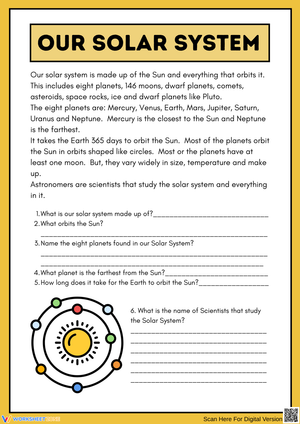
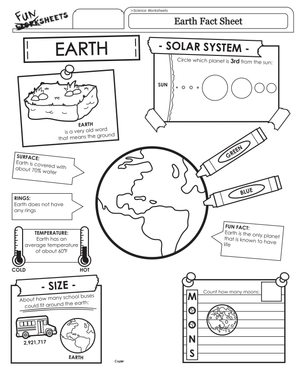
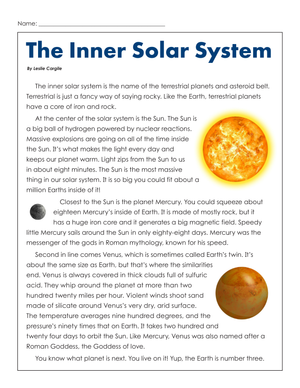
- The Sun: labeling its major layers — core, radiative zone, convective zone, photosphere — understanding its role as the gravitational center of the solar system, and completing scale comparisons. Most students are startled to find that more than one million Earths fit inside the Sun by volume, and that surprise is worth building into the lesson.
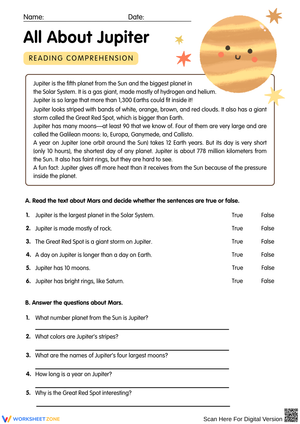
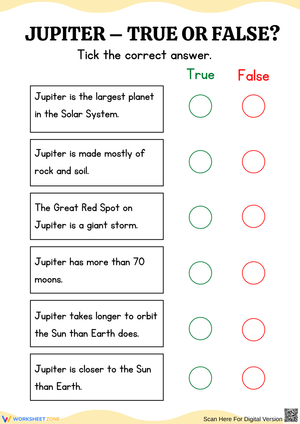
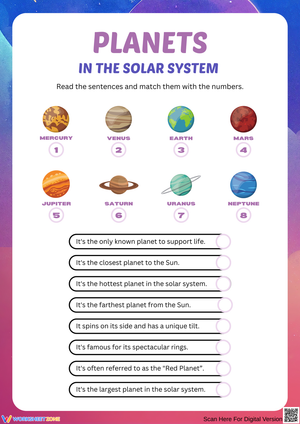
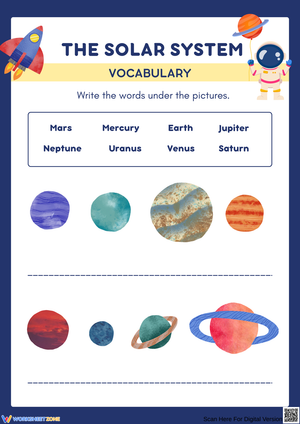
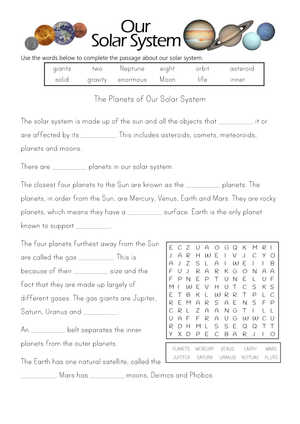
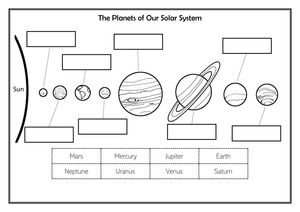
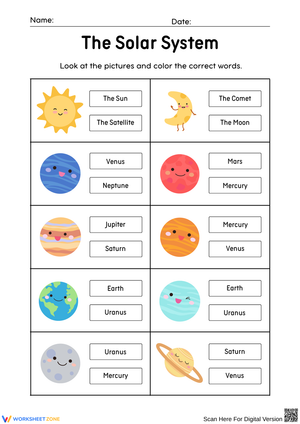
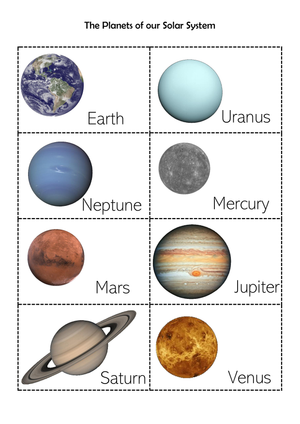
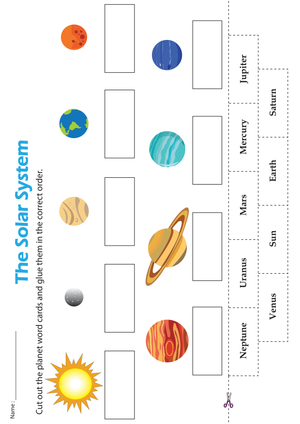
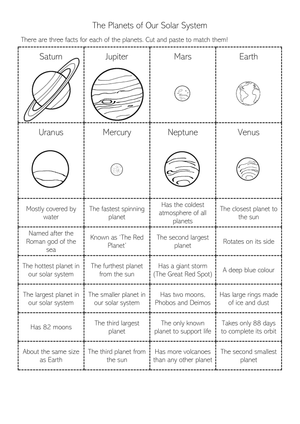
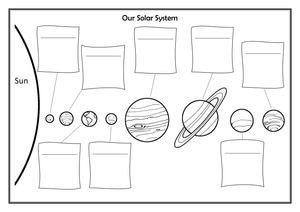
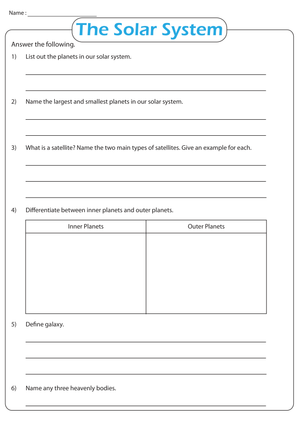
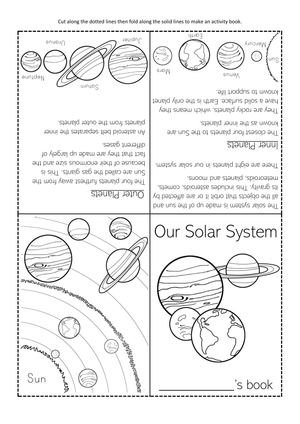
- The eight planets: ordered correctly from Mercury through Neptune, sorted by rocky-terrestrial versus gas-and-ice-giant classification, and compared across attributes like diameter, number of moons, and approximate distance from the Sun in astronomical units.
- Earth's rotation and revolution: diagramming both movements and labeling why rotation produces day and night while revolution — combined with axial tilt — drives seasonal change.
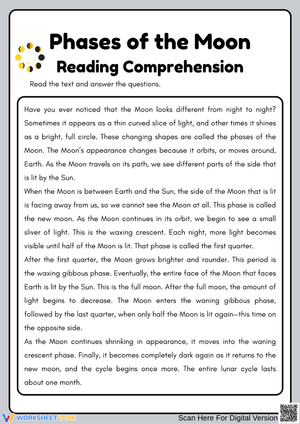
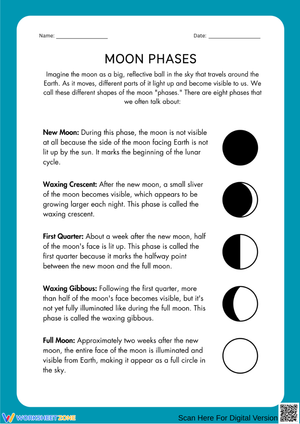
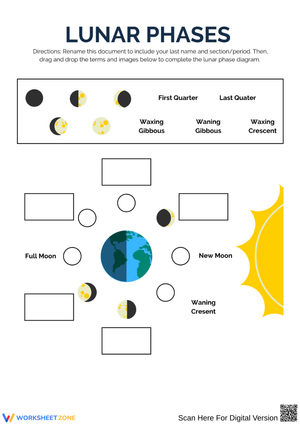
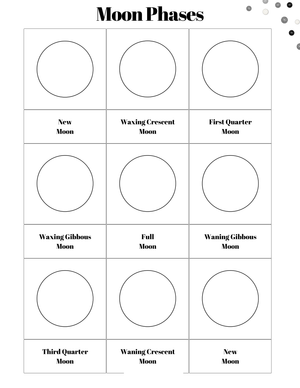
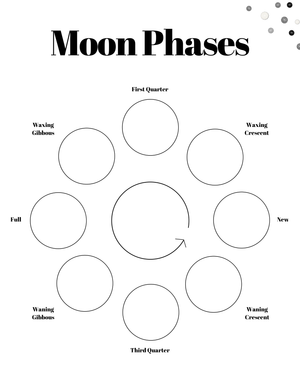
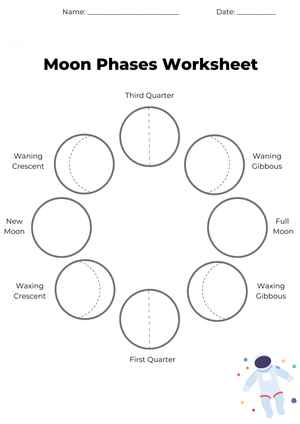
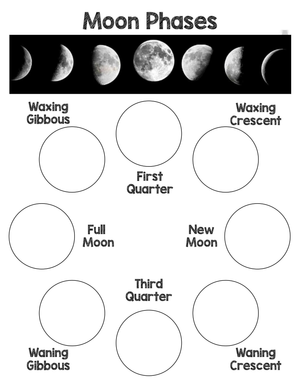
- Lunar phases: sequencing all eight standard phases from new moon through waning crescent, identifying which portion of the Moon is illuminated in each diagram, and distinguishing the Moon's reflected light from luminescence the Moon produces itself.
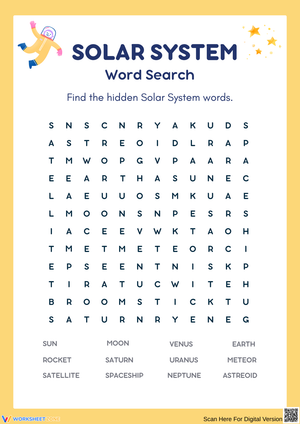
- Basic celestial mechanics: understanding that gravity governs orbital motion, that moons orbit planets while planets orbit the Sun, and that asteroids and dwarf planets occupy specific regions of the solar system.
Each worksheet targets one of these areas rather than combining them all into one task, which keeps cognitive load manageable during instruction and makes it easier to assign pieces selectively as a unit progresses.
Mistakes Students Make That These Worksheets Help You Surface
The most persistent error at grade 4 is conflating rotation with revolution. Students who define both terms correctly on a vocabulary quiz will still write "Earth's rotation causes the seasons" on an open-ended item — because the word "rotation" carries a general sense of "spinning around something," and spinning around the Sun feels intuitive. Worksheets that ask students to shade the night side of Earth, or to place Earth at four positions in its orbit and label the season in each hemisphere, expose this confusion in a way multiple-choice questions typically do not.
Moon phase misconceptions run a close second. A significant number of fourth graders believe the dark portion of the Moon during a crescent phase is Earth's shadow. That idea is logical and feels correct, which is precisely why it persists well past initial instruction. Worksheets that ask students to draw the Sun's position relative to the Earth-Moon system during each phase address this directly, because students must work out the geometry rather than memorize a label.
One more pattern worth watching: when comparing planetary data, students often assume a larger orbit means faster movement — the exact opposite of what orbital mechanics describes. A data table comparing orbital periods across all eight planets will surface that assumption quickly, and a brief discussion at that moment is more effective than any number of pre-emptive explanations before the error appears.
Fitting These Worksheets Into the Week
In a typical 45-minute science block, these worksheets slot in most cleanly during the consolidation phase of a lesson — after direct instruction or a shared video, before independent work is assigned. A brief read-aloud of the target passage followed by 15 minutes on the labeling or analysis task gives the teacher time to circulate and catch errors before students internalize them.
These also work well as second-day warm-ups. Returning to a planet-comparison chart on Tuesday after a Monday introduction uses spaced retrieval to strengthen retention. Students who encountered the content once often believe they know it better than they do; coming back to the same concepts in a slightly different format — ranking planets by orbital period instead of by size, for instance — quickly reveals the gaps.
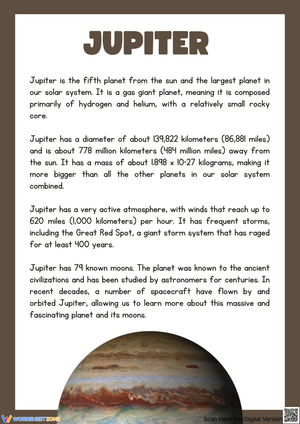
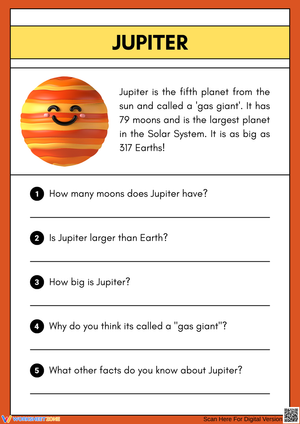
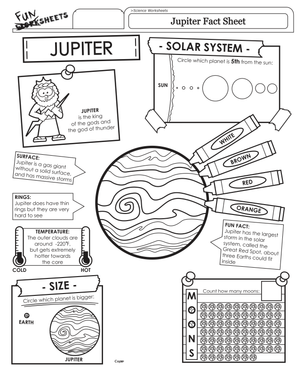
One strategy that amplifies the 4th grade space and the solar system printable worksheets is pairing diagram activities with brief physical models. While students label Earth's position in its orbit on paper, having four desks arranged in a rough ellipse with a lamp at the center makes the abstraction concrete in a way the diagram alone does not. That setup takes roughly 8 extra minutes but reduces the number of students who complete a worksheet correctly and still cannot explain what they labeled. Pairing the set with NASA Space Place or the National Geographic Education site gives students access to imagery that static worksheets cannot replicate — Jupiter's diameter beside Earth's, or Saturn's rings viewed at a steep angle — and grounds the number comparisons in something that registers at this age.
Standard Alignment
The content in this set maps directly to the ESS1: Earth's Place in the Universe disciplinary core idea from the Next Generation Science Standards. NGSS formally positions detailed solar system content — standards 5-ESS1-1 and 5-ESS1-2 — at grade 5, but a substantial number of state frameworks place equivalent material at grade 4. Florida's SC.4.E, Virginia's Science SOL 4.7, and Texas TEKS §112.15(b)(8) all include solar system structure, Earth's orbital mechanics, and lunar cycles as grade 4 expectations. Curriculum teams should verify their own state's grade-band placement, but the conceptual progression this set follows — Sun as central body, planetary classification, Earth's orbital movements, lunar phases — maps to the ESS1 core idea regardless of which grade a state assigns it.
Adjusting These Worksheets for a Range of Learners
These 4th grade space and the solar system printable worksheets include enough variation in task demand that the same worksheet can serve different instructional purposes depending on how it is introduced. For students who need more structured support, providing a word bank and partially completed diagrams removes the retrieval burden and lets them concentrate on understanding the spatial relationships shown. Pairing that with a brief oral check — asking a student to explain a labeled diagram in one or two sentences — gives the teacher formative data that the written work alone does not capture.
For students who move through content quickly, the data comparison tasks extend naturally. Asking a student to rank all eight planets by both diameter and orbital period, then write one sentence explaining any pattern they notice, turns a straightforward activity into basic scientific reasoning. Students who recognize that farther planets take longer to orbit will sometimes try to find a ratio — that kind of self-directed inquiry is worth encouraging even when it exceeds the grade-level expectation.
Multilingual learners benefit from the diagram-heavy format: labeling a visual requires less language production than a written response while still building content vocabulary. Providing a bilingual glossary of the 12 to 15 key terms — rotation, revolution, axis, orbit, terrestrial, lunar, among others — alongside each worksheet reduces language barriers without changing the science task itself.
Frequently Asked Questions
Does solar system content belong in grade 4 or grade 5 under NGSS?
Under NGSS, detailed solar system standards (5-ESS1) are formally placed at grade 5. Many state frameworks, however, include planetary structure, Earth's orbital mechanics, and moon phases as grade 4 expectations. Check your own state's science framework — the content this set covers is appropriate and useful at either grade level, and teachers in NGSS states often introduce it at grade 4 as a conceptual foundation for the formal grade 5 standards.
How do students remember the planet order without over-relying on a mnemonic?
Mnemonics help with recall but not with understanding. Students retain the sequence more durably when they connect it to a structural reason: the four inner rocky planets all sit within the asteroid belt, and the four outer giants lie beyond it. A planet-ordering worksheet that simultaneously sorts planets into those two categories reinforces this logic so the order becomes part of a mental model rather than a string of syllables.
Can these worksheets be used with 5th graders reviewing before a state assessment?
The 4th grade space and the solar system printable worksheets address the same foundational content that appears on most state science assessments at grades 4 and 5. The labeling and data-comparison tasks align closely with the diagram-reading and data-interpretation item types that appear on science tests, making the set a reasonable review tool at the start of grade 5 or before a benchmark exam.
What sequence works best when introducing these worksheets across a unit?
Start with the Sun and scale comparisons before moving to planetary classification — students compare planets more meaningfully once they understand the Sun's size and gravitational role. Rotation and revolution belong mid-unit, after the basic structure of the solar system is established. Moon phases benefit from coming last, since the geometric reasoning involved — where is the Sun relative to Earth and Moon? — depends on a mental model that the earlier content builds.












 Interactive Worksheet Maker
 Quiz Maker
 Word Search Maker
 Crossword Puzzle Maker
 Word Scramble Generator
 Sentence Scramble Generator
 Handwriting Worksheet Generator
 Name Tracing Generator
 Fill In The Blank Generator