




























Views
Downloads
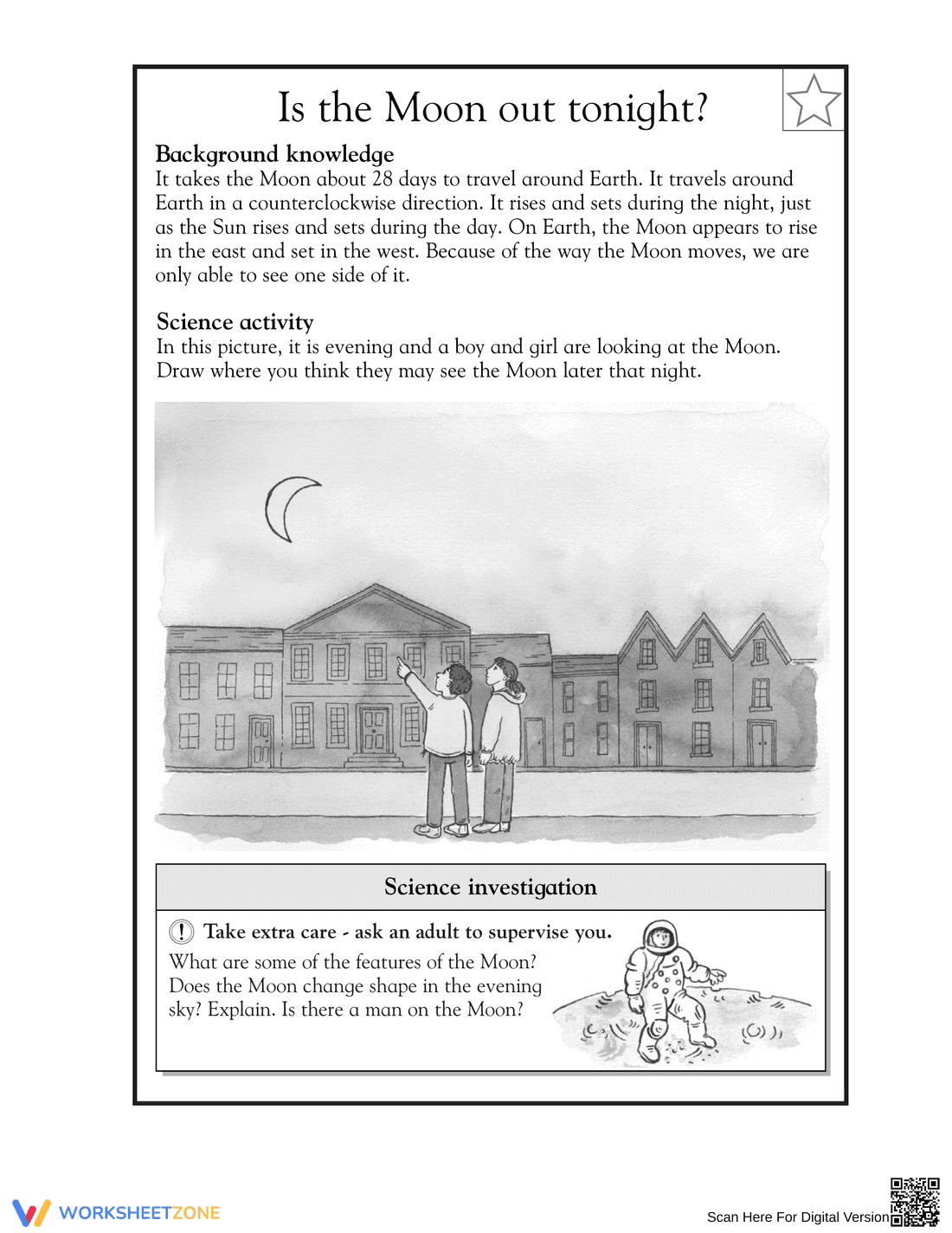


Essential Grade 4 Moon Patterns & Movement Worksheet

Paste this activity's link or code into your existing LMS (Google Classroom, Canvas, Teams, Schoology, Moodle, etc.).
Students can open and work on the activity right away, with no student login required.
You'll still be able to track student progress and results from your teacher account.
This Grade 4 science worksheet helps students observe and predict the patterns of the moon's movement across the night sky. Students engage with background knowledge about the 28-day lunar cycle and the direction of its path from east to west. This resource ensures learners master foundational astronomical observations through sketching and critical thinking.
At a Glance
- Grade: 4 · Subject: Science
- Standard:
1-ESS1-1— Use observations of the moon to describe patterns that can be predicted- Skill Focus: Lunar patterns and celestial movement
- Format: 1 page · 4 problems · Answer key included · PDF
- Best For: Independent practice and science centers
- Time: 15–20 minutes
What's Inside
This single-page science resource features a concise background information section detailing the moon's 28-day orbit and its apparent path from east to west. The primary activity asks students to synthesize this information by drawing the moon's future position in a provided evening scene. Three additional investigation questions prompt students to identify lunar features and discuss phase changes.
Zero-Prep Workflow
- Print (30 seconds): Simply download and print the high-quality PDF version.
- Distribute (1 minute): Hand out the worksheet for morning work or as a transitional activity.
- Review (3 minutes): Use the included answer key to check for spatial understanding of the moon's path.
Total teacher preparation time is under 2 minutes, making this an ideal selection for emergency sub plans or quick science reinforcements.
Standards Alignment
The primary alignment is 1-ESS1-1, which requires students to use observations of the moon to describe predictable patterns. While introduced in early grades, this Grade 4 version extends the concept by introducing the 28-day cycle and counterclockwise orbit. Both standard codes can be copied directly into lesson plans, IEP goals, or district curriculum mapping tools.
How to Use It
Assign this worksheet after an initial lesson on the solar system to reinforce the concept of apparent motion. It serves as an excellent formative assessment tool; observe students as they draw the moon's path to check for misconceptions about celestial direction. Expected completion time is 20 minutes during a dedicated science rotation or as a homework assignment.
Who It's For
This activity is tailored for third and fourth-grade students developing their understanding of Earth and Space Science. It provides necessary scaffolds for English Language Learners through visual drawing prompts and clearly defined vocabulary. It pairs naturally with a classroom lunar calendar or an anchor chart showing the phases of the moon.
The integration of astronomical observation with predictive sketching aligns with the gradual release of responsibility model emphasized by Fisher & Frey (2014). Research indicates that students who engage in drawing-to-learn activities demonstrate a deeper retention of spatial concepts compared to those who only read text. This worksheet targets standard 1-ESS1-1, focusing on the plain-English skill of identifying predictable patterns in the night sky. By requiring students to map the moon’s path based on textual evidence, the resource bridges the gap between literacy and scientific inquiry. Educational analysis from ScienceDirect TpT Analysis suggests that high-quality science worksheets should combine technical background knowledge with active student responses to maximize engagement. This Grade 4 resource provides the structural support needed for students to transition from simple observation to the complex task of predicting celestial events, ensuring a comprehensive understanding of our satellite's 28-day journey.


