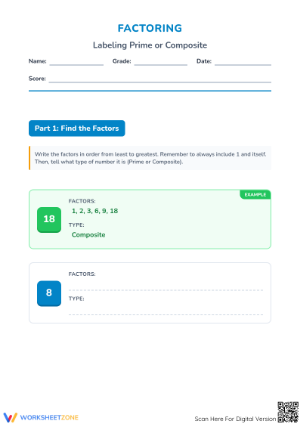
What Grade 4 Math Standard - CCSS 4.OA.B.4 - Requires for Prime and Composite Numbers
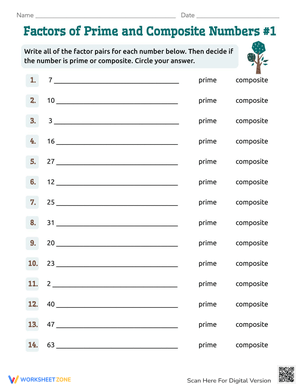
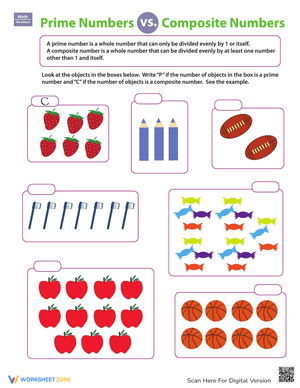
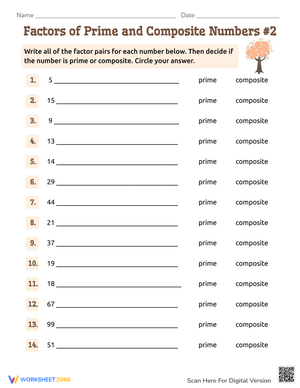
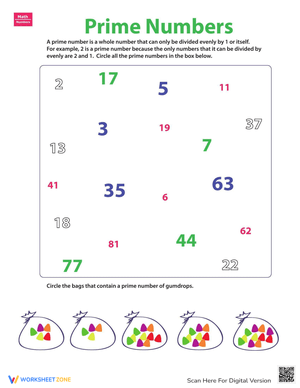
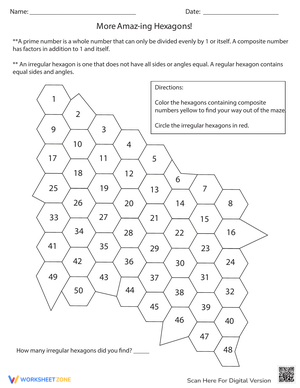
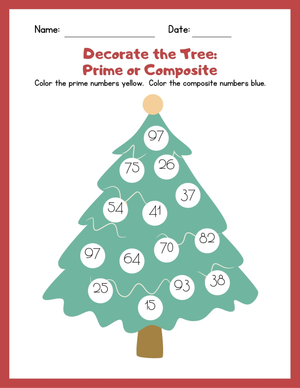
Fourth grade math teachers planning a factors-and-multiples unit need practice sets that match the exact demand of CCSS.Math.Content.4.OA.B.4: students must find all factor pairs for any whole number from 1 to 100, recognize that a number is a multiple of each of its factors, and use that factor work to decide whether the number is prime or composite. This standard sits inside the Grade 4 Operations and Algebraic Thinking domain, in the cluster focused on gaining familiarity with factors and multiples. Worksheets built for this page target that exact scope: whole numbers 1-100, organized factor-pair searches, and prime versus composite sorting, rather than a loose review of multiplication facts.
Factor Pairs and Rainbow Factoring
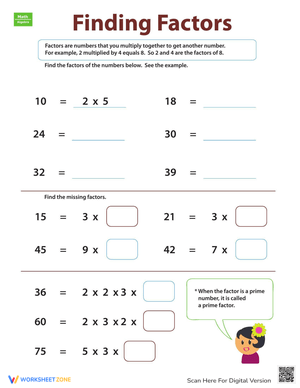
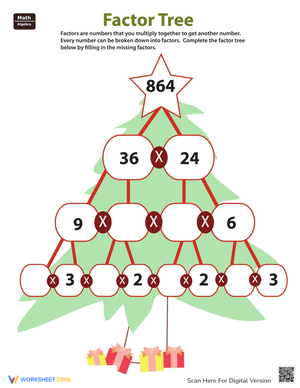
Before students can label a number prime or composite with confidence, they need a repeatable method for finding every factor pair. Rainbow factoring, where students list factors from smallest to largest and connect matching pairs with an arc, gives a visual check for completeness: if the arcs do not nest evenly, a factor pair was likely skipped. A simple T-chart with 1 and the number itself in the top row works just as well for students who find the rainbow method visually busy. The number 96, for example, has six factor pairs, more than any other number under 100, which makes it a useful stretch problem for students who finish early or need an enrichment challenge during a factors unit.
Formative Assessment Ideas for Factor-Pair Fluency
According to the Common Core State Standards Initiative, standard 4.OA.B.4 sits within the broader Grade 4 Operations and Algebraic Thinking domain, which asks students to gain familiarity with factors and multiples as a foundation for later work with fractions and multi-digit arithmetic. A quick formative check, such as a five-number factor-pair quiz with one composite number known for having several pairs, gives a teacher a fast read on whether students are searching completely or stopping early. Exit tickets that ask students to classify a single number and justify it with a factor pair take under two minutes to grade and can be sorted into reteach and enrichment groups the same day.
Teacher Tips
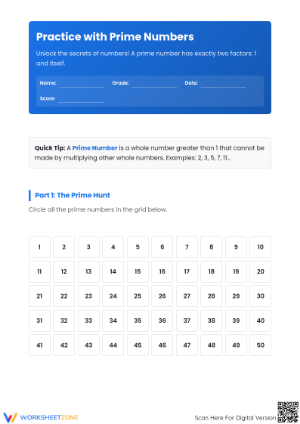
Keep a visible reference for factor pairs from 1 to 100 posted near the math center so students can self-check their work without asking for help on every problem. Rotate the numbers used in daily warm-ups so students meet a mix of small primes, small composites, and a few larger composites like 84 or 96 across a week rather than repeating the same ten numbers. For students ready for enrichment, introduce the sieve of Eratosthenes as a hands-on way to generate every prime number up to 100, which also reinforces the multiples concept embedded in the standard. For students who need more support, narrow the working range to numbers under 20 until factor-pair searches are automatic, then expand back to the full 1-100 range required by 4.OA.B.4.
Frequently Asked Questions
1. How should teachers sequence prime and composite instruction within 4.OA.B.4?
Start with factor-pair fluency using a T-chart or rainbow factoring method on numbers under 20, then introduce the prime and composite vocabulary once students can generate complete factor lists. Expand to the full 1-100 range only after classification is reliable on smaller numbers.
2. What manipulatives or visuals best support factor-pair understanding in 4th grade?
Rainbow factoring diagrams and T-charts give students a visual check for completeness, while number cards used in sorting activities keep the reasoning behind each classification visible to both students and teachers.
3. How can teachers quickly assess mastery of prime vs. composite classification?
A short exit ticket asking students to list all factor pairs for one number and then classify it takes under two minutes to grade and gives a clear signal for regrouping students into reteach or enrichment work.
4. What are the most common student errors with prime and composite numbers and how can teachers correct them?
The most frequent errors are treating 1 as prime, assuming all even numbers are composite, and stopping a factor-pair search too early. Requiring a full factor-pair list alongside the final classification makes these errors visible during independent practice.













 Interactive Worksheet Maker
 Quiz Maker
 Word Search Maker
 Crossword Puzzle Maker
 Word Scramble Generator
 Sentence Scramble Generator
 Handwriting Worksheet Generator
 Name Tracing Generator
 Fill In The Blank Generator