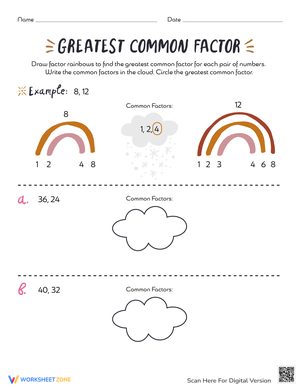
4th Grade Greatest Common Factor Worksheets Guide
4th grade greatest common factor worksheets give students the focused practice needed to master one of the most important number theory concepts in the upper elementary curriculum. Finding the greatest common factor of two numbers requires students to first identify all factors of each number individually, then compare those lists to determine which shared factor is largest. This analytical process strengthens multiplication fluency, systematic thinking, and the ability to recognize relationships between numbers in a structured and meaningful mathematical context.
The exercises in this collection build progressively, starting with smaller numbers that allow students to list all factors without difficulty, then advancing to larger values that require more careful and organized thinking. Students practice identifying GCF through factor listing, using factor trees to support their reasoning, and applying GCF concepts to simplify fractions - demonstrating the real-world utility of this skill in authentic mathematical contexts. The scaffolded structure ensures that students develop genuine procedural and conceptual understanding before being asked to work independently with more complex number pairs.
For teachers, these pages integrate naturally into number theory units and pair well with direct instruction on multiplication, division, and factor relationships. The analytical nature of GCF problems makes them excellent candidates for small group work where students can discuss their reasoning and check each other's factor lists. Teachers can find additional lesson ideas and resources by visiting math activities for 4th graders to supplement worksheet practice with engaging hands-on approaches to the same number theory concepts covered in these printable pages.
Understanding the greatest common factor is closely related to understanding factors and multiples more broadly, and the two concepts reinforce each other when taught in proximity. Students who know their factor pairs well are significantly more efficient at finding GCF because they can list factors accurately and quickly. For additional practice across both concepts, teachers can pair GCF pages with factors and multiples worksheets to give students a comprehensive number theory practice sequence that strengthens both skill areas through aligned and coordinated exercises throughout the unit.
Worksheetzone provides 4th grade greatest common factor worksheets in organized, print-ready PDF format that is easy for both classroom and home use. The collection is designed to support students at different levels of readiness, with pages ranging from guided practice with visual supports to independent problem sets requiring full procedural fluency. These resources ensure that every student has access to the structured, analytical practice needed to develop genuine confidence and competence with 4th grade greatest common factor worksheets before moving on to more advanced mathematical applications in later grades.
Frequently Asked Questions
Question 1: What is the greatest common factor and why does it matter?
The greatest common factor of two numbers is the largest number that divides evenly into both of them. For example, the GCF of 12 and 18 is 6 because 6 is the largest number that is a factor of both values. GCF matters because it is used to simplify fractions to their lowest terms, to solve ratio problems, and to decompose numbers in algebraic contexts. Students who understand GCF deeply are much better prepared for fraction operations and pre-algebra concepts they will encounter in middle school mathematics.
Question 2: What strategies help students find the greatest common factor efficiently?
The two most common strategies for finding GCF are the factor listing method and the prime factorization method. In the factor listing method, students list all factors of each number separately and then identify the largest shared factor. In prime factorization, students break each number down into its prime factors and multiply shared primes together. For 4th graders, the factor listing method is typically most accessible and builds directly on the multiplication and factor pair knowledge students develop throughout the grade level.
Question 3: How does GCF connect to simplifying fractions?
Finding the GCF allows students to simplify fractions efficiently by dividing both the numerator and denominator by the greatest common factor of those two numbers. For example, to simplify 12/18, students find the GCF of 12 and 18, which is 6, and divide both by 6 to get 2/3. This application gives GCF immediate practical relevance in fraction work, making GCF practice directly useful rather than abstract. Students who master GCF find fraction simplification more logical and less procedurally confusing in math class.
Question 4: How can parents support GCF learning at home?
Parents can support GCF learning by reviewing multiplication tables together and practicing factor pair identification using small numbers before moving to larger ones. Playing simple factor-finding games using cards or dice makes the practice feel less routine. Sitting with a child while they complete 4th grade greatest common factor worksheets and asking them to explain their reasoning aloud helps reinforce understanding more effectively than silent independent work alone, building the fluency students need for fraction and number theory work in school.