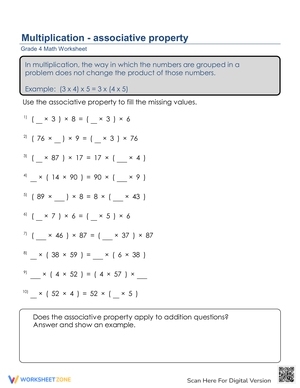
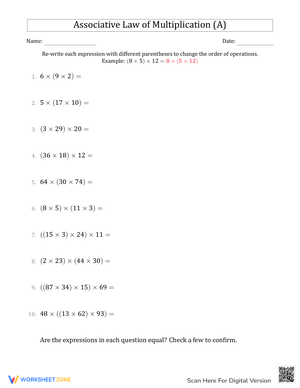
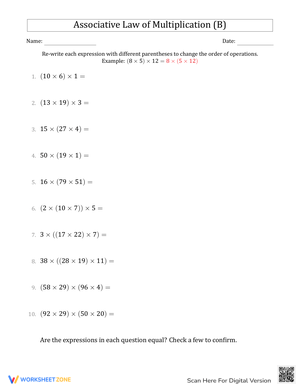
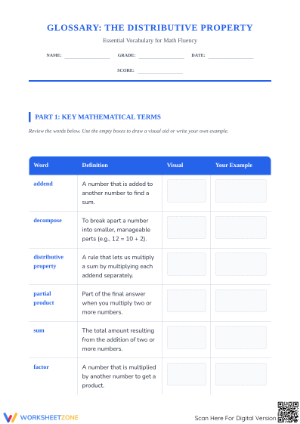
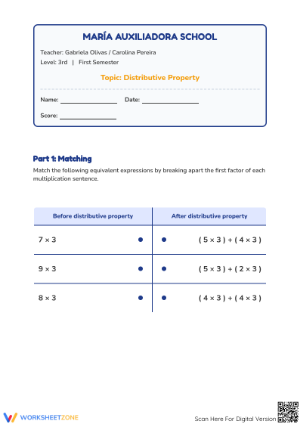
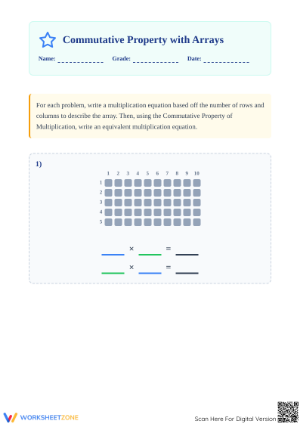
These properties of multiplication printable worksheets for 4th grade give teachers a focused way to build both procedural fluency and conceptual understanding of the commutative, associative, and distributive properties. The set moves students from recognizing a property in a number sentence to explaining why the structure works — a distinction that matters in Grade 4, where properties stop being observations and start functioning as tools for multi-digit multiplication.
The Specific Skills Each Worksheet Builds
Each worksheet addresses one task type rather than bundling every skill together. Across the set, students:
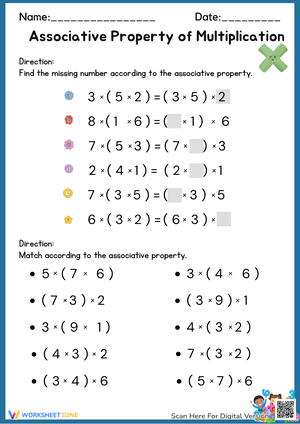
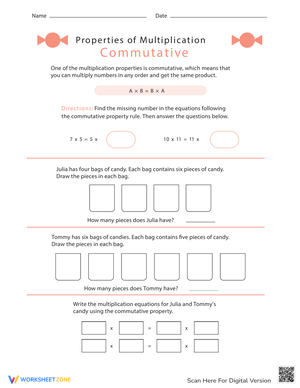
- Identify properties by reading equations such as 6 × 4 = 4 × 6 and naming the property shown.
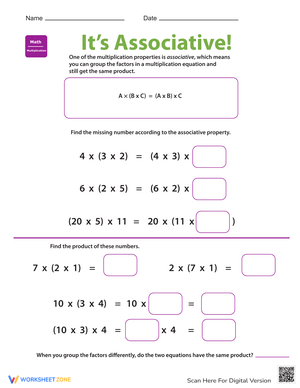
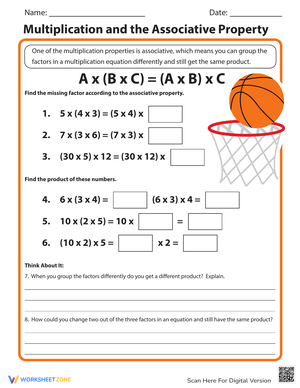
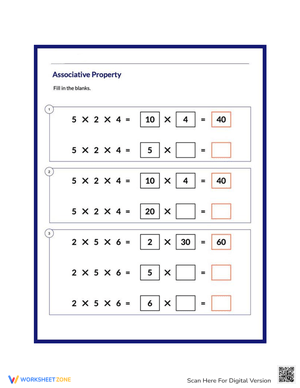
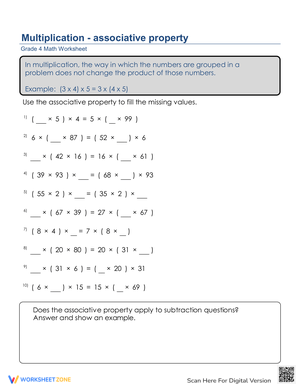
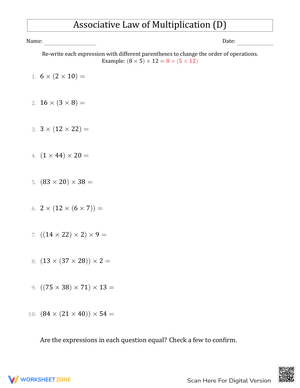
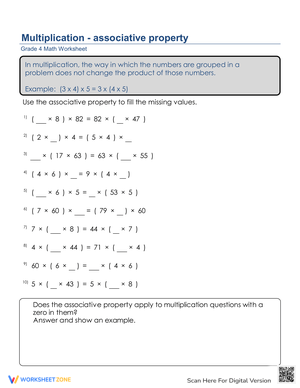
- Complete equations by writing a missing factor — for example, supplying the blank in (3 × ___) × 5 = 3 × (4 × 5).
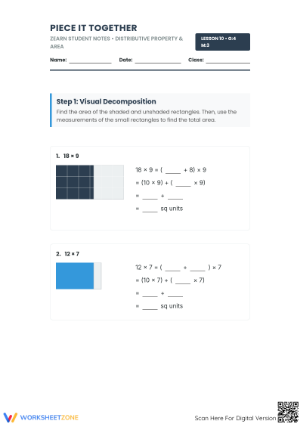
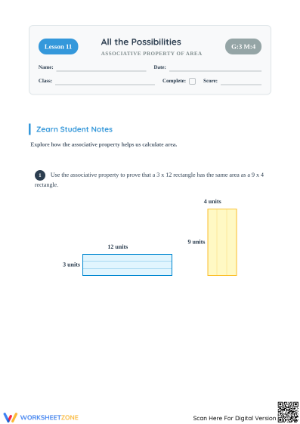
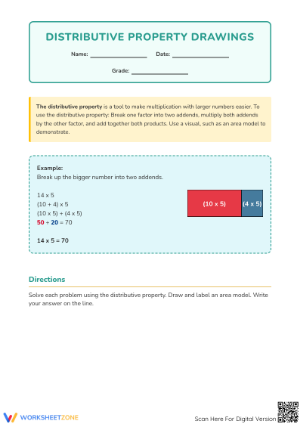
- Interpret and draw arrays and area models that show how factors can be rearranged or decomposed without changing the product.
- Explain in writing how a specific property made a calculation more efficient.
- Apply properties in word problems rather than only in isolated number sentences.
The written explanation task is where the most useful formative information surfaces. A student can correctly identify properties across an entire identification worksheet and still have no understanding of why 4 × (5 + 2) equals (4 × 5) + (4 × 2). The explanation prompt makes that gap visible before the unit assessment does.
Frequent Student Errors Worth Watching For and Addressing
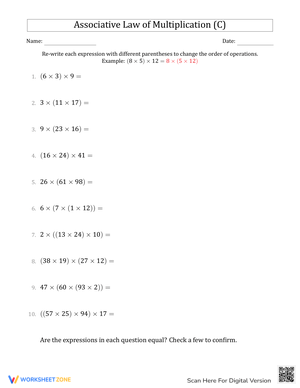
The commutative property rarely causes lasting confusion — most fourth graders accept quickly that 7 × 3 and 3 × 7 produce the same product. The associative property causes more trouble. Students new to parentheses in multiplication often predict that changing the grouping changes the answer. Present (2 × 5) × 3 alongside 2 × (5 × 3) and ask students to predict before calculating; a significant number will guess different products. That misconception needs direct instruction before any independent worksheet work begins.
The distributive property generates the most persistent errors. The specific mistake to watch for: students decompose one factor correctly but forget to multiply both parts. Instead of writing 8 × 7 = (8 × 5) + (8 × 2), they write 8 × 7 = (8 × 5) + 2. They split the 7 into 5 + 2 but only multiplied 8 by the first part. This same error reappears in two-digit multiplication algorithms when students carry the same incomplete logic into more complex work — catching it early on a worksheet with small numbers is far easier than untangling it later.
How Area Models Strengthen the Distributive Property Work
Arrays make the commutative property physical: a student who rotates a 4-by-6 arrangement and counts the same 24 squares has an image to draw on, not just a rule to recall. Area models carry heavier work for the distributive property. A rectangle showing 7 × 6, split by a vertical line into two sections of 7 × 3 and 7 × 3, gives students a visual reason the property holds. Each worksheet that includes an area model connects the drawing directly to the equation beneath it, so students who can handle the picture but not yet the symbols have a concrete bridge between the two representations — the same structure, partition a rectangle and add partial products, that reappears in the standard algorithm for multi-digit multiplication.
Smart Ways to Work These Worksheets Into Your Week
Treat each worksheet as a single-purpose tool rather than assigning the set all at once. A practical five-day structure: begin Monday with a commutative property worksheet as a bell-ringer, follow Tuesday's direct instruction on the associative property with a guided worksheet featuring parentheses examples immediately after the lesson, spend Wednesday and Thursday on distributive property area model work, then close Friday with a mixed-review worksheet where students decide — without prompts — which property applies. That sequence gives students two exposures to each property and ends the week with the kind of property-retrieval practice that builds retention.
One classroom routine that pairs well with these resources: after solving each problem, students write the property name in the margin. This takes fewer than thirty seconds per item and turns a computation check into a reasoning check. At a glance, a teacher can separate three very different situations — solved correctly and named correctly, solved correctly but named incorrectly, solved incorrectly — that a computation-only worksheet cannot distinguish.
Standard Alignment
The core standard is CCSS.MATH.CONTENT.3.OA.B.5 — apply properties of operations as strategies to multiply and divide — which sits formally in Grade 3 but extends into Grade 4 through 4.NBT.B.5, where students multiply multi-digit numbers using strategies based on place value and the distributive property. Properties of multiplication printable worksheets for 4th grade serve a dual purpose in this context: consolidating third-grade understanding and building the reasoning students need for partial-products and area-model strategies that dominate fourth-grade instruction. A student who cannot explain how 6 × 14 becomes (6 × 10) + (6 × 4) will struggle with the algorithm that follows — these worksheets build that explanation into practice before the algorithm is formally introduced.
Adjusting These Worksheets for Different Student Levels
Across properties of multiplication printable worksheets for 4th grade, the range of task types makes it practical to assign different worksheets to different student groups during the same work block. For students who need more support, matching tasks — pairing an equation with a property name — lower the cognitive demand enough to let them focus on structure rather than managing open-response pressure at the same time. Worksheets using smaller factors (2 through 6) with labeled area models also help; students who are still securing multiplication facts cannot evaluate a property's structure when most of their attention is on the calculation itself.
For students ready for more challenge, assign worksheets that remove all property labels. Without a section heading signaling which property applies, students have to make that judgment independently. Asking those students to solve the same problem two different ways — applying different properties each time — pushes toward flexible thinking rather than pattern-matching. Printing introductory and extension worksheets on different paper colors keeps center rotations smooth without requiring separate verbal direction every time.
Frequently Asked Questions
Which properties should students work through first, and how much time should each take?
Most fourth graders arrive having seen the commutative property informally, even without the name. Name it explicitly, practice briefly, and move on — one or two worksheets is usually enough. The associative property, because of its parentheses, typically needs a day of direct instruction before students can work through it independently. The distributive property takes the most time; plan two or three days of guided work with area models before assigning a worksheet that asks students to operate without visual support.
How does properties practice relate to multiplication facts fluency?
They reinforce each other but serve different goals. A student who genuinely understands the commutative property has effectively halved the multiplication table. A student who understands the distributive property can work out an unfamiliar fact by decomposing it into two known parts. Properties practice does not replace a fluency program — it gives students the structural understanding that makes facts practice more efficient and more durable over time.
Do these resources carry over into fifth-grade instruction?
Several worksheets in the set work well as diagnostic tools at the start of a fifth-grade multiplication unit. Area model worksheets transfer directly to multi-digit and fraction multiplication in Grade 5. Used this way, properties of multiplication printable worksheets for 4th grade function as activation tools — helping students reconnect with structural thinking before encountering more complex applications, rather than introducing new content.













 Interactive Worksheet Maker
 Quiz Maker
 Word Search Maker
 Crossword Puzzle Maker
 Word Scramble Generator
 Sentence Scramble Generator
 Handwriting Worksheet Generator
 Name Tracing Generator
 Fill In The Blank Generator