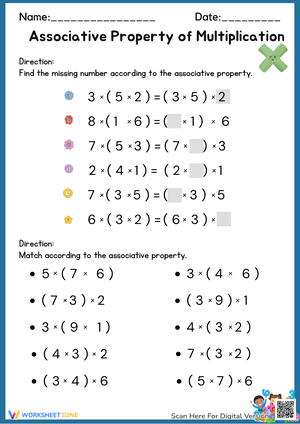
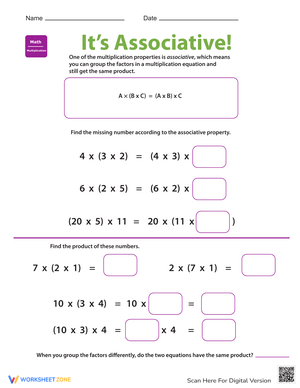
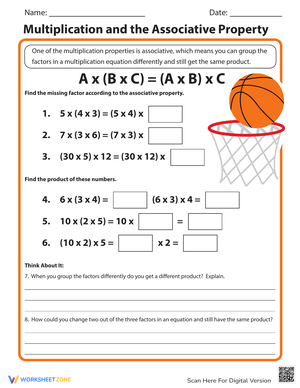
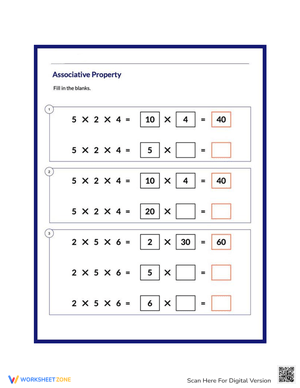
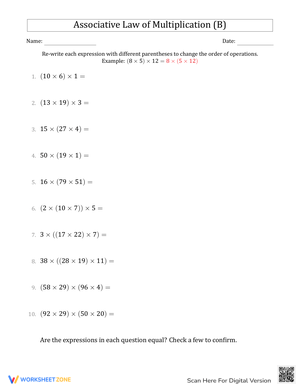
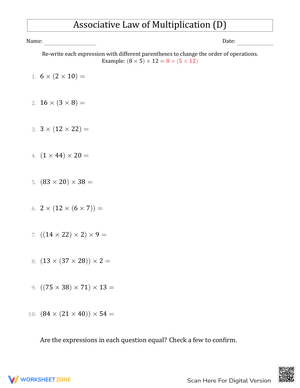
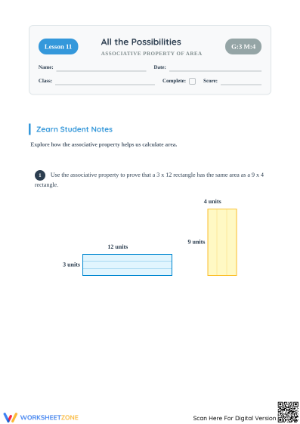
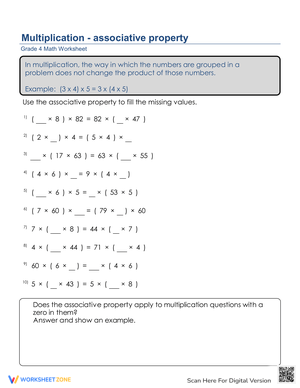
These 4th grade associative multiplication printable worksheets give students focused, repeated practice with the grouping property — the principle that when multiplying three factors, which pair you calculate first has no effect on the final product, but can have a meaningful effect on how hard the problem feels. The set runs from straightforward parentheses-shifting tasks to word problems where students decide which grouping makes mental calculation faster, then explain their reasoning.
What's Inside the Set
Each worksheet targets a specific facet of the associative property rather than asking students to practice everything at once. Problem types across the set include:
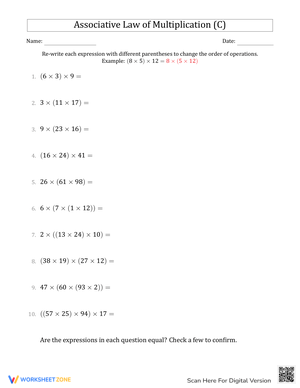
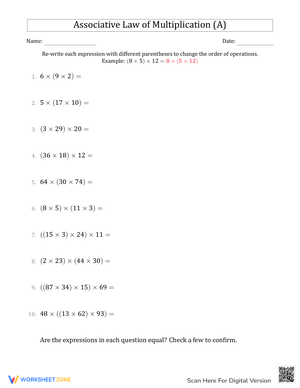
- Rewriting expressions by shifting parentheses to the other factor pair and confirming both sides yield the same product
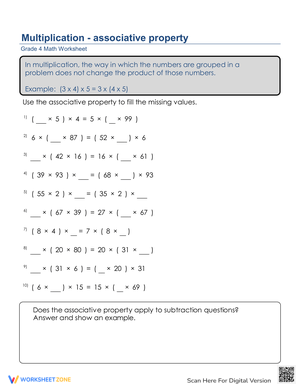
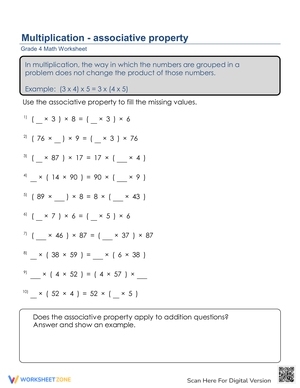
- Missing-factor problems — for example, (3 × ___) × 5 = 3 × (4 × 5) — where students must identify the grouped factor, not just compute an answer
- Comparison tasks where students evaluate two differently grouped versions of the same problem and identify which grouping is mentally easier to execute
- Three-factor word problems requiring students to set up the expression, choose a grouping, and label their reasoning
- Mixed-review problems that include both associative and commutative examples side by side, asking students to identify which property applies
The 4th grade associative multiplication printable worksheets in this set include problems built specifically around factor pairs that reward strategic grouping — students can feel the difference between an efficient path and a laborious one. When students see (6 × 4) × 5 = 6 × (___ × 5), they have to think about what the parentheses are doing — not just calculate. That shift from arithmetic execution to structural analysis is what separates meaningful property practice from routine fact review.
Why Grouping Strategy Belongs at This Grade Level
Grade 4 is when multiplication moves beyond single-digit facts into multi-digit territory, and that is exactly the moment when the associative property starts paying dividends. A student who sees 5 × 7 × 2 and multiplies left to right gets 35 × 2 — doable, but harder than necessary. A student who groups 5 × 2 first arrives at 10, then 10 × 7 in one mental step. The same logic applies to 4 × 25 × 3: grouping 4 × 25 produces 100, and 100 × 3 requires no effort. Teaching students to scan a string of factors before calculating is a concrete mental math habit, not an abstract vocabulary exercise.
At this grade level, students who understand the grouping logic can transfer it to new problem types; students who memorized the rule as a fact about parentheses cannot. That lived contrast is what makes the property memorable.
Student Errors to Watch For and Address Early
The most common error is conflating this property with the commutative property. Students already know that order doesn't affect the product, so when they encounter a parentheses-shifting problem, many move the factors rather than just the parentheses. Given (2 × 6) × 5, a student might rewrite it as 5 × (2 × 6) and call that the associative property — but that's the commutative property applied to the entire grouped expression. The associative form is 2 × (6 × 5): same factor order, different grouping. This distinction requires direct, repeated instruction. Writing both properties on an anchor chart with one worked example each and returning to it every lesson for the first week helps, but expect the confusion to resurface in the mixed-review problems.
A second error pattern appears in missing-factor tasks. Students solve the parenthetical correctly, then stop there and record that partial result as the final answer. In (4 × 5) × 6 = ___, a student writes 20. This is not a conceptual misunderstanding of the property — it is a procedural attention lapse. It shows up consistently enough in actual student work that building in an explicit step-check habit is worthwhile: after solving the first group, ask students to circle whether they have finished multiplying all three factors.
There is also a small cluster of students who try to extend associative grouping to subtraction — writing (10 − 3) − 2 = 10 − (3 − 2) and expecting the same result. A direct counterexample early in the unit prevents that overgeneralization from taking hold before it is even addressed.
Lesson-Planning Strategies to Get the Most From These Worksheets
The most efficient use of these resources is not whole-class independent practice — it is targeted deployment at specific moments in the lesson cycle. A three-problem exit ticket from the missing-factor worksheet tells you exactly who understands the structural logic of the property and who is pattern-matching without comprehension. That data shapes the next morning's small-group pullout better than a unit pre-test, and it takes about eight minutes to score during the afternoon prep block.
For small-group instruction, an effective move is to have students solve the same three-factor problem two different ways, side by side on the same workspace, then write one sentence explaining which grouping they found mentally easier and why. That metacognitive step — naming your own reasoning — turns a fill-in-the-blank exercise into a mathematical conversation. Students who cannot yet articulate why one grouping felt simpler are students who have executed the procedure without internalizing the principle; they need more concrete examples before moving to abstract notation.
During math center rotations, the word-problem worksheets hold up especially well as independent tasks because students can work through them at different paces without requiring teacher facilitation. Laminating the expression-rewriting worksheets and pairing them with dry-erase markers makes them reusable across multiple rotations — a practical consideration when printing budgets are tight.
Standard Alignment
These worksheets align to CCSS.MATH.CONTENT.3.OA.B.5, which directs students to apply properties of operations — including the associative property of multiplication — as strategies for computing. In most Grade 4 classrooms, this standard is revisited explicitly during the multi-digit multiplication unit, because applying grouping strategies strategically supports the work described in CCSS.MATH.CONTENT.4.NBT.B.5. Teachers using these in Grade 4 are reinforcing a Grade 3 standard while students apply it in more complex numerical territory — a deliberate and well-documented instructional overlap rather than a misalignment. Students who solidified the property with single-digit factors in third grade are ready to extend it to two-digit factor work by the time they reach fourth-grade multiplication units.
Adjusting These Worksheets Across Ability Levels
Students who are still uncertain about basic multiplication facts need a modified entry point before the associative property makes sense as a strategy. Starting with factor sets built around 2s, 5s, and 10s keeps the arithmetic simple enough that attention can go toward the grouping structure itself. Providing the parentheses already placed — so students are only asked to confirm that both groupings produce the same product before moving the parentheses themselves — is a reasonable intermediate step that reduces the cognitive demand without removing the conceptual task entirely.
On the other end, students who grasp the basic property quickly benefit from problems that include two-digit factors — 4 × 25 × 3 or 2 × 15 × 5 — where strategic grouping is genuinely useful rather than optional. These students can also work with extension prompts that ask them to produce a counterexample showing why the property does not hold for subtraction, or to write their own three-factor word problems and swap them with a partner for solving. The 4th grade associative multiplication printable worksheets support these extensions without requiring separate materials — the problem structure adapts naturally in both directions.
Frequently Asked Questions
How does the associative property connect to multi-digit multiplication in Grade 4?
Directly. When students multiply 4 × 30, the most efficient mental path treats 30 as 3 × 10, applies the grouping (4 × 3) × 10, computes 12 × 10, and arrives at 120 without paper. That is the associative property applied to place-value decomposition. Students who understand the grouping logic can transfer it to new problem types; students who memorized the rule as a fact about parentheses cannot.
What is the most important concept to establish before students attempt mixed-property problems?
The vocabulary distinction between "grouping" and "order." Establishing that the associative property changes which factors are grouped while the order stays fixed — and that the commutative property changes the order of factors — needs to happen before students see problems that require them to identify which property applies. A short anchor activity where students label five pre-sorted examples, without yet solving anything, prevents the confusion that otherwise resurfaces throughout the unit.
Are these worksheets better suited for classroom practice or homework?
Classroom practice, in most cases. The missing-factor and comparison problem types require students to analyze the structure of an expression before computing — the kind of thinking that benefits from teacher proximity and quick correction. Homework works better with the expression-rewriting tasks, where students already have the procedure and are building fluency through repetition. The word-problem worksheets are the least appropriate for homework if students have not yet practiced extracting a three-factor equation from a narrative context.
How do I help students who keep mixing up the associative and commutative properties?
A sorting activity before any calculation helps more than re-explaining the definitions. Give students a set of expression pairs — some showing changed order, some showing changed grouping — and have them physically sort the cards into two labeled columns before solving anything. The act of categorizing slows down the impulsive pattern-matching that causes the confusion. Returning to the 4th grade associative multiplication printable worksheets after that sorting session typically shows clear improvement in students correctly identifying which property they are applying.













 Interactive Worksheet Maker
 Quiz Maker
 Word Search Maker
 Crossword Puzzle Maker
 Word Scramble Generator
 Sentence Scramble Generator
 Handwriting Worksheet Generator
 Name Tracing Generator
 Fill In The Blank Generator