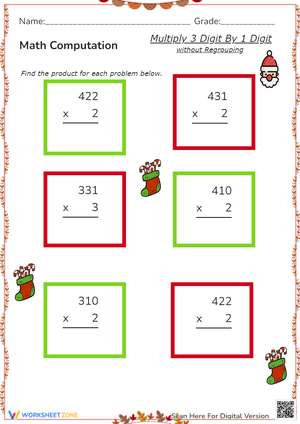
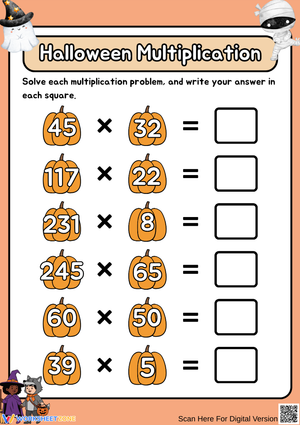
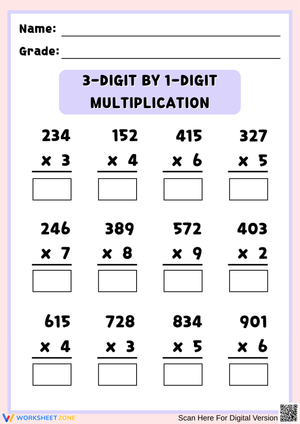
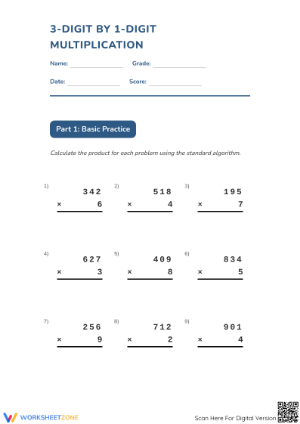
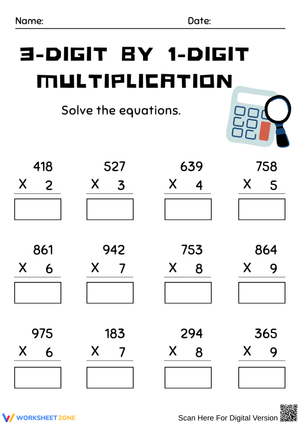
These 4th grade 3 by 1 printable worksheets resources give teachers a print-ready set for the stretch of instruction when students move from multiplication fact fluency into multi-digit work — one of the more technically demanding transitions of the 4th grade year. Each worksheet targets three-digit by one-digit multiplication through one of three distinct formats: area model templates, partial products layouts, or standard algorithm problems with pre-printed grid columns. Together, the set covers the full arc from early conceptual understanding to procedural fluency.
What's Inside the Set
The three formats each serve a different instructional purpose, and they work in sequence rather than in isolation.
- Area model worksheets ask students to partition a rectangle into hundreds, tens, and ones sections, multiply each section by the one-digit factor, then add the partial products. Working 452 × 3 this way means solving three separate multiplications — 400 × 3, 50 × 3, 2 × 3 — before summing. The rectangle keeps place value visible at every step.
- Partial products worksheets record each multiplication in full before adding. For 614 × 5, students write 5 × 4 = 20, 5 × 10 = 50, and 5 × 600 = 3,000, then stack and add. This format makes it possible to locate exactly where a student's reasoning breaks down, because every step is visible on the page.
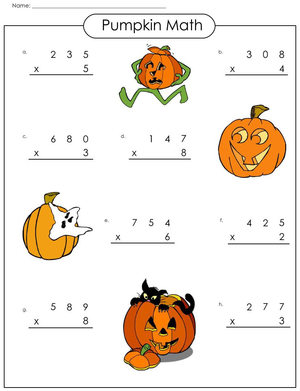
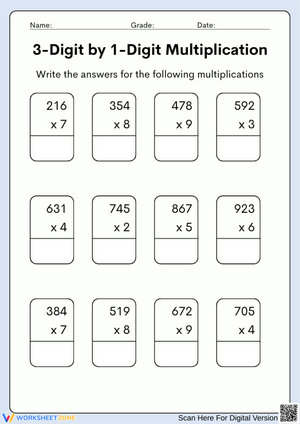
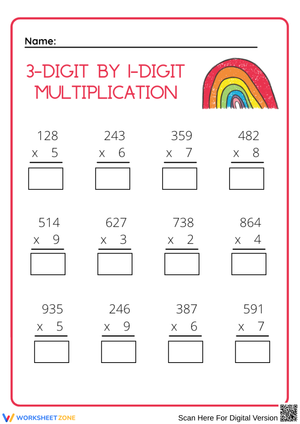
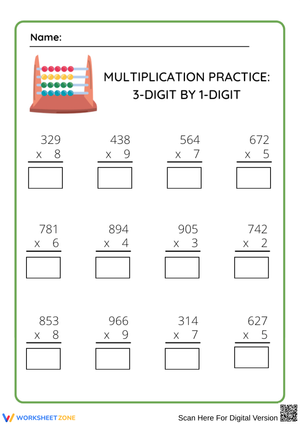
- Standard algorithm worksheets include grid-lined problems and, on several worksheets, guided boxes for regrouped digits. Problems are sequenced from no-regrouping to regrouping in the ones column only, then both columns, so teachers can assign from the right entry point in the unit.
Errors That Surface Most Often in Student Work
The most persistent error in the standard algorithm is a working memory failure, not a fact error. In a problem like 347 × 6, a student will correctly multiply 7 × 6 = 42, write the 2 in the ones column, and carry the 4. Then they multiply 4 × 6, arrive at 24, and record it without adding the carried 4. The answer they write is 2,442 instead of 2,082. The multiplication was accurate every time — what failed was tracking the carry through the next step. Students who check their own work by repeating the same procedure repeat the same omission, so the error goes uncaught.
A second pattern worth anticipating: students who handle the area model cleanly often struggle when they see the standard algorithm for the first time, because the condensed vertical format looks nothing like the rectangle they practiced with. Assigning a worksheet where they solve the same problem in both formats — side by side — makes the connection between the two methods explicit. Also watch for column drift during partial products work. When students arrive at 600 × 4 = 2,400, many write "24" rather than "2,400," dropping the zeros that hold the place value. Pre-printed grid columns on the algorithm worksheets eliminate most of these organizational mistakes before they become habits.
Working These Worksheets Into Your Weekly Lesson Plans
The most practical entry point is the last 8 minutes of a whole-group lesson. Rather than assigning a full worksheet for independent work at the close of class, pull one or two problems from a 4th grade 3 by 1 printable worksheets resource and use them as a live exit ticket — students work the problem, flip it face-down, and you collect. That stack tells you immediately whether tomorrow's lesson needs to revisit regrouping or can move forward into word problems. Full-worksheet independent practice fits best mid-unit, after students have been introduced to all three methods and need volume to build accuracy.
In small-group rotations, these worksheets make teacher-table time easier to manage. Students at one station work independently on a standard algorithm worksheet while you pull a group of four to work partial products problems alongside base-ten blocks. The consistent structure of each worksheet — same problem count, predictable layout — means students at the independent station know what to do without needing directions repeated, which reduces interruptions during your small-group time.
Standard Alignment
CCSS.MATH.CONTENT.4.NBT.B.5 calls for multiplying a whole number of up to four digits by a one-digit whole number using strategies based on place value and properties of operations. In most 4th grade sequences, this standard lands mid-year after students have consolidated the place value concepts in 4.NBT.A and before the unit extends into two-digit by two-digit multiplication. Instructionally, it marks the point where multiplication stops requiring only fact recall and starts requiring students to manage regrouping, column organization, and multi-step arithmetic simultaneously — which is why sustained, well-sequenced practice across multiple problem types matters here.
Adjusting the Worksheets for Different Learners
For students who are not yet ready for regrouping, every 4th grade 3 by 1 printable worksheets option in the set includes a no-regrouping problem sequence that builds the algorithm's steps cleanly: multiply the ones, record, multiply the tens, record, multiply the hundreds, record. Problems like 321 × 2 or 412 × 2 let students internalize the procedure without the added demand of tracking a carried digit. Once that step sequence is automatic, introducing regrouping in the ones column only — problems like 137 × 4 — adds one new demand rather than two at once, which keeps the learning manageable.
Students who have already mastered the standard algorithm need a different kind of challenge. Word problems that require them to identify multiplication as the correct operation — before they calculate anything — slow these students down in a productive way. Their procedural fluency often outpaces their reading of the problem context. Pairing a computation worksheet with a word-problem worksheet from the same set, and asking students to write a matching equation before solving, extends the work without leaving the 4.NBT.B.5 standard behind.
Frequently Asked Questions
How do I help students who keep dropping the carried digit during regrouping?
Anchor the explanation in place value language, not procedure. When 7 × 6 = 42, say: "We have 42 ones — that's 4 tens and 2 ones. The 2 stays in the ones column, and the 4 tens move left." Base-ten blocks make this concrete: students physically trade 10 ones for 1 ten on the mat before they write anything. The carried digit stops being an abstract pencil mark and becomes a stack of tens they watched get traded. Students who work these 4th grade 3 by 1 printable worksheets materials alongside blocks internalize the regrouping step faster than those who work the algorithm on paper alone from the start.
When is a student ready to move from the area model to the standard algorithm?
Move a student when they can explain what each partial product in the area model represents — not when they can complete the rectangle quickly. Speed with the box method does not guarantee readiness for the algorithm. A useful check: ask the student to point to where the 1,200 came from in 4 × 347. If they trace it back to 4 × 300 without hesitation, they are ready to see that same value compressed into a "carry" in the standard algorithm. Rushing this transition before that understanding is solid produces exactly the regrouping confusion described above.
Are the area model worksheets appropriate to send home for homework?
Send area model worksheets home only after students have practiced the format in class at least two or three times. Parents unfamiliar with the box method sometimes "correct" their child's work by crossing out the rectangle and rewriting the problem as a vertical algorithm — which undoes the conceptual work the worksheet was doing. The standard algorithm worksheets travel better as homework because most families recognize the vertical format. A brief note in the worksheet header explaining what the student is practicing helps prevent well-meaning but counterproductive home corrections.













 Interactive Worksheet Maker
 Quiz Maker
 Word Search Maker
 Crossword Puzzle Maker
 Word Scramble Generator
 Sentence Scramble Generator
 Handwriting Worksheet Generator
 Name Tracing Generator
 Fill In The Blank Generator