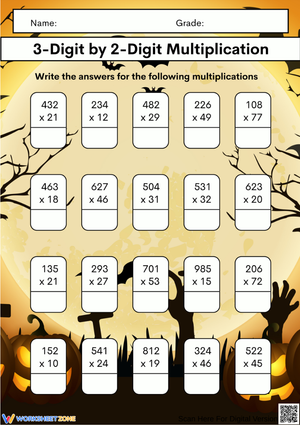
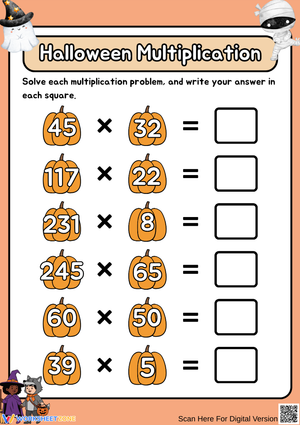
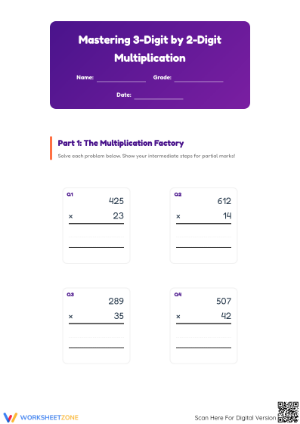
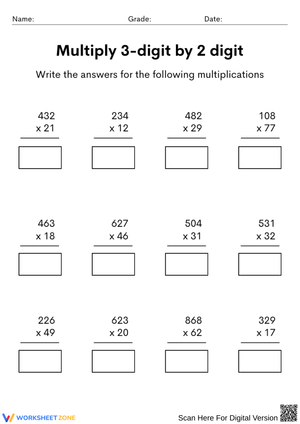
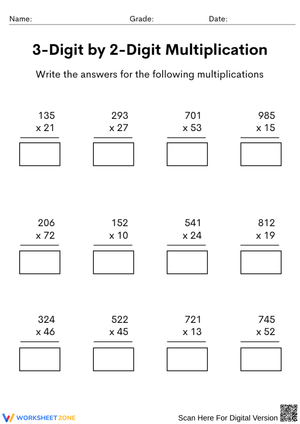
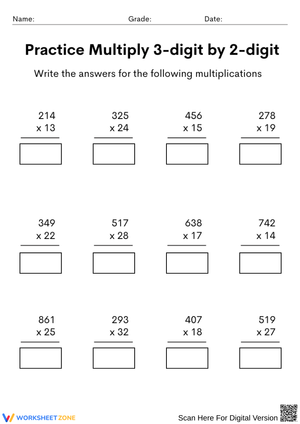
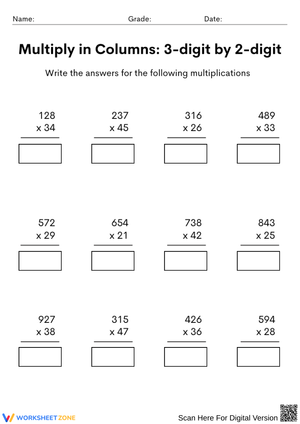
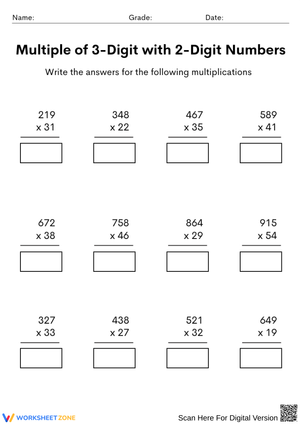
These 3 digit 3 by 2 printable worksheets for 4th grade move students from the area model into the standard algorithm through a sequence that keeps place value reasoning visible at every step. The set includes grid-assisted workspace, open practice, and estimation prompts — each worksheet targeting a different point in the learning arc, so teachers can assign them as guided practice, morning warm-ups, or targeted review without extra preparation.
The Specific Skills These Worksheets Address
Students work through three distinct skill areas across the set. Area model worksheets ask students to expand a three-digit factor — say, 345 — into hundreds, tens, and ones, then multiply each part by the two-digit factor and sum the partial products. This makes the place value logic explicit before the standard algorithm compresses it into columnar steps.
Standard algorithm worksheets use grid-lined workspace to enforce correct column alignment during both partial product rows. As students gain accuracy, later worksheets remove the grid and require them to manage alignment independently. A third worksheet type prompts estimation before calculation: students round each factor, record an estimated product, then compare it to their exact answer. If the two diverge sharply — say, an estimated 16,000 versus a computed 1,565 for 412 × 38 — the discrepancy flags an error before the teacher ever reviews the work. Some worksheets also include real-world word problems that require students to write the multiplication expression before solving, which slows impulsive calculation and builds problem-setup habits.
Where Student Work Breaks Down and What to Watch For
The placeholder zero accounts for the highest percentage of wrong answers in this operation. When a student multiplies 345 × 26, the first partial product (345 × 6 = 2,070) usually comes out right. The error happens on the second row: the student multiplies 345 × 2 and writes 690 directly beneath 2,070 without shifting one column left. The final addition then produces a number off by a factor of ten — and because the individual calculations look correct, students almost never catch it on self-review. Grid-assisted worksheets interrupt this by boxing each partial product into its correct column. The open-workspace versions reveal exactly who has internalized the column logic and who is still following a memorized pattern without place value understanding behind it.
Regrouping errors are the second consistent problem. Students add the carried digit before multiplying instead of after — often because the regrouped number sits above the column and feels like part of the addition step rather than a modifier to the current multiplication. Asking students to write the regrouped digit in a different color during the first several lessons makes the step auditable: the teacher can see exactly where the process broke down rather than working backward from a wrong final answer.
Partial product misalignment in the addition step is the third pattern worth watching. Before students write the second partial product, have them draw a light pencil line down from the ones digit of the first row. That vertical reference catches most column-shift errors before they reach the addition step and takes roughly five seconds per problem.
Fitting These Worksheets Into the School Day
The area model worksheets belong on the day of introduction, not the day after. Students need to see the expanded form written on the board at the same moment they are working through it on the worksheet — that simultaneous modeling keeps the connection between the visual representation and the notation intact. Introducing the area model on Monday and assigning the corresponding worksheet on Tuesday breaks that connection and often costs the teacher a full re-explanation at the start of independent work.
For the standard algorithm phase, a highlighter strategy reduces the placeholder zero error significantly in practice. Before multiplying the tens digit, students highlight the zero's position in the second partial product row. The physical act of picking up the highlighter creates a deliberate pause inside an otherwise automatic procedure — and automaticity is exactly what makes this error so persistent. Most students internalize the step after four or five practice sessions and stop needing the prompt, but the habit forms faster with that physical reinforcement than with verbal reminders alone.
The 3 digit 3 by 2 printable worksheets for 4th grade that emphasize estimation work well as a Monday warm-up at the start of a multiplication unit, giving teachers a fast read on which students are using number sense versus just grinding through steps. Five minutes, four problems, and you know before whole-group instruction begins who needs the grid support during independent work that afternoon.
Adjusting the Set for a Range of Student Readiness Levels
Students who are not yet fluent in single-digit multiplication facts hit a different wall here than students who are procedurally confused. For them, the cognitive load of retrieving facts while simultaneously tracking partial products and column alignment is simply too high — not because the algorithm is beyond them, but because each step draws on working memory that fact retrieval is already consuming. Pairing the grid-assisted worksheets with a multiplication reference chart separates those two demands. The student focuses on the procedure; fluency practice happens in a different part of the day.
Students who finish quickly get more from the word problem format than from additional computation rows. Having them write their own multiplication scenario — real-world or invented — then swap with a partner to solve is a natural extension that costs no extra materials and requires the kind of flexible application that a column of bare problems does not.
For students with working memory challenges, reducing each worksheet to four or five problems rather than a full row set keeps the session productive. The procedural sequence is identical; the volume is lower. Accurate work on five well-executed problems builds more durable understanding than twelve rushed ones with uncorrected errors buried in the middle rows.
Standard Alignment
The 3 digit 3 by 2 printable worksheets for 4th grade address CCSS.MATH.CONTENT.4.NBT.B.5, which requires fourth graders to multiply multi-digit whole numbers using strategies based on place value and the properties of operations. Three-digit by two-digit multiplication sits near the upper end of this standard's scope at the fourth-grade level. Most teachers reach it in the second half of the year, after students have worked through two-digit by two-digit problems — a structurally identical operation with fewer digits to track, making it the better entry point before adding the hundreds place and its accompanying regrouping demands.
Frequently Asked Questions
Why does the placeholder zero keep causing mistakes even after students say they understand it?
Understanding a concept and performing it inside an automatic procedural sequence are different cognitive tasks. Students who have practiced single-digit multiplication extensively have a well-worn rhythm: multiply, write the product, move left. The placeholder zero requires inserting a deliberate step into that automatic sequence — which is precisely what automaticity resists. The physical highlighting strategy works because it makes the interruption external and concrete, rather than relying on a mental reminder competing for space inside an already-loaded working memory.
Can students below 4th grade use these worksheets?
Third graders who have secured two-digit by two-digit multiplication and are comfortable with regrouping work through the area model worksheets without difficulty. The 3 digit 3 by 2 printable worksheets for 4th grade in the standard algorithm format are also useful as early fifth-grade review before students move into multiplication with larger factors or begin long division, where partial product reasoning reappears in a new procedural context.
How do I know when a student is ready to move from grid-assisted to open-workspace practice?
Two to three sessions of accurate work on grid-assisted practice is usually sufficient. If a student still misaligns partial products after three grid-assisted worksheets, the issue is not practice volume — it almost always means the placeholder zero concept needs direct reteaching, not more repetition in the same format. Consistent left-shift errors on the second partial product row are a specific signal: that pattern points to a place value gap rather than a careless mistake, and additional computation practice will not close it.













 Interactive Worksheet Maker
 Quiz Maker
 Word Search Maker
 Crossword Puzzle Maker
 Word Scramble Generator
 Sentence Scramble Generator
 Handwriting Worksheet Generator
 Name Tracing Generator
 Fill In The Blank Generator