4th Grade Equivalent Fractions and Decimals worksheets
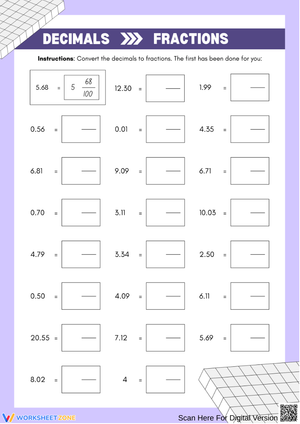
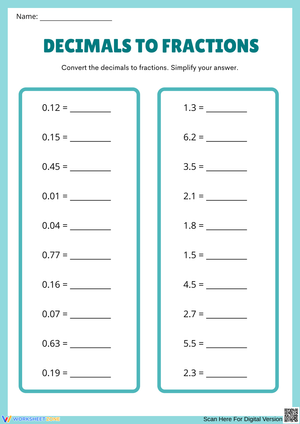
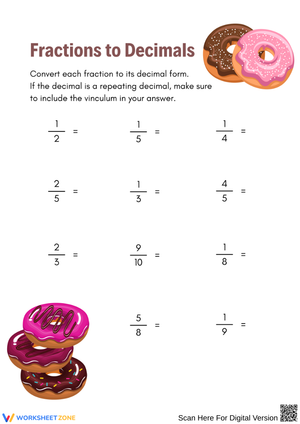
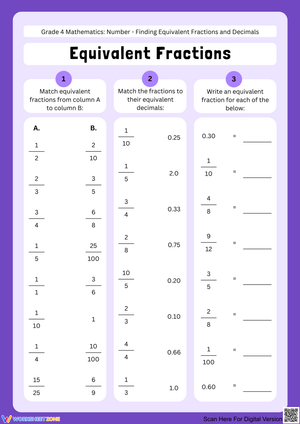
These 4th grade equivalent fractions and decimals worksheets give students structured, repeated practice with the specific conversions that give fourth graders the most trouble: expressing tenths as hundredths, translating both into decimal notation, and making sense of why 0.3 and 0.30 name the same amount. Each worksheet targets a distinct slice of that skill set — visual grid work, number line placement, conversion tables, and applied word problems — so teachers can sequence them intentionally rather than handing out a generic mixed-review page.
The Specific Skills Targeted
The core work across this set moves from concrete to abstract in a deliberate sequence. Students begin by shading 10×10 grids — coloring three full columns to see that three-tenths and thirty-hundredths cover identical area before a single decimal point is written. From there, the worksheets ask students to record the fraction, then the equivalent fraction with a denominator of 100, then the decimal, all from the same grid. Later worksheets remove the visual scaffold and ask students to move between representations using only place value reasoning.
Beyond the grid work, students practice placing fractions and decimals on number lines between 0 and 1, completing conversion tables that pair tenths fractions with their hundredths equivalents, writing decimals in word form, and comparing pairs of values using <, >, or =. Several worksheets connect the concepts to money — using dimes as a physical model for tenths and pennies for hundredths — because most fourth graders already know that four dimes is forty cents, and that entry point makes the abstract place value relationship suddenly legible.
Standard Alignment
This set addresses 4.NF.C.5 and 4.NF.C.6 directly. Standard 4.NF.C.5 requires students to express a fraction with a denominator of 10 as an equivalent fraction with a denominator of 100 — the foundational step before decimal notation is introduced. Standard 4.NF.C.6 extends that into decimal notation: students must use decimal form to represent fractions with denominators of 10 or 100. In classroom terms, 4.NF.C.5 is the work of the grid-shading and conversion table worksheets, while 4.NF.C.6 is what the number line and comparison worksheets assess. Teachers who are pacing against a unit map can use the two standards as natural staging markers: grid work and equivalence first, then decimal notation and comparison once the equivalence is solid.
Frequent Student Errors Worth Watching For
The most persistent error is the placeholder zero omission. A student who can correctly write seven-tenths as 0.7 will confidently write seven-hundredths as 0.7 as well — the spoken names sound similar enough that the distinction blurs. The problem sharpens when students write single-digit hundredths from dictation: "four-hundredths" gets recorded as 0.4, and the student sees nothing wrong with it. These worksheets address that directly by pairing tenths and hundredths side-by-side in the conversion tables, so students are forced to write 0.7 and 0.07 in adjacent cells and notice the structural difference.
A second error pattern involves whole-number thinking bleeding into decimal comparisons. Students who have spent three years learning that 60 is greater than 6 resist the claim that 0.60 and 0.6 are equal — and for similar reasons, they often rank 0.45 above 0.8 because 45 feels bigger than 8. The number line worksheets are particularly effective here because students have to physically locate both values, and it becomes impossible to place 0.45 to the right of 0.8 once the number line is drawn correctly. Catching this during the placement activity is far better than discovering it on a unit test.
One instructional habit that helps across both error types: require students to read decimals aloud using their fraction names rather than digit-by-digit. A student who says "zero point four" has no cue about place value. A student who says "four-tenths" already knows the denominator, which makes writing the equivalent hundredths fraction a much shorter leap.
Fitting These Worksheets Into Your Week
The grid-shading worksheets work well as a lesson opener when you are first introducing the tenths-to-hundredths equivalence — ten minutes of shading and labeling before direct instruction gives students a concrete image to hold during the explanation. Later in the unit, the conversion table and comparison worksheets slot naturally into the last eight minutes of class as a quick independent check while you circulate: the format is tight enough that you can scan the room and immediately see who is writing 0.07 and who is still writing 0.7.
For Monday warm-ups after a weekend break, the money-based word problem worksheets tend to re-engage the concept quickly — the familiar context pulls students back in without requiring you to re-teach from scratch. The number line worksheets, because they generate visible disagreement about placement, are particularly productive during partner work; two students who disagree about where 0.40 belongs will talk through the reasoning in ways that a solo worksheet never produces. If your schedule includes a Friday review block, the comparing and ordering worksheets function as a light formative assessment — they are fast to complete and fast to scan, and the error patterns they surface are specific enough to inform Monday's instruction.
Adjusting the Worksheets for a Range of Learners
Students who are not yet secure with basic fraction concepts — what a numerator and denominator represent — will struggle to engage with the decimal conversion work productively. For those students, starting with only the grid-shading worksheets and asking them to write fractions without introducing the decimal notation yet lets them build the visual foundation without the added demand of a new symbol system. The conversion to decimal notation can follow once they can reliably label the shaded grid with the correct fraction.
On the other end, students who move through the standard conversion work quickly benefit from the comparison worksheets reframed as an ordering task: given six values in mixed fraction and decimal form, arrange them on a number line from least to greatest. That task requires all of the same skills but adds the coordination of holding multiple values in relation to each other — a meaningful extension without requiring any additional preparation. For students working above grade level, introducing fractions with denominators of 5 and 25 (converting to equivalent hundredths before writing the decimal) connects 4.NF.C.5 reasoning to cases outside the standard while staying within the same conceptual framework.
Frequently Asked Questions
Why do these worksheets focus only on denominators of 10 and 100, and not other fractions?
The 4.NF.C standards specifically bound this work to tenths and hundredths because those denominators connect directly to base-ten place value. The goal at this grade is for students to see that the decimal system extends to the right of the decimal point using the same logic it uses to the left — that is the conceptual insight. Fractions with other denominators (thirds, eighths, fifths) require division to convert, which is a fifth-grade skill. Keeping the denominator constraint tight lets fourth graders focus on place value structure rather than computation.
Can these worksheets be used for intervention with fifth graders?
Yes. Fifth graders who are struggling with decimal operations often have a gap specifically in understanding what a decimal represents, not just how to manipulate it. The grid-shading and number line worksheets in this set address that gap directly. They are not labeled with grade-level branding in a way that would feel condescending, and the visual format tends to work well for students who have been proceeding on procedural autopilot and need to rebuild conceptual grounding.
How many worksheets are in the set, and are they sequenced?
The set includes multiple worksheets organized by representation type and cognitive demand — grid-based visual tasks appear before decontextualized conversion practice, and comparison and ordering tasks come last. They are designed to be used in that sequence during initial instruction, but individual worksheets also stand alone for review, assessment, or targeted re-teaching after a unit has concluded.
Clear All