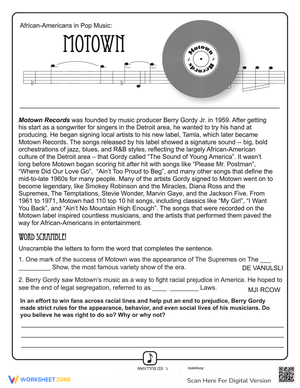
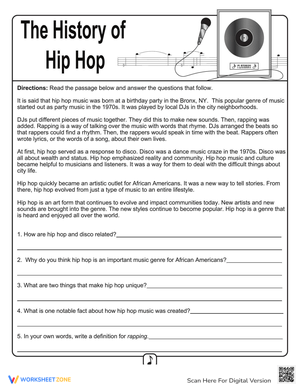
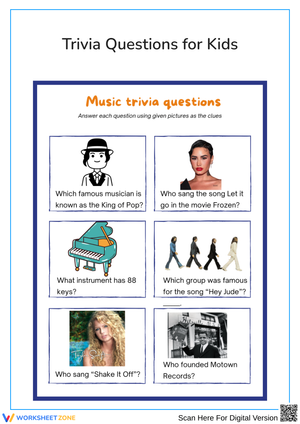
These 4th grade music worksheets printable resources give music specialists and classroom teachers direct, pencil-ready support for the skills that show up most at this grade level — rhythm notation, treble clef reading, musical symbols, instrument families, and listening vocabulary. The set works across multiple classroom contexts: warm-up minutes, center rotations, independent practice blocks, early finisher bins, and substitute plans, all without requiring instruments in hand.
Skills Each Worksheet Targets
Fourth grade sits at a notable transition in music literacy. Students are moving from purely aural and kinesthetic learning — clapping, singing, moving — toward reading and writing standard notation. The worksheets reflect that shift by keeping the skill target narrow and asking students to show what they know through marking, labeling, or short written response rather than circling or coloring with no analytical demand.
With these 4th grade music worksheets printable materials, teachers can revisit each skill area in different contexts across the year rather than covering it once and moving on. The six core areas the set addresses are:
- Rhythm values: students identify note and rest values, compare durations, and complete partial measures by supplying the missing beat count.
- Treble clef note reading: students name notes on the staff, mark note positions from given letter names, and identify notes in short melodic fragments.
- Musical symbols and dynamics: students match symbols to meanings, sequence dynamics from softest to loudest, and identify repeat signs and barlines.
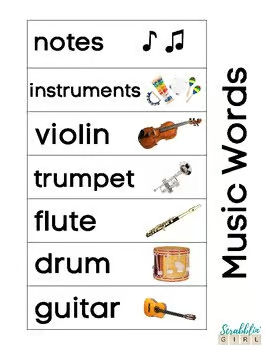
- Instrument families: students sort, label, and compare instruments by visual features, sound-production method, and family group.
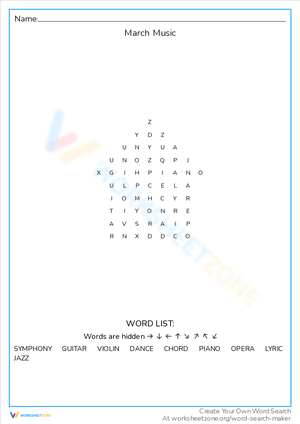
- Music vocabulary: students match Italian and common music terms to definitions, or apply vocabulary by completing short written sentences in context.
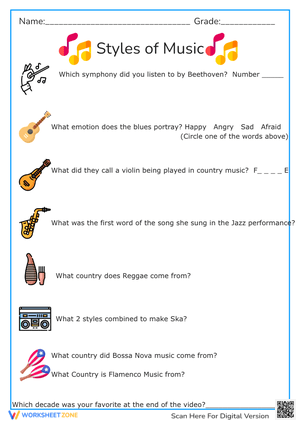
- Listening responses: structured prompts ask students to annotate observations about tempo, dynamics, mood, or prominent instruments after a brief recorded excerpt.
How to Build These Worksheets Into Your Lesson Plans
The most productive use of these materials is as a bridge between active music-making and written reflection. After students clap a rhythm pattern, sing a melody, or respond to a recording, a five-to-eight-minute worksheet addressing the same concept shifts learning from muscle memory toward conceptual articulation. That transfer step is what gives you something concrete for a student folder or a quick formative check — the worksheet earns its place in the period when it follows the music rather than replacing it.
A few reliable placements. A rhythm completion worksheet works well as a warm-up during the 8 to 10 minutes after entry routines, before the lesson's main activity. Symbol and vocabulary worksheets fit center rotations because students can partner-check without teacher proximity. Listening response sheets are strong sub-day plans: they require no live instruction and produce student work you can review after returning. The set also supports spaced retrieval — returning to a treble clef labeling worksheet three weeks after initial instruction reveals far more about durable learning than a review completed on the same day of teaching.
Mistakes Students Make That These Worksheets Help You Catch
Rhythm completion activities surface one of the most consistent Grade 4 errors: students who correctly identify note values in isolation often miscount when filling a partial measure. When a 4/4 measure already contains a quarter note and a half note — three beats total — many students write a half note for the remaining space, over-filling the measure to five beats. They're responding to the visual empty space rather than tracking the running beat count. That error shows up in performance too, but worksheets isolate it in a way that makes it visible and correctable before the habit hardens.
Treble clef labeling produces a different and equally predictable problem. Students who have memorized "Every Good Boy Does Fine" and "FACE" can still freeze on the note D, which sits in the space below the first line of the staff. Because D doesn't appear in either mnemonic in a way that maps visually to the staff, students either skip it or substitute E. Any labeling worksheet that includes the space below the first line makes that specific gap show up immediately across a class set of papers.
Dynamics recognition trips students up differently. The word forte carries no English cue about volume, while piano carries a misleading one — students who know piano as an instrument name often mark the dynamic as "medium" or "neutral" rather than soft. Matching worksheets surface this confusion clearly before it calcifies in performance habits.
Adjusting the Worksheets for a Range of Learners
Rhythm worksheets are the most straightforward to tier. For students who need additional support, provide a reference strip listing note values alongside their beat counts — this keeps the cognitive load on the actual task of adding beats correctly rather than on recall. For students who are ahead, extend the same measure-completion format by asking them to write a second measure that uses different note combinations but totals the same beat count. That's a small compositional push that doesn't require a different worksheet.
Treble clef labeling works differently across levels. Students still building confidence do well when the first two or three notes on the staff are pre-labeled, giving them a counting anchor; from there, they can work up or down the staff. Students who already know the line and space names benefit most from a mixed task that includes both labeling and writing — read the printed note name AND notate a given note on a blank staff nearby. It's worth using matching-format worksheets carefully with students who are strong pattern-matchers: some can complete a vocabulary or symbol match entirely through process of elimination without retrieving any music knowledge. For those students, requiring a one-sentence written justification for any three answers turns the activity into genuine retrieval practice rather than visual sorting.
Standard Alignment
These worksheets align most directly with MU:Pr4.2.4 from the National Core Arts Standards, which asks Grade 4 students to read and perform rhythmic and melodic patterns using standard notation. In classroom terms, that standard is addressed in sequence: first through performance (clapping, singing), then through recognition (labeling, matching), then through production (completing partial measures, short composition prompts). The rhythm completion and treble clef worksheets fit the recognition and production phases of that progression and give teachers a written artifact for each phase.
Listening response worksheets align with MU:Re7.2.4, which addresses how students explain their responses to music based on structural elements and context. A response sheet with targeted prompts for tempo, dynamics, and instrumentation gives students a framework for that explanation — most 9- and 10-year-olds cannot yet organize open-ended listening impressions without a structural guide, and the prompts do that work without dictating the answer.
Frequently Asked Questions
Will these worksheets work for a classroom teacher who doesn't specialize in music?
Yes. Each worksheet identifies its skill target clearly, and answer keys keep review efficient. Rhythm and symbol worksheets require no musical performance from the teacher — students work from printed patterns, definitions, and labeling tasks. Listening response sheets need access to a recording, which most classroom teachers can provide through a streaming service or a short online clip.
How long does each worksheet take?
Most fall in the 5 to 12 minute range for independent work. Labeling and matching worksheets run on the shorter end; listening response sheets, which ask for written observations, take a bit longer. That range makes them practical for warm-ups, transitions, and center work without consuming the core lesson.
Can these materials work for 3rd or 5th grade music classes?
The 4th grade music worksheets printable label reflects the primary design intent, but the skill range means the materials flex across adjacent grades reasonably well. Rhythm and instrument-family worksheets work in 3rd grade without modification; treble clef labeling may need the reference-strip support described above for younger students. Several worksheets fit a 5th grade review context without any adjustment, particularly the rhythm completion and notation materials.
Are these worksheets appropriate for assessment, or only for practice?
Both. A completed rhythm completion or treble clef labeling worksheet gives you a quick picture of where individual students stand — the beat-overcounting error and the D-below-the-staff freeze are diagnostic when you see them across a class set of papers. Using these as 4th grade music worksheets printable formative checks alongside performance-based observation gives a fuller picture of music literacy than listening alone can provide, especially for students who perform confidently but struggle to articulate what they hear or see on the staff.












 Interactive Worksheet Maker
 Quiz Maker
 Word Search Maker
 Crossword Puzzle Maker
 Word Scramble Generator
 Sentence Scramble Generator
 Handwriting Worksheet Generator
 Name Tracing Generator
 Fill In The Blank Generator