


























Views
Downloads
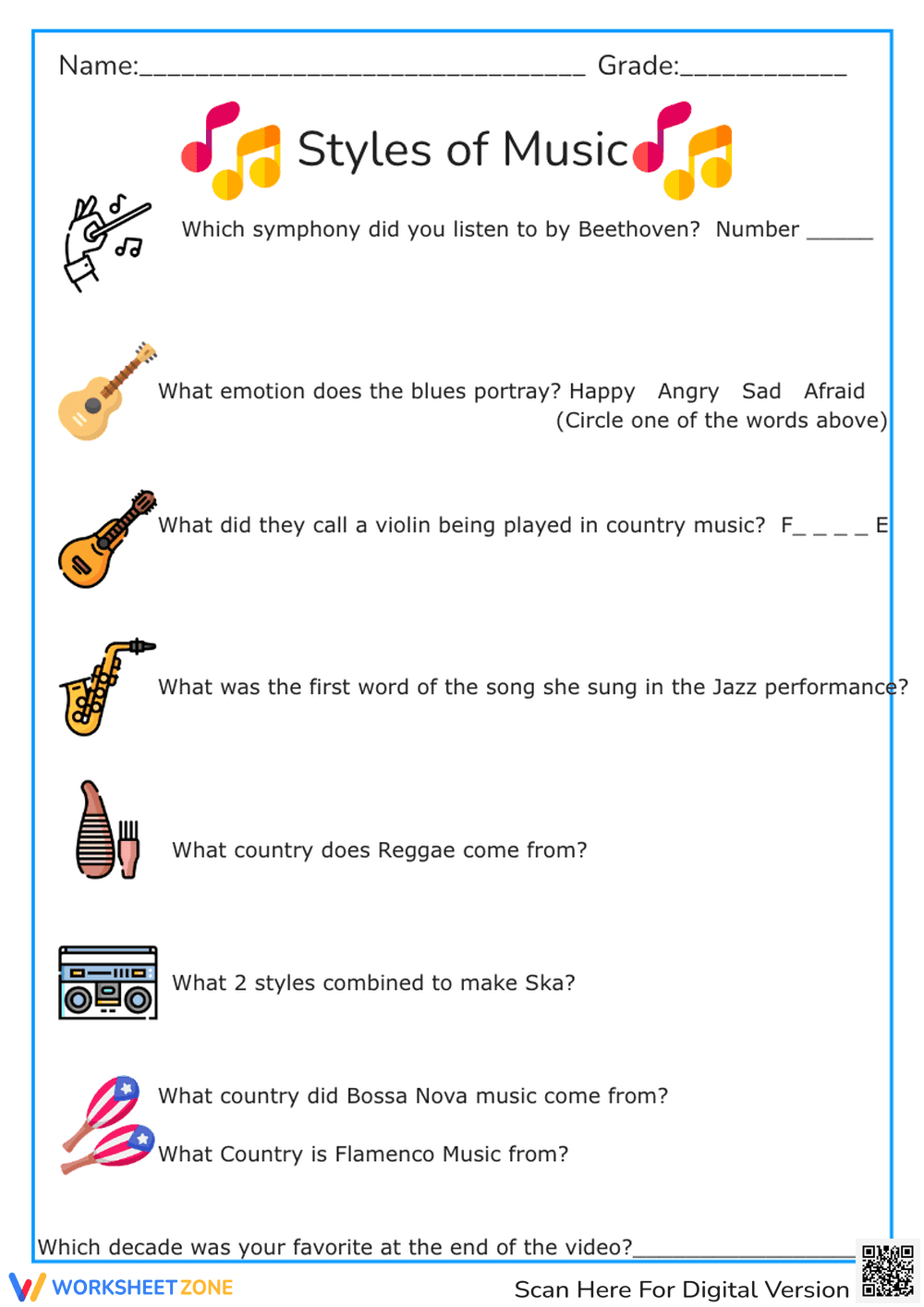

Essential Styles of Music Worksheet | Grade 4-5
Paste this activity's link or code into your existing LMS (Google Classroom, Canvas, Teams, Schoology, Moodle, etc.).
Students can open and work on the activity right away, with no student login required.
You'll still be able to track student progress and results from your teacher account.
This Grade 4 and Grade 5 music worksheet provides a structured listening guide for students to identify diverse musical genres and their cultural origins. By engaging with specific auditory cues, learners connect styles like Jazz, Reggae, and Flamenco to their historical and geographical contexts. It ensures students remain focused during multimedia presentations while building foundational music appreciation skills.
At a Glance
- Grade: 4-5 · Subject: Music
- Standard:
MU:Re7.2.4a— Describe how responses to music are informed by context and structure- Skill Focus: Genre identification and cultural origins
- Format: 1 page · 9 problems · Answer key included · PDF
- Best For: Video companion or listening center activity
- Time: 15–20 minutes
The resource consists of a single-page PDF featuring 9 targeted comprehension questions. It includes fill-in-the-blank prompts, multiple-choice emotion identification for the Blues, and geographical matching for international styles like Bossa Nova. The layout is clean, featuring iconic instrument illustrations that provide visual scaffolds for younger learners or English Language Learners. A complete answer key is provided to facilitate rapid grading.
This worksheet is designed for a zero-prep classroom environment. Teachers can print the document in less than 1 minute, distribute it to the class, and play the accompanying educational video. Students complete the 9 tasks in real-time as they listen. Reviewing the answers as a whole group takes approximately 5 minutes, making the entire instructional cycle efficient and effective for busy schedules or emergency sub plans.
The primary alignment is MU:Re7.2.4a, which requires students to demonstrate and explain how responses to music are informed by the structure, elements, and context. By identifying the emotion of the Blues or the decade of a favorite style, students analyze the expressive qualities of music. Both standard codes can be copied directly into lesson plans, IEP goals, or district curriculum mapping tools.
Use this worksheet during the guided practice phase of a unit on global music history. It serves as an excellent formative assessment tool; teachers can observe which students struggle to identify the fiddle in country music to gauge prior knowledge. The expected completion time is 15 to 20 minutes, depending on whether the video is paused for discussion or played straight through.
This resource is ideal for general music classrooms in upper elementary grades. It supports differentiated instruction by providing clear sentence starters and visual icons. It pairs naturally with a world map or a genre-based anchor chart to help students visualize the geographical origins of the music styles discussed in the tasks, such as Jamaica for Reggae or Brazil for Bossa Nova.
According to the National Assessment of Educational Progress (NAEP), students who engage in active listening and contextual analysis demonstrate significantly higher retention of music theory concepts. This worksheet leverages the research-backed listening guide strategy, which Fisher & Frey (2014) identify as a critical scaffold for processing complex auditory information. By aligning with standard MU:Re7.2.4a, the resource ensures that Grade 4 and 5 students are not merely hearing music but are actively decoding the cultural and structural elements that define global styles. The inclusion of 9 specific tasks encourages focused attention, reducing the cognitive load often associated with passive video consumption. This structured approach to music appreciation is essential for meeting rigorous fine arts benchmarks and fostering a comprehensive understanding of how history and geography shape the sounds of different eras and regions.


