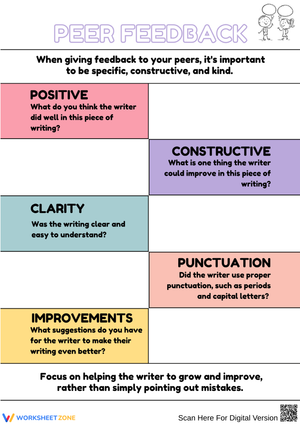
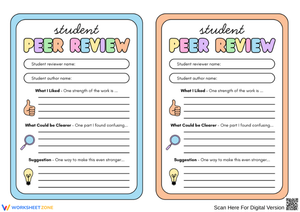
Peer editing printable worksheets for 4th grade give students a structured process for reading a classmate's draft that goes well beyond vague praise — they require the editor to move through specific mechanical categories in a deliberate order, name the errors they find, and record at least one genuine strength before offering any critique. The set covers capitalization, punctuation, spelling, and word usage, with feedback frameworks built in that keep editorial comments kind without making them meaningless.
What Students Do With Each Worksheet
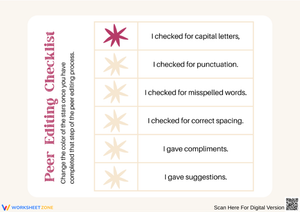
The core task is a multi-pass read. Rather than moving through the draft once and writing general impressions, the editor reads the paper several times, focusing on one category per pass. The CUPS framework — Capitalization, Usage, Punctuation, Spelling — structures those passes. Each read carries a single guiding question: Did every sentence start with a capital letter? on the first pass, Are there any misused homophones? on the spelling pass. Reading for one thing at a time means the editor can actually find errors instead of getting pulled in four directions at once.
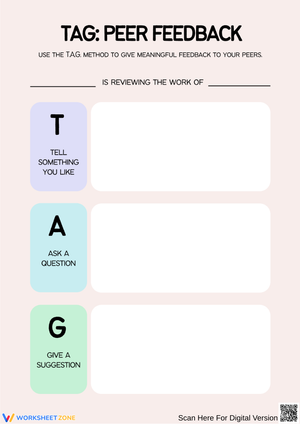
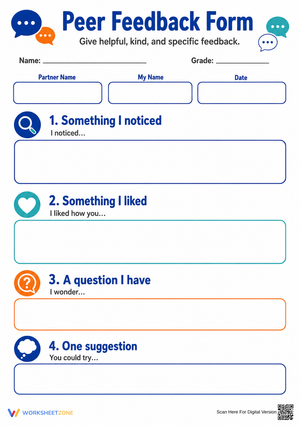
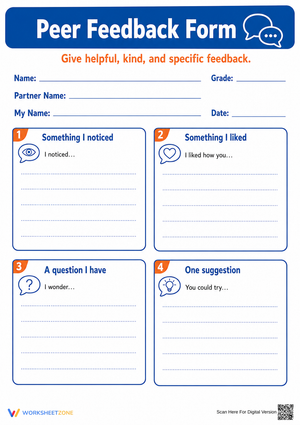
Beyond error-hunting, each worksheet also requires a positive observation. Methods like Two Stars and a Wish (two strengths, one suggestion) or Praise-Question-Polish (note something effective, ask a clarifying question, offer one mechanical fix) are built into the checklist. The editor fills these out before returning the draft, which means the writer always receives feedback that includes something they did well — not just a column of corrections.
Editing Versus Revising — a Distinction Worth Enforcing
Fourth graders reliably collapse these two stages into one undifferentiated "fix your paper" event unless the teacher draws the line clearly. Editing, as these worksheets frame it, is strictly about conventions: capitalization, punctuation, spelling, subject-verb agreement. It does not touch whether the ideas are compelling or whether the paragraphs follow a logical order — that's revision, and it belongs in an earlier stage. Worksheets that keep this boundary explicit solve a specific classroom problem: without it, some editors end up essentially rewriting the entire draft, which leaves the original writer feeling erased rather than helped. When the checklist only asks mechanical questions, the editor stays in their lane.
How to Build These Worksheets Into Your Writing Unit
The most reliable placement for peer editing printable worksheets for 4th grade is the session immediately after students complete a second draft. Editing a first draft gets the order wrong — the writer still has major content decisions to make, and fixing a comma before the paragraph structure is settled is wasted effort. After a second draft, the ideas are mostly in place, and the editor can direct full attention to mechanics.
Before releasing students to work, model the process with a teacher-written sample or an anonymized draft projected on the board. Walk through the CUPS checklist out loud, mark errors using standard editing symbols — three underlines beneath a letter signals capitalize; a circle around a word flags a spelling concern — and give students a printed reference card listing those symbols to keep beside the worksheet. Then run the editing session in timed rounds: five minutes on capitalization, five on punctuation. The timer keeps students from drifting into content discussion and holds the session to what the worksheet actually asks. Pair students intentionally, and rotate partners across the unit so each writer receives feedback from more than one set of eyes.
Mistakes Students Make That Are Worth Catching Early
The most common derailment is over-marking: a student circles half the sentences on the draft and writes "fix this" in the margin, which tells the writer nothing useful. These worksheets address this by asking the editor to name the error, not just mark it. A student who writes "this word should be capitalized — it's a proper noun" is demonstrating real understanding. A circle with no explanation is not feedback; it's pressure without direction.
Homophones are consistently the hardest category at this grade level. Students read past their/there/they're and its/it's errors because the word looks like a real word in context. Worksheets that include a short homophone reference list in the margin help significantly — without it, most editors flag only the visually obvious misspellings and miss substitution errors entirely. It's worth naming this out loud before the session starts rather than discovering after the fact that no one caught a single homophone error.
Standard Alignment
These peer editing printable worksheets for 4th grade align directly with CCSS.ELA-LITERACY.W.4.5, which requires students to develop and strengthen writing with guidance and support from peers through planning, revising, and editing. W.4.5 is notable because it treats peer input as a required instructional method, not optional enrichment — using a printed checklist gives that peer support a consistent, assessable structure rather than leaving it as an informal conversation that leaves no trace. The worksheets also support L.4.1 and L.4.2, which address conventions of standard English grammar and the mechanics of capitalization, punctuation, and spelling in student writing.
Adjusting the Set for a Range of Writers
For students who are still building basic sentence-level control, reduce the checklist to two categories instead of four. Capitalization and end punctuation together make a realistic single-session task. Covering the lower portion of the worksheet with a sticky note and revealing additional categories over subsequent editing sessions keeps the task achievable without stripping away the worksheet's structure entirely.
Students who move through the full checklist accurately and quickly benefit from an extension prompt added in the margin: identify one sentence where word choice could be more precise and suggest an alternative. This introduces a light revision task within the editing frame and gives the strong editor something genuinely more demanding — without putting them in the position of rewriting the partner's draft from scratch.
Frequently Asked Questions
How do I keep students from just writing "looks good" and handing the paper back?
Require the editor to fill out every section of the worksheet before returning the draft, and collect peer editing printable worksheets for 4th grade alongside final drafts so students know their editing work will be reviewed. A blank field on the checklist is not acceptable — if the worksheet asks for a named error with an explanation, a dash or a smiley face doesn't count. Attaching a brief completion check to the writing unit grade makes that expectation concrete from the first session.
Should students sign the peer editing worksheet?
Yes, and it changes the dynamic noticeably. When the editor's name is on the worksheet, they approach the task with more care. It also opens up a useful follow-up conversation: the writer can go back to the editor with a specific question about the feedback, which extends the learning well past the session itself.
What should I do when an editor misses obvious errors throughout the draft?
Treat it as instructional data. A student who misses every comma splice on a partner's draft probably hasn't internalized what a comma splice is — which means the class needs more direct instruction on that feature before the next editing round. Keep a running note of which error types are consistently missed across editing sessions and address those in whole-class instruction. The pattern in peer edits is often a clearer diagnostic than any quiz.
How often should peer editing happen across the school year?
Frequently enough that it stops feeling like a special event. When peer editing happens only once per unit, students spend most of each session figuring out the process rather than executing it. Short practice rounds — checking a weekly paragraph for end punctuation only, for example — keep the routine active. The full CUPS process makes the most sense for formal assignments where students have already drafted and revised, but quick single-category checks maintain the habit in between.












 Interactive Worksheet Maker
 Quiz Maker
 Word Search Maker
 Crossword Puzzle Maker
 Word Scramble Generator
 Sentence Scramble Generator
 Handwriting Worksheet Generator
 Name Tracing Generator
 Fill In The Blank Generator




 BACK TOSCHOOL