4th Grade K W L Chart Graphic Organizer PDF Worksheets
These 4th grade K-W-L chart graphic organizer worksheets give students a structured way to move through the thinking that reading actually requires — activating what they already believe, generating real questions before a text, and then pinning down what changed after they read it. Fourth grade is exactly when that sequence starts to matter most: students are expected to read independently, respond in writing with specific evidence, and explain their thinking with more precision than they managed in third grade. A K-W-L chart makes that expectation visible and concrete.
What Each Worksheet Asks Students to Do
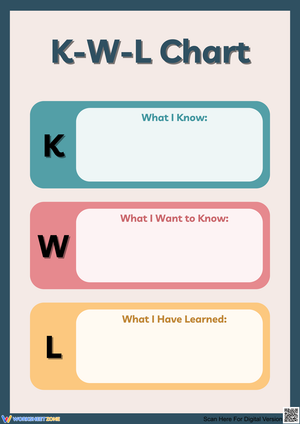
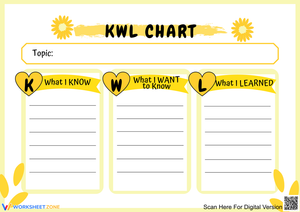
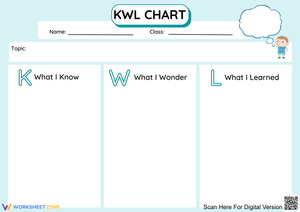
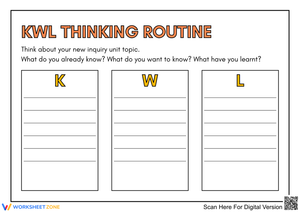
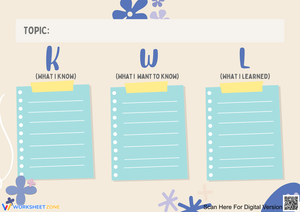
The three columns divide the reading process into distinct cognitive moves rather than letting it blur together. In the K column, students write what they already know about a topic — which reveals as much about their misconceptions as their prior knowledge. The W column asks them to convert curiosity into actual questions, which is its own skill and one that fourth graders often need direct practice with. The L column, completed after reading, is where students record what they found out, revise earlier assumptions, and note which questions the text actually answered.
Each worksheet in the set keeps the column structure consistent while offering layout variations suited to different tasks: blank open-field versions for class modeling, lined boxes for independent practice, and versions with sentence-starter prompts for students who need a firmer foothold. Teachers can pull the format that fits the lesson without rebuilding the routine each time.
Standard Alignment
These worksheets align most directly with CCSS.ELA-LITERACY.RI.4.1, which asks students to refer explicitly to a text to explain what it says and to draw inferences from it. The L column, used well, is where that standard lives on paper: students record what the text actually said in response to questions they set before reading. The W column also supports CCSS.ELA-LITERACY.RI.4.3, which addresses the explanation of events, concepts, and procedures using text-based evidence — asking a focused question before reading orients students toward the explanatory information the standard targets. For teachers using these worksheets in a writing context, the finished organizer supports CCSS.ELA-LITERACY.W.4.2 by giving students organized notes to draw from when producing informational writing.
Why This Format Works at This Grade Level
Fourth graders are in a transitional place with informational reading. Most can comprehend a grade-level nonfiction article well enough to answer literal questions, but they struggle to read with sustained purpose — they move through paragraphs without tracking how the information connects to anything they expected to find. The W column interrupts that passivity before it starts. When a student writes "Does a desert get any rain?" before reading, she reads differently than a student who opens the same article without a question in hand. That shift — from reading for completion to reading for evidence — is one of the more important things a worksheet format can accomplish in the upper elementary grades.
The K column also gives teachers diagnostic information they rarely get from a reading quiz. A class that fills in the K column with heavily confident and mostly incorrect claims needs a different opening discussion than a class that writes tentative, accurate background knowledge. Scanning the K entries before starting the lesson is worth the two minutes it takes.
Mistakes Students Make That These Worksheets Help You Catch
The most persistent error with K-W-L charts is that students treat the W column as a formality. They write questions that require no reading to answer ("What is a rainforest?") or questions so broad they could never be answered ("What do scientists think?"). These worksheets are most effective when teachers explicitly model the difference between a genuine question and a placeholder. Project the W column, write a weak question, and ask students to help sharpen it before moving on. That five-minute modeling investment pays off across the whole year.
A second consistent pattern: students copy sentences from the text into the L column instead of paraphrasing their learning. The result looks thorough but reflects very little processing. Asking students to close the text before completing the L column — even briefly — produces more honest entries and surfaces comprehension gaps that copied sentences would hide.
A third pattern worth watching is students who list contradictory items across the K and L columns without noticing. A student who writes "deserts are always hot" in the K column and "some deserts are cold" in the L column without acknowledging the shift has not fully completed the comprehension loop. The most useful discussion question you can ask after reading is: "Find something in your K column that your L column changes or corrects."
Lesson-Planning Strategies for Getting the Most From These Worksheets
The whole-group introduction works best with a projected blank organizer and a familiar topic — one where students have strong enough prior knowledge that they're not frozen in front of the K column for six minutes. Save the first solo attempt for a topic with some accessible background so the routine can settle before the content gets harder.
In the 10 minutes before a reading block, the K and W columns make a productive pre-reading routine. Students fill them in independently, then do a quick pair-share before the reading begins. That discussion almost always surfaces one or two misconceptions worth naming aloud before the class reads. It also generates investment: students want to find out whether their questions get answered.
After reading, the L column feeds directly into several common follow-up tasks. Students can use their entries as notes for a short constructed response, a partner retell, or an exit ticket. The finished worksheet also supports summary writing — students who can see their L column entries organized in front of them write tighter paragraphs than students who are asked to summarize from memory alone. For research tasks that span multiple days, students keep the same worksheet and add to the L column as they work through sources, which gives them a running record of what they've found.
Adapting These Worksheets for a Range of Learners
For students who struggle to get started in writing, the sentence-starter versions reduce the activation cost without lowering the thinking demand. I already know... / I wonder if... / I found out that... gives students a grammatical on-ramp without telling them what to think. Pair this with a brief oral rehearsal — students say their idea to a partner first, then write it — and the K column stops being the obstacle it sometimes becomes.
For multilingual learners, the most useful adjustment is pre-teaching four or five topic-specific vocabulary words before students touch the worksheet. When students hit the W column and can't form questions because they lack the vocabulary to name what they're curious about, the whole structure stalls. A short word wall or labeled image before the lesson solves most of that.
Students who are ready for more challenge benefit from a variation that asks them to sort the L column into categories of their own design before writing — which ones are main ideas, which ones are supporting details, which ones raised new questions. That sorting step turns the organizer into a planning tool for multi-paragraph writing rather than a summary aid, and it's a natural bridge toward the research writing expectations that arrive in fifth grade.
Frequently Asked Questions
Are these worksheets useful outside of ELA?
Yes, and science and social studies are natural fits. The column structure works well with any informational text, whether that's a chapter on ecosystems or a primary source in a history unit. The literacy skills — note-taking, question-setting, evidence-based summary — transfer directly, which is part of why the format holds up across content areas without needing to be rebuilt for each one.
How long should students spend on each column?
The K and W columns together rarely need more than 5–8 minutes for most fourth graders. Longer is not necessarily better — students who spend 15 minutes on the K column often over-elaborate and then resist revising it in the L column because they've become attached to what they wrote. Short, specific entries in each column produce more useful organizers than long ones.
What's the best way to use these worksheets as a formative assessment tool?
Collect the completed worksheets after the L column is filled in and scan for two things: students whose L column is thin or inaccurate despite reading the same text the rest of the class read (a comprehension signal), and students whose W column questions were never addressed by the text (a good indicator of whether the text was matched well to what students actually needed to know). Neither of those signals shows up on a multiple-choice quiz, which is part of what makes the completed K-W-L chart graphic organizer worksheet useful as a planning tool for the next lesson.
Can these worksheets be sent home for homework or used in sub plans?
The format is self-explanatory enough for both. For homework, pair the worksheet with a short, accessible nonfiction article and give a clear instruction about which column students fill in at home versus in class the next day — usually K and W at home, L together in the room. For sub plans, the open-ended structure means the worksheet runs without the sub needing deep content knowledge; the organizer carries the instructional structure on its own.
Clear All