These topic sentence worksheets for 4th grade give teachers five distinct exercise types that move students from passive identification toward independent construction of opening statements. The jump from "I can find the main idea" to "I can write the sentence that controls a paragraph" is where 4th graders most reliably stall, and this set targets that exact gap.
What's Inside the Set
Each worksheet isolates one skill rather than blending multiple tasks into a single exercise. That separation matters at this grade level: when students are trying to understand what a topic sentence does, mixing in a concluding sentence task splits their attention in unhelpful ways.
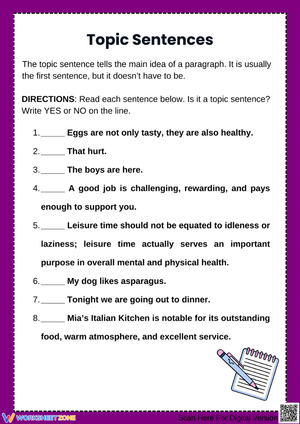
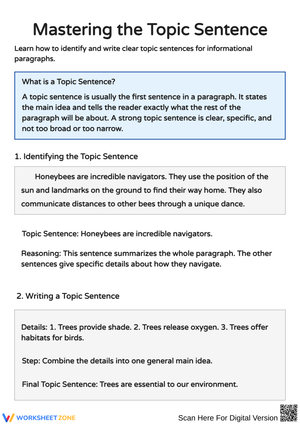
- Multiple-choice identification: Students read a paragraph with its opening sentence removed, then select the most fitting topic sentence from four options. The distractors are deliberate — one is always too broad, one restates a supporting detail, and one introduces an idea not present in the paragraph. Students who miss these reveal a specific misunderstanding, not just general confusion.
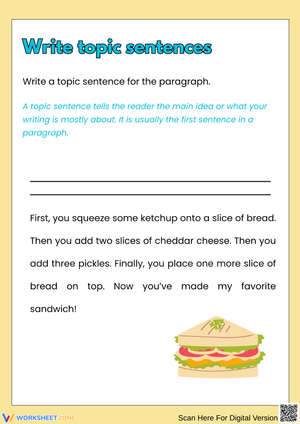
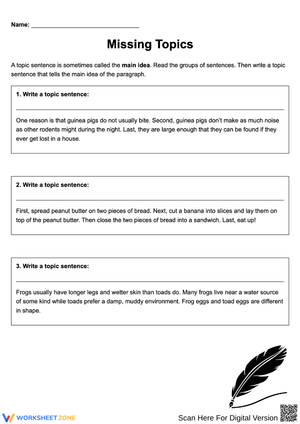
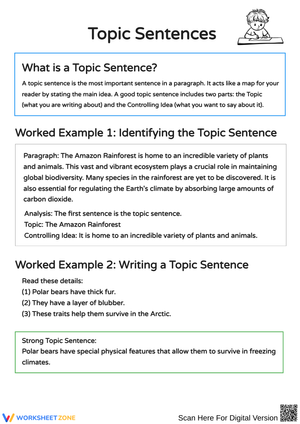
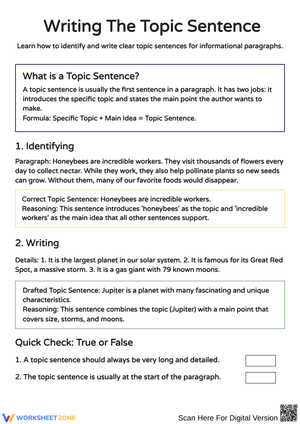
- Reverse drafting: Given a set of three or four supporting details, students write the topic sentence that would control them all. This is the hardest task in the set. It requires synthesis rather than recognition, and students cannot fall back on pattern-matching.
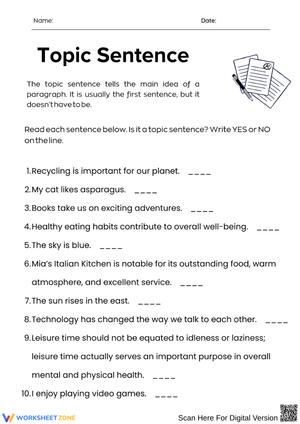
- Sorting exercises: A mixed list of sentences — topic sentences, supporting details, and conclusions — gets sorted into labeled columns. Students who rush through identification tasks slow down here, because the sentences look deceptively similar on the surface.
- Genre-specific practice: Writing an opinion opener ("Homework should be limited to thirty minutes a night") works differently than writing an informative opener ("Rainforests contain several layers, each with its own distinct plants and animals"). Separate worksheets address persuasive, informative, and narrative purposes so students learn to match their opening statement to the writing's goal.
- Annotation and highlighting: Students mark the topic sentence, supporting details, and concluding sentence in complete, well-written paragraphs. These pair well with a read-aloud — after hearing a paragraph read aloud, students annotate it silently, then compare their marks with a partner.
Where 4th Graders Get Stuck
The most persistent error isn't forgetting to write a topic sentence — it's writing one that functions as a title rather than a statement. A student who knows a paragraph is about penguins writes "Penguins" or "About penguins" at the top instead of a controlling claim like "Penguins have several physical adaptations that allow them to survive in freezing temperatures." The reverse drafting exercises surface this immediately, because students must produce a complete sentence, not a label.
A second reliable problem: students draft topic sentences too broad for the paragraph they've written. "Animals are interesting" cannot control a paragraph about emperor penguin nesting habits. The sorting exercises build a concrete frame for self-correction — students handle sentences that sit on a spectrum from vague generality to overly narrow detail, and they develop an instinct for the middle ground. In genre-specific work, a third error appears consistently: students carry informative sentence structure into opinion writing, producing lines like "Today I will tell you about why recess should be longer" rather than staking an actual claim.
Standard Alignment
W.4.1a and W.4.2a both require students to introduce a topic or state an opinion clearly at the outset of a piece — one standard for opinion writing, one for informative. Both treat the opening statement as structural rather than stylistic, which is why they appear as the first sub-standard in each writing strand. The identification and annotation worksheets address the reading-side understanding that underlies both; the reverse drafting and genre-specific worksheets address the production side. RI.4.2, which asks students to determine the main idea of a text and explain how key details support it, connects directly as well — students who can write a strong topic sentence read informational texts more fluently because they recognize what an anchor statement looks like from the inside.
Smart Ways to Work These Worksheets Into Your Week
The identification and annotation worksheets fit naturally into the first eight minutes of a writing block — students settle in, pick up the worksheet, and work independently while attendance and morning logistics resolve. That brief, low-stakes repetition builds automaticity faster than a single extended lesson. Save the reverse drafting worksheet for right after a direct-instruction mini-lesson on topic sentences, while the teaching point is still fresh. Assign it independently, then use two or three student responses as the basis for whole-class discussion: project anonymized examples and ask the group to evaluate whether each sentence controls all the listed details or only some of them.
For small group intervention, the sorting exercises give teachers a clear formative signal. A student who consistently miscategorizes supporting details as topic sentences usually has a definitional problem — they understand "what the paragraph is about" as "what the paragraph says first" — and that requires a different reteach than a student who can define a topic sentence but writes ones that are too vague. These topic sentence worksheets for 4th grade provide that diagnostic clarity without requiring a separate assessment instrument.
Adjusting the Worksheets for a Range of Learners
For students still building basic paragraph awareness, begin with the annotation worksheets using short, clear paragraphs — three sentences, simple structure, topic sentence in the first position. These students need success with the concept before they encounter paragraphs where the topic sentence doesn't appear first or where the structure is more complex. The multiple-choice identification worksheet works well at this level too, because it limits the cognitive load to recognition rather than production.
Students who move through identification quickly need the reverse drafting and genre-specific worksheets. Raise the challenge further by asking them to write two different topic sentences for the same set of supporting details — one for an informative purpose, one for an opinion piece — and then explain in a sentence why the two openings differ. Topic sentence worksheets for 4th grade that push students to articulate their reasoning move the skill from procedural execution to genuine understanding.
Frequently Asked Questions
What is the difference between a main idea and a topic sentence?
The main idea is the concept — the core point a paragraph conveys. A topic sentence is the written sentence that states that concept explicitly. Students can grasp the main idea of a paragraph even when no single sentence states it outright, but a topic sentence is always a discrete sentence the writer chooses to include. In 4th grade, a large part of instruction involves getting students to translate what they intuit about a paragraph's focus into a sentence they actually write down. The annotation worksheets make this concrete: students first identify what they think the paragraph is "about," then locate which sentence makes that explicit — and notice when those two things don't quite match.
Does the topic sentence always have to be the first sentence?
In most elementary writing instruction, yes — and for good reason. Placing the topic sentence first gives students a reliable rule they can follow consistently while they're learning paragraph organization. Once students demonstrate they can write paragraphs with controlled, focused opening statements, some teachers introduce mentor text examples where a hook or transition precedes the actual topic sentence. For students just getting comfortable with topic sentence worksheets for 4th grade exercises, keeping the topic sentence first removes one variable and lets them focus on the quality of the statement itself rather than its placement.
How do I help students whose topic sentences are consistently too broad?
The most useful classroom move is to take their broad sentence and test it against each supporting detail in the paragraph. Ask: does this topic sentence promise the reader what every sentence below it actually delivers? A student who writes "Dogs are great pets" as the opener for a paragraph about how golden retrievers are easy for first-time owners to train will see immediately that their sentence covers far more ground than the paragraph does. The sorting exercises formalize that habit — students practice evaluating sentences against a concrete question: is this too big, too small, or the right size for what the paragraph actually says?












 Interactive Worksheet Maker
 Quiz Maker
 Word Search Maker
 Crossword Puzzle Maker
 Word Scramble Generator
 Sentence Scramble Generator
 Handwriting Worksheet Generator
 Name Tracing Generator
 Fill In The Blank Generator




 BACK TOSCHOOL