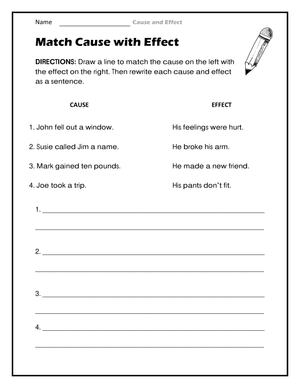
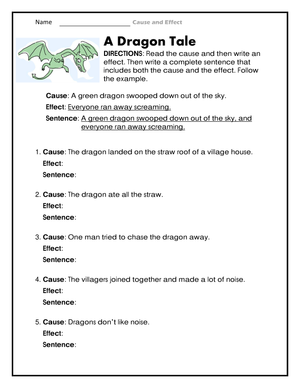
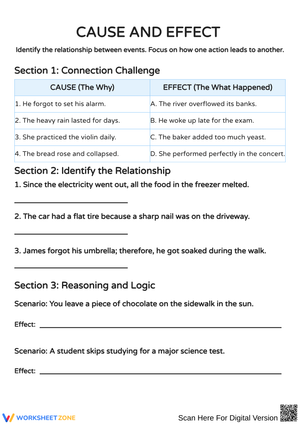
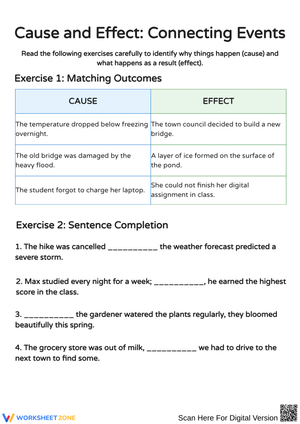
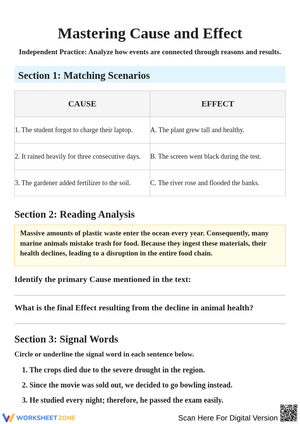
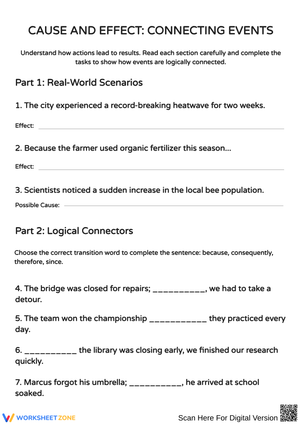
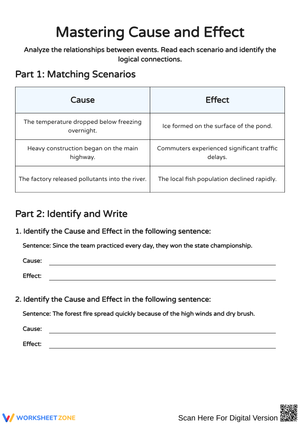
These cause and effect worksheets for 4th grade give teachers ready-to-print exercises targeting one of the upper-elementary ELA block's most teachable text-structure skills — the logical relationship between events in both narrative and informational reading. Each worksheet focuses on a specific dimension of that skill: signal word identification, graphic organizer completion, sentence combining, or written response to a short passage. The set builds the kind of flexible, transferable reasoning that shows up in comprehension scores and in student writing, not just on a worksheet exercise.
The Specific Skills Each Worksheet Targets
The task formats vary deliberately, because students who can label "because" in an isolated sentence still need separate practice when the effect appears before the cause or when no signal word marks the relationship at all. Across the set, students:
- underline signal words — because, therefore, as a result, since, consequently — then label which clause is the cause and which is the effect
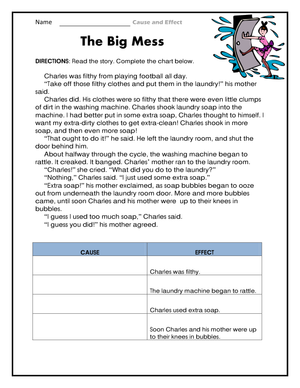
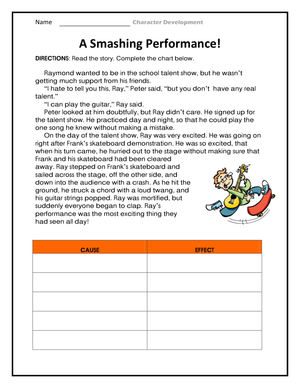
- complete T-charts after reading a short passage, sorting events into cause and effect columns at the sentence level
- trace chain reactions on flow maps where an initial effect becomes the cause of the next event, a structure that appears constantly in science and social studies reading
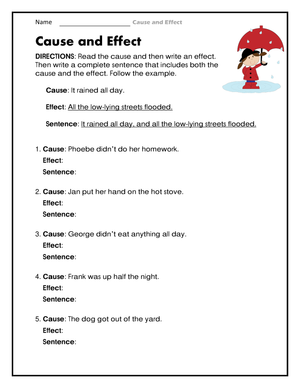
- combine two independent clauses using an appropriate signal word to produce a complex sentence that names the relationship explicitly
- fill in web organizers showing a single event branching into multiple effects, or several contributing factors converging on one result
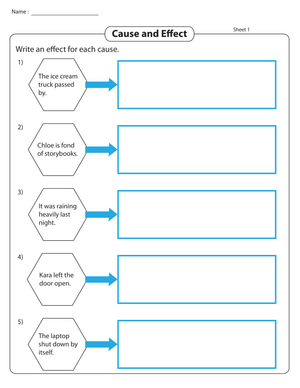
- write a short explanation of a cause-effect relationship in their own words after reading, which closes the gap between recognizing a structure on a graphic organizer and actually communicating about it
Mistakes Students Make That These Worksheets Help You Catch
The most persistent error at this level is directional confusion when the sentence puts the effect first. "The dam broke, so the path flooded" is easy. "Because the dam broke, the path flooded" is also manageable for most students. But "The path was underwater — the dam had given way three days earlier" stops many students cold because there is no signal word, and the effect appears before the cause. Students trained mainly on exercises that front-load signal words often label the wrong clause or skip the question entirely when the structure is inverted or implicit.
A second consistent problem: students conflate sequence with causation. If a story says "Maya studied all weekend. On Monday she aced the quiz," many students write that studying caused the good grade — which is a reasonable inference but not the same as a stated causal relationship. The text shows sequence and implies cause and effect. That distinction matters on CCSS-aligned assessments, which often ask whether a relationship is stated or inferred. Surfacing this when you debrief a worksheet together — asking students to find the sentence where the author actually states the connection — sharpens their reading more than a second pass through the graphic organizer would.
How to Build These Worksheets Into Your Lesson Plans
The most productive use of cause and effect worksheets for 4th grade is parallel to whatever text the class is already reading that week, not as isolated skills practice. A T-chart exercise lands better the day after students finish a read-aloud — the events are fresh, the graphic organizer gives them a second way to process what they heard, and completed worksheets can open the next day's discussion rather than just getting collected. The signal word sentence-combining exercises fit naturally at the start of a writing workshop block, priming students to reach for complex sentence structures before they draft.
For independent stations, the passage-based response worksheets are the most versatile — students move through them without direct instruction, and the written response at the end gives you real data. Three minutes reading student answers tells you whether the class is ready to move from stated to implied relationships or whether you need another day on the basics. The reverse-engineering exercise — start with a major plot event and map backward to find contributing causes — works especially well in guided reading groups, where it reliably generates productive disagreement about which events most drove the outcome. That disagreement is worth sitting in for a few minutes; it means students are actually reading causally rather than just locating sentences.
Standard Alignment
The primary target is CCSS.ELA-LITERACY.RI.4.5, which asks fourth graders to describe the overall structure of a text and explain how an author uses cause and effect to organize information. In most classrooms, this standard comes into focus in third quarter, when informational reading units shift from identifying main idea toward analyzing how authors build arguments and explanations — that is the right time to pull these exercises into regular rotation. The set also connects to CCSS.ELA-LITERACY.RL.4.3, which asks students to describe a character's response to events. Character motivation is a cause-effect question reframed in narrative terms, and the exercises built around story passages address both standards at once.
Adapting the Exercises for Different Readers in the Room
For students still building reading fluency, the sentence-level exercises are the right entry point — the text load is low and the task is concrete. If even those feel like too much, read the sentences aloud as a group before asking students to label cause and effect; that removes the decoding demand without changing what the thinking task requires. The cause and effect worksheets for 4th grade also suit partner work, which naturally provides peer support without requiring a separate modified version: a stronger reader handles decoding while both students negotiate which clause is the cause — and that negotiation is where the real learning happens.
Students who move quickly through the exercises benefit most from the chain-reaction flow maps and the reverse-engineering tasks, both of which require more critical reading and more precise writing. Adding the constraint "do not use the word because" in the sentence-combining exercises forces those students to reach for consequently, as a result, and therefore — and the resulting sentences are noticeably more varied and more sophisticated than what they produce when they default to the first signal word they know.
Frequently Asked Questions
Do the exercises draw on informational texts, narrative texts, or both?
The set includes both. Some exercises use narrative passages where a character's choice leads to a consequence; others use informational excerpts built around science and social studies content. Cause and effect tends to be more explicitly marked in informational writing — authors of explanatory text use signal words consistently — which makes those exercises a lower-pressure entry point for students who freeze when asked to find the relationship in a story. Starting with the informational exercises and then returning to narrative often helps students see the structure more clearly in both modes.
How many signal words should fourth graders be expected to know?
A working vocabulary of eight to ten covers the vast majority of what students encounter in grade-level text and on standardized assessments. The core set — because, since, so, therefore, as a result, consequently, if...then, and due to — is sufficient for most tasks. Earlier worksheets in the set provide a word bank; later ones ask students to select or supply the right word without that support. That gradual removal of the word bank is intentional: students who still need it can refer back, while students who no longer do are practicing independent retrieval.
Can these worksheets serve as a formative assessment?
The passage-based written response exercises work well for that purpose. A student's written explanation reveals both their comprehension of the text and their understanding of the concept — you can see at a glance whether they are describing the relationship accurately or just recopying a sentence from the passage. Cause and effect worksheets for 4th grade used this way give you quick, specific data on which students understand stated relationships, which are still confusing sequence with causation, and which are ready to work with implied relationships in more complex texts.












 Interactive Worksheet Maker
 Quiz Maker
 Word Search Maker
 Crossword Puzzle Maker
 Word Scramble Generator
 Sentence Scramble Generator
 Handwriting Worksheet Generator
 Name Tracing Generator
 Fill In The Blank Generator




 BACK TOSCHOOL