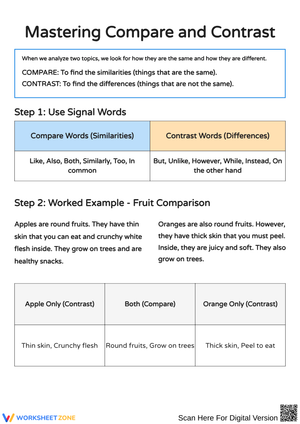
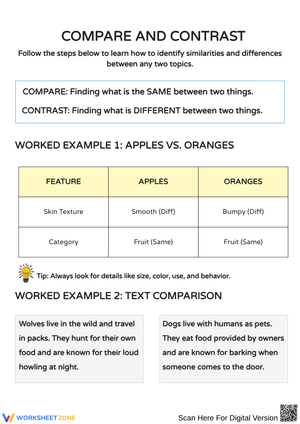
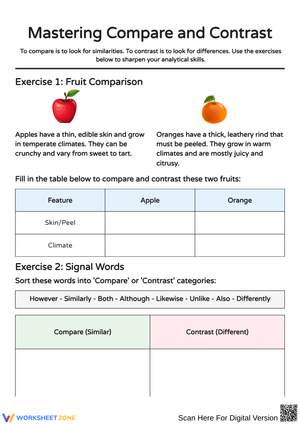
These 4th grade compare and contrast printable worksheets resources give teachers short paired texts, sorting organizers, and structured writing prompts in one place — the full sequence students need to move from reading to writing a clear, evidence-based response. Each worksheet holds together a complete thinking task: read the passages, sort the evidence, write the comparison.
What Students Practice Across the Set
Fourth grade is when compare-and-contrast work shifts from "find two differences" to "explain why those differences matter." That is harder than it sounds, and the 4th grade compare and contrast printable worksheets resources here address that transition directly. Each worksheet moves students through a deliberate sequence — read and mark the texts, sort evidence into an organizer, then write a short response — so they practice the full process rather than treating the graphic organizer as the endpoint.
The content spans both literary and informational reading:
- Paired informational passages on science and social studies topics — weather systems, animal habitats, historical figures
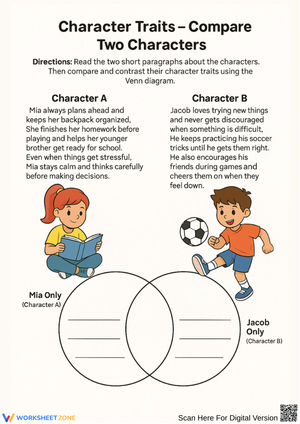
- Paired literary passages comparing two characters, two settings, or two versions of a similar event
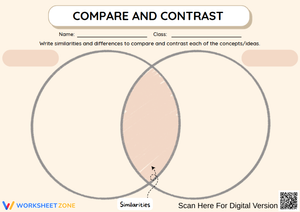
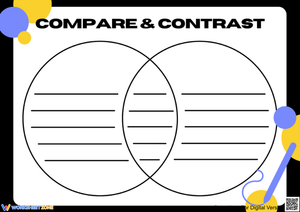
- T-chart and Venn diagram organizers — students encounter both formats across the set
- Text-dependent questions that require returning to both passages before writing
- Transition word banks: both, however, on the other hand, similarly, in contrast
- Writing prompts with space for a four-to-six sentence response
The Errors That Appear Most Often in Student Work
The most predictable breakdown: a student fills both sides of the T-chart with accurate details, then writes "They are different because one is bigger." The organizer is complete; the paragraph is nearly empty. This isn't carelessness — the student genuinely doesn't have a model for how to turn sorted notes into prose. A sentence frame like "The first text explains ___, while the second text shows that ___" closes that gap more reliably than telling students to write more detail.
A second pattern is single-source drift. Students pull three or four specific details from the first passage and mention the second only in passing — often with a vague sentence like "The other one is different" — because returning to familiar text feels safer. Text-dependent questions that require evidence from both passages interrupt that pattern before it carries into the writing section.
There is also a subtler error worth naming. Students who write "Both texts are about oceans" have identified a shared subject, not a comparison. They have noted that two texts cover the same topic without saying anything about what either text actually claims. The distinction between subject overlap and content comparison is exactly what fourth-grade instruction needs to make explicit, and it surfaces in nearly every class that works through these materials.
How to Build These Worksheets Into Your Lesson Plans
The most reliable use is as a follow-up to a mini-lesson. Model the comparison together using a shared text on the document camera — think aloud through the organizer, draft two sentences — then release students to a worksheet with a parallel but unfamiliar passage pair. Same organizer format, fresh content. The evidence of real learning lives in the transfer, not in whether students followed along during the model.
Before students start the organizer, have them highlight details from the first passage in one color and from the second passage in a different color. That three-minute step visibly tags evidence by source and consistently improves written responses. Students arrive at the organizer knowing what came from where, which eliminates most of the mix-ups that produce single-source paragraphs.
Literacy centers work well with a short partner conversation built in: each student reads independently, then tells their partner one similarity and one difference before writing. That oral step helps students who can explain the comparison in conversation but freeze when they face a blank writing frame. For the first ten minutes of a Monday morning after a long weekend, the shorter worksheets with pre-labeled organizers bring students back to analytical thinking without a steep warm-up. For sub days, the self-contained worksheets — those with a sample sentence and a visible step sequence — run without teacher narration.
Standard Alignment
The two reading standards at the center of this work are RI.4.9, which asks fourth graders to integrate information from two texts on the same topic, and RL.4.9, which focuses on comparing stories in the same genre by theme, pattern of events, or character type. Both standards require students to use text details as evidence for the comparison — surface observation is not enough to meet either. W.4.2 connects directly through the writing component: students organize their explanation using transitions and support each point with relevant details from the text. Because these 4th grade compare and contrast printable worksheets resources move from text evidence to organized written response within a single task, they address RI.4.9, RL.4.9, and W.4.2 without requiring separate assignments for each standard.
Calibrating the Set for Different Levels of Learners
For students working below grade level, reduce the reading load and pre-fill one side of the T-chart with two details already pulled from the first text. Students then contribute matching details from the second passage and write a single comparison sentence using the provided frame. That narrows the cognitive work to the comparison itself rather than splitting attention across reading volume, evidence selection, and writing structure at the same time.
For students working above grade level, remove the sentence frame and assign a two-paragraph response: one paragraph on similarities, one on differences, each with a clear topic sentence and at least two pieces of textual evidence. Students who are ready to push further can evaluate which comparison is most significant and defend that judgment in a closing sentence — a step toward the analytical writing they will encounter in fifth and sixth grade.
Frequently Asked Questions
What does a complete worksheet in this set include?
Most worksheets include two short passages — typically under 200 words each — paired with a sorting organizer, two or three text-dependent questions, and a writing section with a transition word bank and space for a full paragraph response. Some worksheets focus exclusively on organizer practice; others combine reading, sorting, and writing within a single task.
How long does one worksheet take to complete during class?
A focused 20-minute block works for most fourth graders: roughly 7 minutes reading and marking text, 6 minutes completing the organizer, and 7 minutes writing. Students who stall almost always stall at the organizer — which is useful information about where the instruction gap is and where a quick check-in during independent work will help.
Are these useful for state ELA test preparation?
Most fourth-grade state ELA assessments include paired passages followed by a constructed response asking students to compare both texts — the same task structure as the 4th grade compare and contrast printable worksheets resources here. Consistent practice with this format builds both the underlying skill and the procedural familiarity that reduces hesitation during timed testing.












 Interactive Worksheet Maker
 Quiz Maker
 Word Search Maker
 Crossword Puzzle Maker
 Word Scramble Generator
 Sentence Scramble Generator
 Handwriting Worksheet Generator
 Name Tracing Generator
 Fill In The Blank Generator




 BACK TOSCHOOL