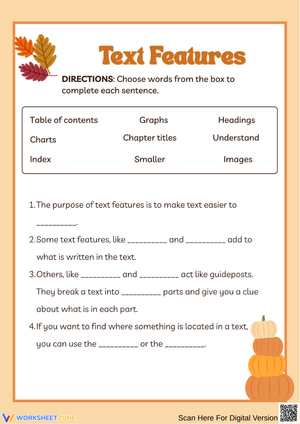
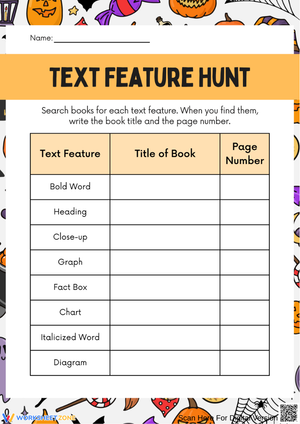
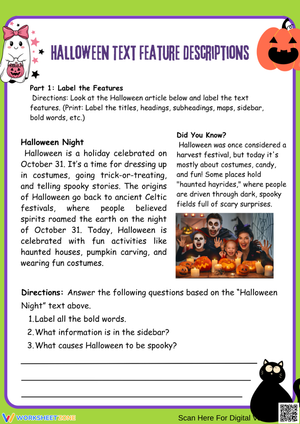
Nonfiction text features printable worksheets for 4th grade ask students to do more than circle a heading or underline a bold word — each worksheet builds toward the harder task of explaining what a specific feature actually contributes to a reader's understanding. That shift from identification to reasoning is where Grade 4 instruction needs to operate. The set covers headings, subheadings, captions, labels, bold print, glossaries, indexes, tables of contents, diagrams, charts, maps, and timelines.
The Specific Skills Each Worksheet Targets
Each worksheet pairs a short informational passage with questions that move from naming to interpreting. Students mark where a feature appears, identify it correctly, and explain how it helps the reader — which produces substantially different written work than a matching exercise alone.
Across the set, students practice:
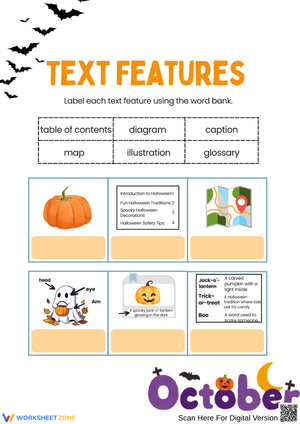
- Labeling diagram parts — students identify and name components within a visual, not just acknowledge that a diagram exists.
- Glossary work — students locate a bold word in the passage, find the definition in a glossary, and restate it in their own words within context.
- Caption comparison — students read a caption alongside its accompanying paragraph and identify what information appears only in the caption, not in the body text.
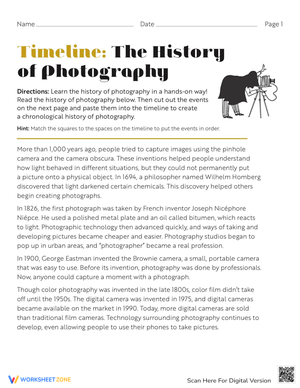
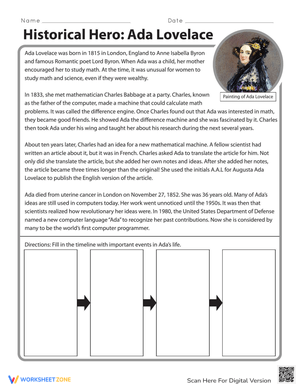
- Timeline reading — students pull sequence details from a timeline and explain why that chronological organization reads more clearly in visual form than it would in paragraph form.
- Index and table of contents navigation — students use page references and section titles to locate or predict where specific information would appear in a longer text.
- Purpose questions — students explain why an author chose a particular feature at that location, not just what the feature is called.
The range of response formats across the worksheets — labeling, multiple choice, short answer, and written explanation — prevents students from defaulting to one kind of thinking. A student who breezes through a matching exercise often slows down when asked to write a sentence explaining why a chart communicates sequence more clearly than a paragraph does. That friction is instructionally useful.
Student Errors Worth Catching Before They Become Habits
The most persistent problem in this skill area is what might be called the "tells you information" loop. When asked to explain what a caption does, Grade 4 students routinely write "it tells you information about the picture" — a circular answer that doesn't describe the caption's actual contribution. The worksheets address this directly by asking students to quote or paraphrase the specific fact the caption adds, rather than just restating that it exists.
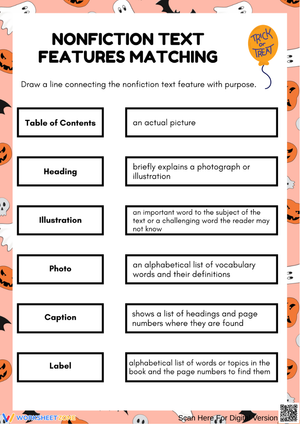
A second common mix-up: students conflate captions and labels. Both appear near images, so the confusion is understandable, but the functions differ. Labels name parts of a diagram; captions explain context or add factual content not found in the surrounding paragraph. When students call a labeled diagram a "captioned image" on an assessment, they're not making a careless error — they have a genuine conceptual gap that identification-only practice won't resolve.
There's also a location-versus-purpose problem. Ask a student why an author included a chart, and they'll sometimes describe where it appears on the page rather than what it does for the reader. That answer reveals students treating text features as layout decisions rather than reading tools. Addressing it directly before sending the worksheets out — "I want to know what job the feature does, not where it sits on the page" — changes the quality of written responses noticeably.
Where These Worksheets Fit Across an ELA Week
One approach that holds up well: introduce a single feature on Monday with a whole-group projection of one worksheet, model the identification step, and then think aloud through the purpose question before students attempt any items independently. Midweek, shift two or three worksheets into literacy centers — laminated in protective sleeves, they reuse across rotations without any extra prep. By Thursday or Friday, assign a passage-based worksheet independently as a quick formative check on who can transfer the skill without guided support.
A specific teacher move worth trying: have students cover the caption, diagram, or heading with a sticky note and read the paragraph alone first. Then uncover the feature and discuss what understanding shifted. Fourth graders who observe that comparison directly — rather than just hearing that text features "help readers" — grasp the reasoning much faster. It turns an abstract comprehension goal into something they can see happening in real time.
Using nonfiction text features printable worksheets for 4th grade as Monday warm-ups during the return week of a unit reinforces retention through spaced practice. That repeated return to the skill, rather than a single concentrated lesson, shows up in stronger performance when these features appear in standardized reading passages later in the year. Each worksheet is also self-contained with its own passage and directions, which makes the set clean for sub plans — a substitute doesn't need content expertise to run the activity.
Standard Alignment
These worksheets anchor most directly to CCSS RI.4.7, which asks students to interpret information presented visually — in charts, graphs, diagrams, timelines, and similar formats — and explain how that information contributes to an understanding of the text in which it appears. That standard is often underweighted in ELA planning because it sits at the intersection of reading and visual literacy, and teachers sometimes address it briefly during a shared science read-aloud without giving it standalone practice. Well-structured nonfiction text features printable worksheets for 4th grade give RI.4.7 the focused, repeated practice that a single shared-reading lesson rarely delivers.
CCSS RI.4.5, which addresses overall text structure, connects here as well. Students who understand why an author used a heading or subheading to organize a section are better positioned to identify compare-and-contrast and cause-and-effect structures in longer informational texts. Text feature instruction in Grade 4 feeds directly into the structural analysis students need in Grades 5 and 6, which is one reason the skill is worth treating seriously rather than covering once and moving on.
Tiering the Practice for Mixed-Ability Fourth-Grade Classes
For students who need more support, choose worksheets with fewer features per passage, larger visuals, and direct question stems. A prompt like What does the caption tell you that the paragraph does not? is more accessible than an open-ended "explain the purpose of this feature." Preteaching the feature vocabulary list before students encounter it in the passage also reduces cognitive load and keeps attention on comprehension rather than on decoding the question itself.
For students ready for more challenge, open-ended comparison prompts work well — for example, asking which feature, the diagram or the timeline, gives more useful information about a topic, and requiring a text-based defense of that choice. A create-your-own task extends the skill further: give students a plain informational paragraph and ask them to add an appropriate heading, caption, and diagram label. That task reveals whether they understand how the features function, not just what they are called — a meaningful distinction at this grade level.
Varying the output type helps across levels without changing the skill target. Some students annotate and label in a first pass, then write one sentence about purpose. Others write a multi-sentence explanation of how two features work together. Both groups are working on the same reading skill; they're demonstrating it at different depths within the same classroom period.
Frequently Asked Questions
Which text features matter most for sustained practice in Grade 4?
Headings, captions, diagrams, bold print, glossaries, and timelines are worth the most instructional time at Grade 4 — not because the others are unimportant, but because these appear most consistently in the informational texts students encounter across content areas. Once students can explain the purpose of these with confidence, indexes, tables of contents, charts, and maps come together more quickly because the core reasoning transfers: what does this feature give the reader that the paragraph alone doesn't?
How do these worksheets fit into a nonfiction reading unit?
Feature-specific worksheets work best early in the unit when students are building language for discussing how informational text is organized. Mixed-feature practice fits the midpoint as reinforcement. Passage-based response worksheets — where students read, identify multiple features, and explain each one — serve as summative evidence at the end. Nonfiction text features printable worksheets for 4th grade slot naturally into any unit that includes informational reading, including science and social studies content taught during ELA blocks.
What is the difference between a text feature and a text structure?
A text feature is a visible element of the page — heading, caption, diagram, glossary — that helps readers locate or understand information. A text structure is how the author organizes ideas: description, sequence, compare and contrast, cause and effect, problem and solution. These are related but distinct concepts, and conflating them on assessments creates genuine grading confusion. Worksheets focused on text features stay on the visible tools; text structure belongs in a separate instructional unit.
Can these worksheets be used in science and social studies?
Yes, and they often land better in those contexts because the informational passages feel content-relevant rather than constructed solely as reading practice. A worksheet built around a passage on animal adaptations or the water cycle gives students a real reason to care about what the diagram shows. The reading work is identical — identifying a labeled diagram in an ELA worksheet requires exactly the same thinking as reading one in a science textbook — so the skill transfers without any additional instruction.












 Interactive Worksheet Maker
 Quiz Maker
 Word Search Maker
 Crossword Puzzle Maker
 Word Scramble Generator
 Sentence Scramble Generator
 Handwriting Worksheet Generator
 Name Tracing Generator
 Fill In The Blank Generator